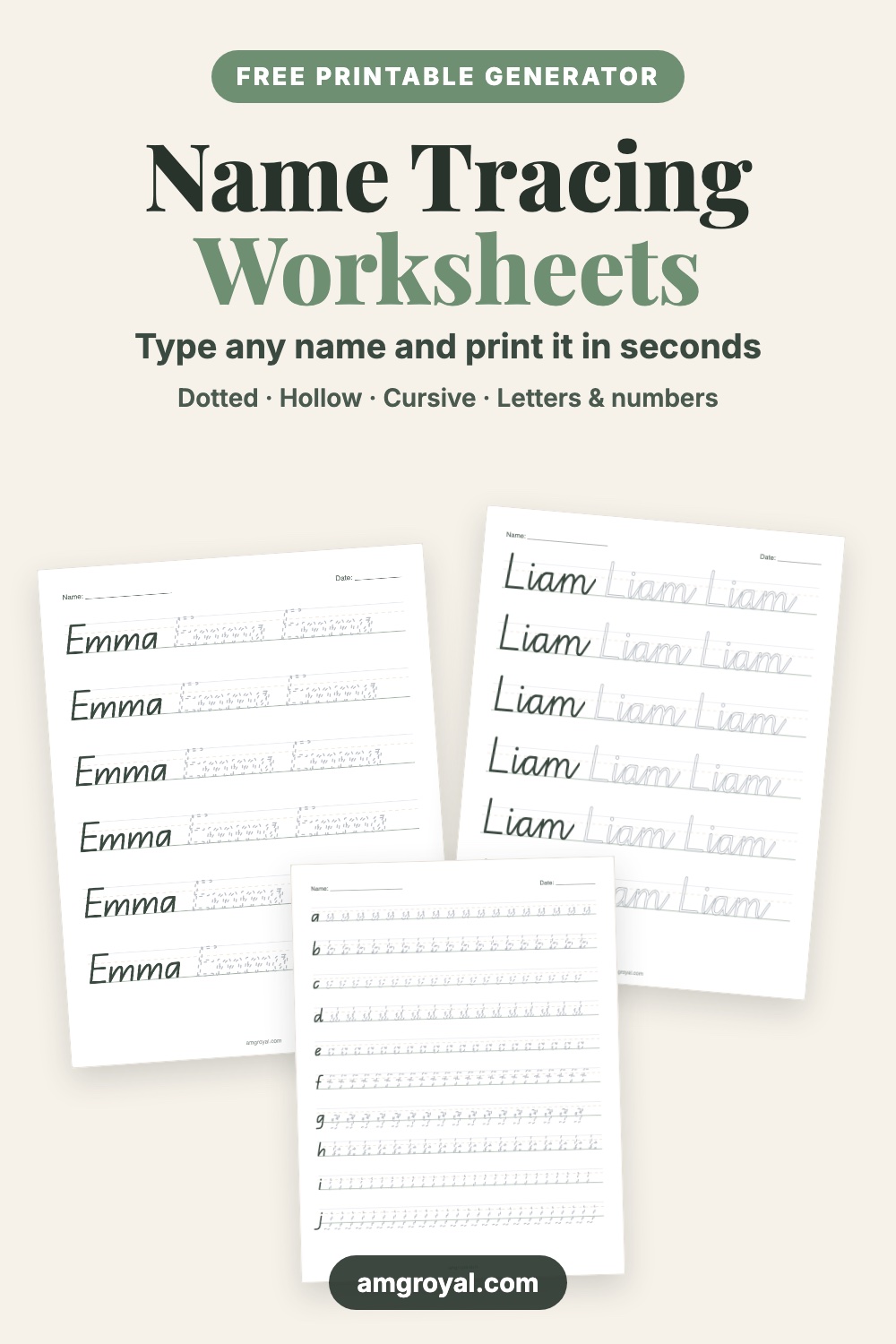
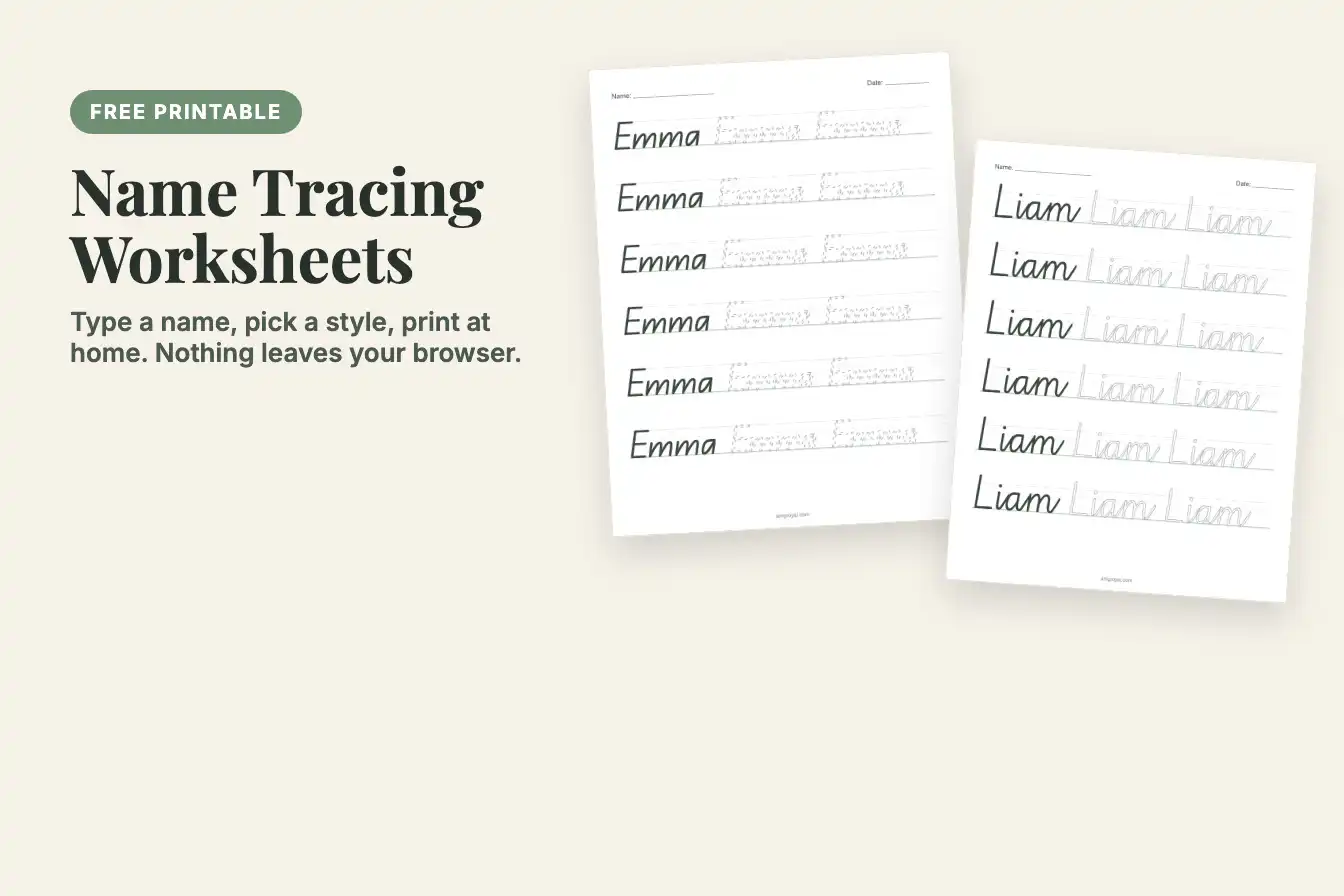
Type a name, choose a style, and print. This free generator makes name tracing worksheets that look like the ones in a workbook, with proper handwriting guide lines, in about ten seconds.
It works for a first name, a spelling list, the alphabet or numbers, in print or cursive. Everything is drawn in your browser, so nothing you type about your child is sent anywhere.
How to Use the Name Tracing Worksheet Generator
- Type the name or word you want your child to practise.
- Pick a letter style and size. Dotted letters for beginners, hollow outlines for a little more freedom, grey letters for children who trace with a light touch.
- Press print. The controls disappear and each sheet prints on its own page, with no blank pages in between.
What You Can Change
- Quick fill buttons: days of the week, months, colour words, number words, the alphabet or numbers, in one click.
- Letter case: keep what you typed, capitalise the first letter only, or print in ALL CAPITALS or lowercase.
- A worksheet title printed at the top, useful when you keep the sheets in a folder.
- A drawing box at the bottom of the page for younger children who finish early.
- Two blank practice lines so your child writes the word alone after tracing it.
- Guide lines on or off, a solid model on the first line, and a name and date header.
Four Ways to Use It
A single name
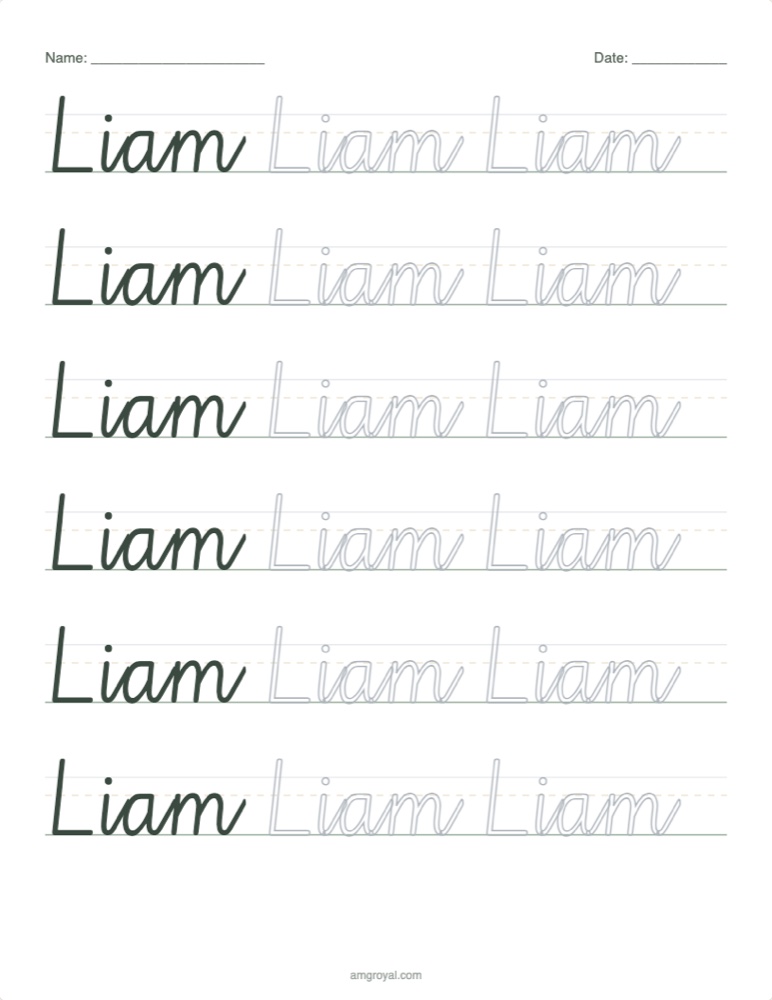
The classic first worksheet. The page fills with practice rows of the same name, and the first word on each line is solid so your child always has a model to copy.
A word list
Switch to the word list mode and type one word per line. Spelling words, sight words, family names or the days of the week each get their own rows. It turns this page into a small set of custom tracing worksheets.
Numbers
Number tracing worksheets from 1 to 10, with the same guide lines. Useful when a child can write letters but still reverses digits.
The alphabet
Uppercase or lowercase A to Z, one letter per row. The generator spreads the alphabet over several printable pages.
Dotted, Hollow or Grey Letters?
All three styles trace the same letters. They simply ask for more or less control.
| Style | Best for | What it looks like |
|---|---|---|
| Dotted outline | A first contact with a letter shape | A dashed line your child follows point by point |
| Hollow outline | A child who already knows the shape | An empty letter to fill in or trace |
| Grey letters | Moving towards writing alone | A soft full letter to write over, then copy |
Which Size Should You Print?
Print your first name tracing worksheets in the large size. Big letters ask less of small hands, and the guide lines are far enough apart to stay readable. Move down a size when the letters stop wobbling, not on a set date. Many children use all three sizes over a year.
How to Make Tracing Practice Stick
- Keep it short. A few minutes of careful tracing beats a full page done in a rush.
- Say the letter out loud while tracing it. Sound and movement together help it stay.
- Trace, then copy. Let your child trace a line or two, then write the name once with no guide.
- Use the whole line. The dashed middle line shows where lowercase letters stop, which fixes most size problems.
- Praise the effort, not the neatness. Handwriting improves with repetition, not with pressure.
For where this fits in a normal school day, see our day-by-day homeschool guide, which includes a free daily planner.
When to Move On From Tracing
Tracing is a step, not a destination. Watch for these signs that your child is ready for the next one:
- The letters stay on the baseline without wandering.
- Lowercase letters stop at the dashed middle line most of the time.
- Your child starts finishing the word before the model ends.
- They ask to write it themselves.
When that happens, switch the style to grey letters, then print a sheet with only the first line solid. After that, plain lined paper is enough. You can always come back to name tracing worksheets for a new word list or for cursive.
Use It Beyond Handwriting
- Spelling practice: put this week’s words in the list mode.
- New vocabulary: trace the word, then use it in a sentence underneath.
- Names of family members for a thank-you card or a birthday sign.
- Numbers before maths: tracing digits makes the sums that follow easier to read.
Printing Tips
- Choose US Letter or A4 before printing so the lines match your paper.
- Print in black and white. The guide lines stay visible and you save ink.
- Set your printer margins to the default. The worksheet already leaves a clean border.
- Print two copies of the same name tracing worksheets: one for today, one for later in the week.
Name Tracing Worksheets: Questions Parents Ask
Are these worksheets really free?
Yes. Make and print as many as you like. There is no account, no limit and no watermark.
Is my child’s name saved anywhere?
No. The page builds the worksheet inside your browser. What you type is never sent to a server and never stored.
What age are name tracing worksheets for?
Most families start when a child shows interest in forming letters, often in preschool or kindergarten. Start with the large size, then move down as control improves. Follow the child, not the calendar.
Can I make cursive worksheets?
Yes. Pick the cursive handwriting font, then choose dotted or hollow letters.
Can I put several names on one sheet?
Use the word list mode and type one name per line. Each name gets its own practice rows, and long lists continue on the next page.
Why do the letters look different from my child’s school font?
Schools use different handwriting models. The generator offers a beginner print font, a simple print font and a cursive font, so you can pick the closest one.
More Homeschool Guides
- Homeschooling 101: what homeschooling is, the law, the costs and the main teaching approaches.
- How to start homeschooling in 7 steps, with a free printable checklist.
- How to homeschool day by day, with a free daily rhythm planner.
Save this for later: pin the image below to your homeschool board so you can find the generator again.