
Deciding to homeschool is a big step, and figuring out how to start homeschooling can feel overwhelming. State laws, curriculum, schedules, records: where do you even begin?
The good news is that you do not have to figure it all out at once. This guide breaks the process into 7 simple steps you can follow in order, plus a free printable checklist to keep you on track. If you are still deciding whether homeschooling fits your family, read our Homeschooling 101 guide first.
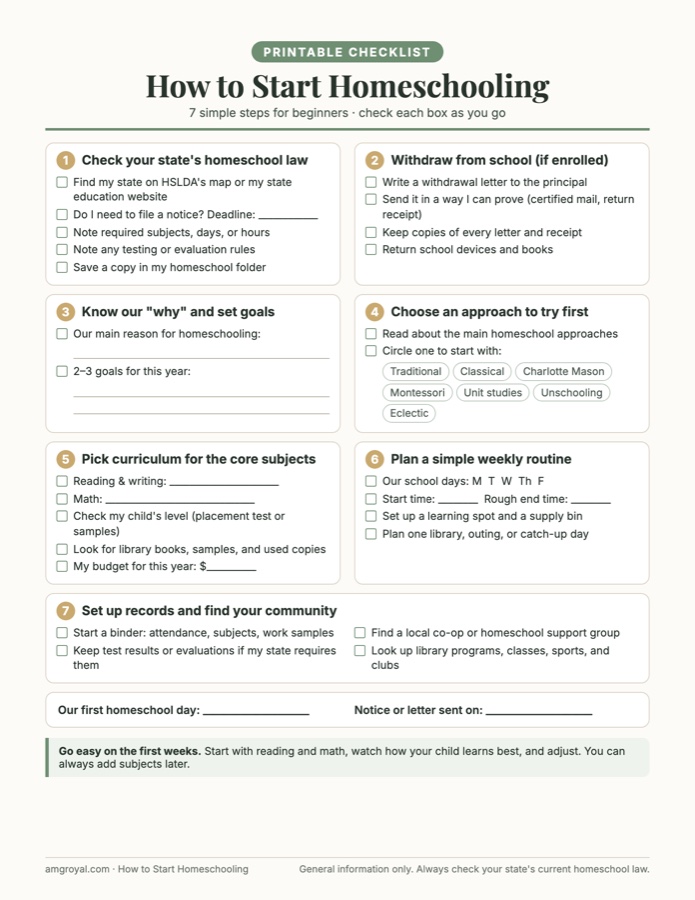
The 7 Steps at a Glance
Here is how to start homeschooling, in order:
- Check your state’s homeschool law
- Withdraw your child from school, if enrolled
- Know your “why” and set a few goals
- Choose a homeschool approach
- Pick curriculum for the core subjects
- Plan a simple weekly routine
- Set up records and find your community
Get the free checklist: it puts all 7 steps on one printable page, plus a planner for your first homeschool week. Print it, stick it on the fridge, and check off each step as you go.
Step 1: Check Your State’s Homeschool Law
Homeschooling is legal in all 50 states, but every state writes its own rules. That is why checking the law always comes first: what you must do depends on where you live.
Look up your state on HSLDA’s homeschool law map or on your state department of education’s website, and write down:
- Whether you must file a notice, often called a notice of intent, and by what date
- Which subjects you are required to teach
- Any minimum number of school days or hours
- Testing, evaluation, or portfolio review rules
- Which records you need to keep
- Any parent qualification rules
Tip: save a copy of your state’s requirements in a homeschool folder. You will come back to it more than once.
Step 2: Withdraw Your Child from School (If Enrolled)
If your child is enrolled in a public or private school right now, the Home School Legal Defense Association (HSLDA) recommends formally withdrawing before you start homeschooling. Skipping this step can get your child marked absent or truant.
- Write a short withdrawal letter to your child’s principal. Some schools and states use their own forms, so ask the school and check your state’s rules.
- Send it in a way you can prove, such as certified mail with a return receipt.
- Keep copies of the letter, any forms, and your receipt.
- Return school devices, library books, and other school property.
Starting after summer break? If your child is already registered for next year, withdraw before the new school year begins so the school does not mark them absent.
Never enrolled? If your child has never attended school, a kindergartner for example, there is usually nothing to withdraw from. You may still need to file a notice if your state requires one. HSLDA explains the details in Should You Notify the School When You Start Homeschooling?
Step 3: Know Your “Why” and Set a Few Goals
Before you buy a single book, take ten minutes to write down why you are homeschooling. Your “why” will guide every choice that follows, and it will keep you going on harder days.
Then choose two or three simple goals for your first year, such as:
- Help my second grader read with confidence
- Make math less stressful
- Spend more time outdoors and on hands-on projects
- Build a calm, steady daily routine
Keep your goals short and realistic. You can always add more once you find your rhythm.
Step 4: Choose a Homeschool Approach
There are many ways to homeschool, from a structured “school at home” to fully interest-led learning. Here are the most common approaches in one sentence each:
| Approach | In one sentence |
|---|---|
| Traditional | Textbooks, grade levels, and a set schedule, much like school. |
| Classical | Learning in stages with a strong focus on reading, writing, and history. |
| Charlotte Mason | Short lessons, “living books,” nature study, and narration. |
| Montessori | Hands-on materials and child-led work in a prepared space. |
| Unit studies | One theme, like weather or ancient Egypt, that ties several subjects together. |
| Unschooling | Learning driven mostly by your child’s own interests. |
| Eclectic | A mix of methods, chosen subject by subject. |
Not sure which one fits? A simple, structured starting point can make the first months easier, and you can relax it as you learn how your child learns best. Our Homeschooling 101 guide compares these approaches in more detail.
Step 5: Pick Curriculum for the Core Subjects
Curriculum shopping is where many new homeschoolers get overwhelmed and overspend. Keep it simple: start with the core subjects, reading and writing (language arts) and math, then add the rest over time.
- Teach at your child’s level, not their grade. Many curriculum publishers offer placement tests or sample lessons so you can see where your child fits.
- Try before you buy. Look at samples, library copies, or a friend’s books first.
- Use the library. Read-alouds and nonfiction books can cover a lot of science and history.
- Consider used books. Many families resell the curriculum they have finished, so used copies are often available.
- Set a budget. According to NHERI, homeschool families spend about $600 per student per year on average. Pick your number before you shop.
You do not need a complete boxed curriculum for every subject on day one. A reading program, a math program, and a library card are enough to begin.
Step 6: Plan a Simple Weekly Routine
Homeschooling does not have to copy the school bell schedule. Because lessons are often one-on-one, many families cover the core subjects in the morning and keep the afternoon for reading, play, projects, and outings.
Here is an example of a simple first week you can adapt:
| Day | Core lessons | Extras |
|---|---|---|
| Monday | Reading, writing, math | Science read-aloud |
| Tuesday | Reading, writing, math | History or geography |
| Wednesday | Reading, writing, math | Art or music |
| Thursday | Reading, writing, math | Hands-on science project |
| Friday | Math review, free reading | Library, field trip, or co-op |
- Start small. Keep lessons short for young children and add one subject at a time.
- Do the hardest subject first, while your child is fresh.
- Track your days or hours if your state sets a minimum.
- Keep your learning space simple. A table, a shelf, and a bin of supplies are enough. No classroom required.
The second page of the free checklist is a one-week planner you can fill in for your first week.
Step 7: Set Up Records and Find Your Community
Keep simple records
Even if your state asks for very little, simple records protect you and show your child’s progress. Start a binder or folder with:
- A school-day or attendance log
- A list of the subjects and books you use
- A few work samples from each subject
- Test scores or evaluations, if your state requires them
These records also help if your child returns to school later or applies to college.
Find your people
Homeschooling is easier with support around you. Look for:
- Local homeschool co-ops, where families share teaching or activities
- Homeschool support groups and park days
- Library programs, classes, sports teams, and clubs
- Online groups for your state or your curriculum
Experienced homeschool parents in your area are often the best source of practical, local advice.
Your First Month: What to Expect
The first weeks are an adjustment for everyone, and that is normal.
- Some days will feel messy. That does not mean homeschooling is not working.
- Your child may need time to adjust, especially after leaving a traditional school.
- Watch how your child learns best, and change your plan when something is not working.
- Try not to compare your homeschool with anyone else’s.
- After four to six weeks, look back at your goals and adjust.
Common Beginner Mistakes to Avoid
- Buying too much curriculum before you know your child’s needs
- Trying to recreate a full school day at home
- Skipping the state law check or the withdrawal letter
- Not keeping any records at all
- Trying to do everything alone
Get Your Free “How to Start Homeschooling” Checklist
Everything in this guide fits on one printable page, plus a planner for your first week. Download it, print it, and check off each step as you go.
How to Start Homeschooling: FAQ
How long does it take to start homeschooling?
It depends on your state. If your state requires a notice, file it on time. Once you meet your state’s requirements, you can begin. Starting light with reading and math lets you begin without having every subject planned.
Can I start homeschooling in the middle of the school year?
Yes, in most cases. If your child is enrolled in school, follow your state’s rules and formally withdraw them first so they are not marked absent or truant.
Do I have to tell the school I am homeschooling?
It depends on your state and on whether your child is enrolled now. Some states require a notice to the school district, and if your child is enrolled, HSLDA recommends a formal withdrawal letter. Check your state’s law first.
Do I need to buy a full curriculum?
No. You can start with one reading program, one math program, and the public library, then add more as you learn what works for your child.
How much does it cost to start homeschooling?
Costs vary a lot. NHERI reports that homeschool families spend about $600 per student per year on average, and free resources like the library can keep your costs low.
What if homeschooling does not work for us?
You are not locked in. If you decide to go back to school, ask the school about its enrollment and placement process. The records you kept will help.
The Bottom Line
Learning how to start homeschooling comes down to seven clear steps: check your state law, withdraw properly, set your goals, pick an approach, choose your core curriculum, plan a simple routine, and keep records while you build your community. Take it one step at a time, and remember that your first year is a learning year for you, too.
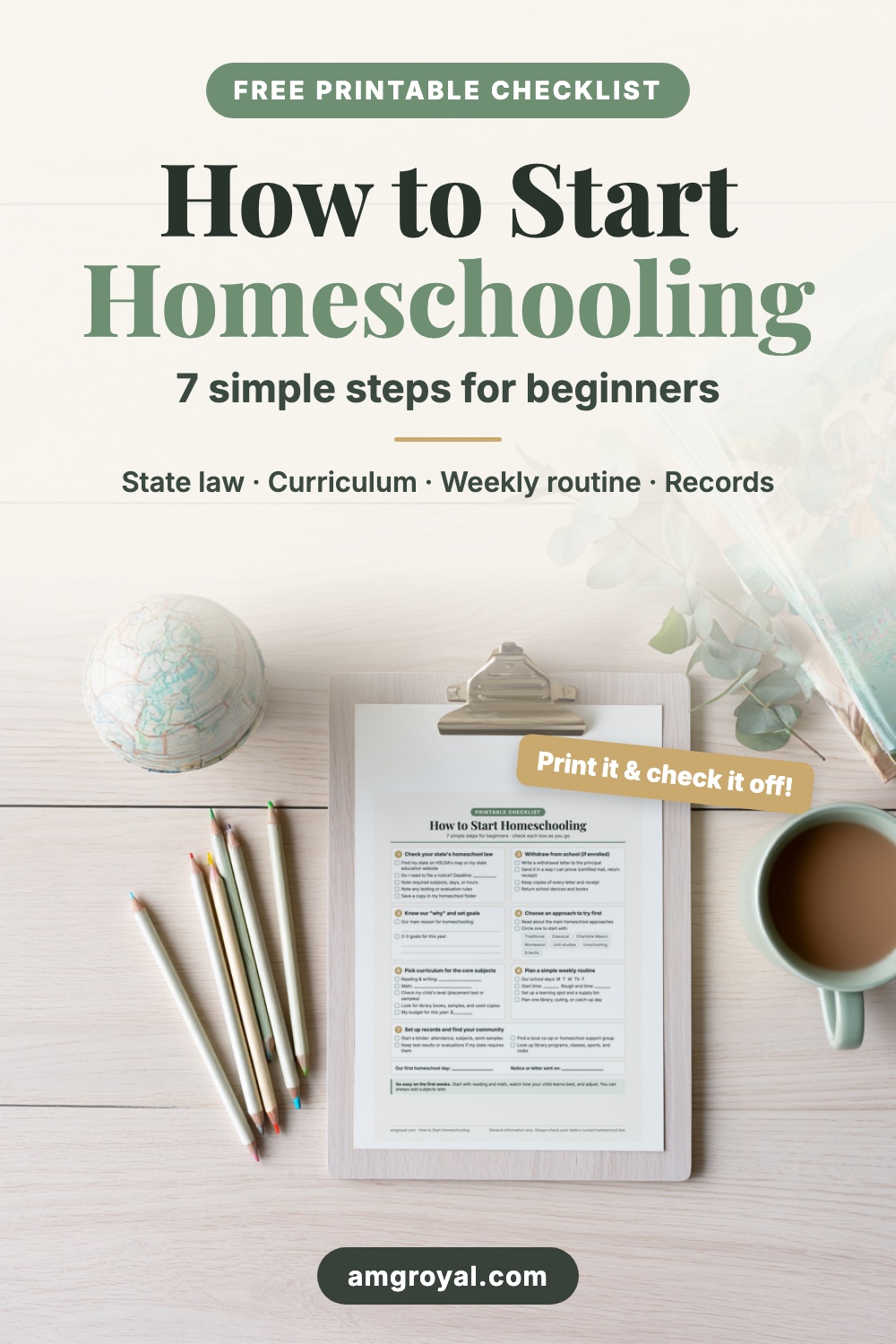
Planning to start later? Pin this image to your homeschool board on Pinterest so you can find this guide again.
This article is for general information only and is not legal advice. Homeschool laws change, so always confirm current requirements with your state.