
Almost every homeschool science curriculum claims to be “hands-on.” Most comparison lists take the publisher’s word for it and move on. This one does not: every program below is rated by how often a real experiment actually happens, not by how the cover looks.
Ten programs, compared on three things that decide whether science becomes the favorite subject or the one that keeps getting skipped: how much hands-on work is actually built in, who leads the lesson, and whether the content is secular, neutral or faith-based. Print the free chart at the end and you will shortlist three instead of guessing from a logo.
About this comparison: every fact here was checked against each publisher’s own site in September 2026, and all of them are linked in the sources. No publisher paid for a place on this page and there are no affiliate links. Prices change constantly, so this article compares how the programs teach rather than what they cost. Check current pricing on the publisher’s site.
Key Takeaways
- Decide your Hands-On Level first — Light, Moderate or Heavy — before you compare a single program name.
- Decide who leads it second: you from a guide, the child reading alone, or a video.
- For grades 9–12, HSLDA’s own guidance is to log 180 hours minimum for a lab science credit, with 30 or more of those hours as actual lab work.
- A “hands-on” program that never gets opened teaches nothing. Match the mess level to what your week can actually hold.
- Shortlist three programs. Nobody compares ten honestly.
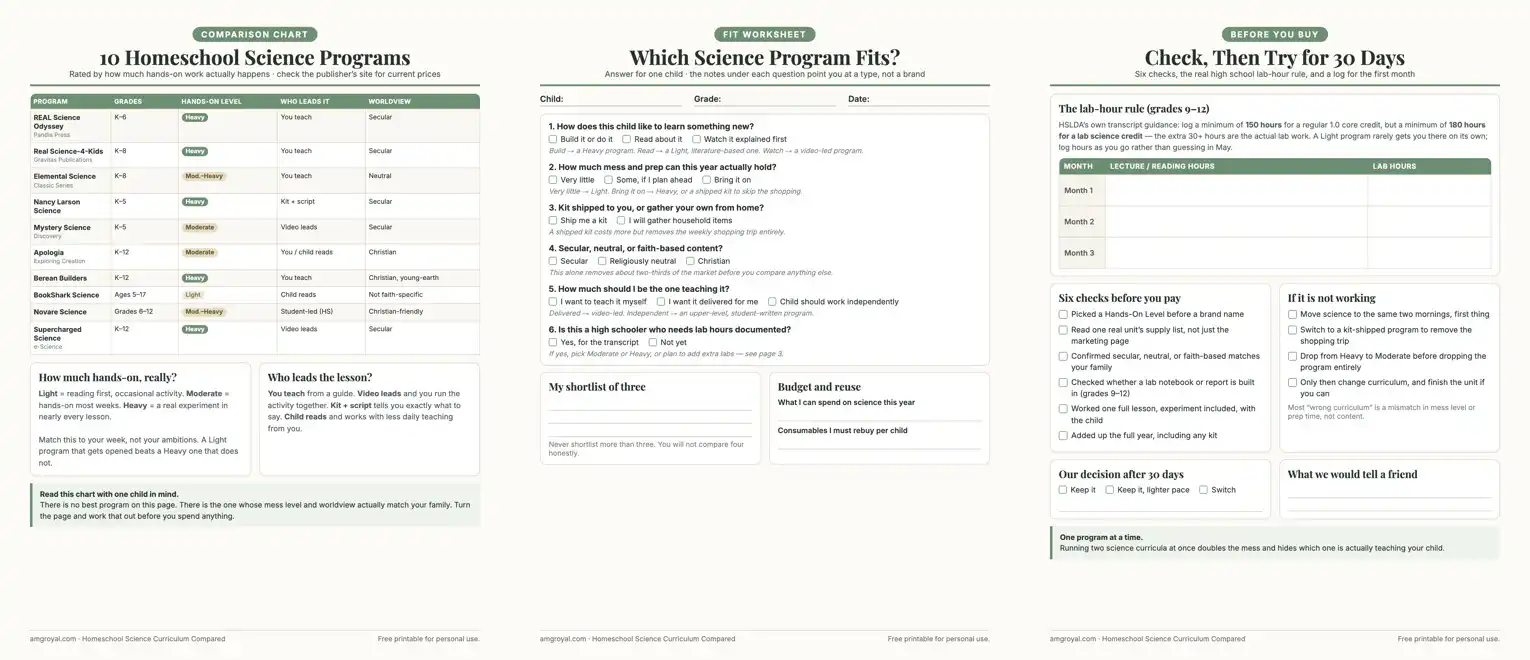
Free printable: a one-page chart of all ten programs, a worksheet that narrows them down for your child, and a 30-day trial log. Three pages, no email needed.
The First Question: How Much Hands-On, Really?
“Hands-on” is not one thing. Some programs build an experiment into every single lesson. Others hand you a beautifully illustrated book and an activity page once a week. Both are marketed the same way, so we sorted all ten programs into three tiers instead.
| Light | Moderate | Heavy | |
|---|---|---|---|
| What a lesson looks like | Reading first, an activity sheet or occasional project | A hands-on activity most weeks, mixed with reading | A real experiment in nearly every single lesson |
| Materials | Usually already on hand | Household items, gathered ahead | Household items or a kit, gathered ahead |
| Prep time | Low | Moderate, plan the week before | Higher, read the supply list in advance |
| Mess level | Low | Low to moderate | Moderate to high |
| In this article | BookShark Science | Elemental Science, Mystery Science, Apologia, Novare | REAL Science Odyssey, Real Science-4-Kids, Nancy Larson Science, Berean Builders, Supercharged Science |
There is no wrong tier. A Light program that actually gets opened every week teaches more than a Heavy one that gets skipped because the kitchen is already a mess from dinner prep.
The Second Question: Who Leads It?
This decides whether science survives a busy week as much as the hands-on level does.
- You teach it. You read the guide and lead the lesson, including the experiment. Real Science-4-Kids, Elemental Science and Berean Builders all expect this.
- A video leads, you run the activity. Mystery Science and Supercharged Science deliver the lesson on screen, then you and your child do the hands-on part together.
- The child reads and works independently. Apologia’s upper elementary and secondary books, and Novare at the high school level, are written for the student to work through with less day-to-day teaching from you.
- A kit walks you through it. Nancy Larson Science is fully scripted and ships the actual materials, so there is nothing to plan.
If you have more than one child, this matters even more. Our homeschool schedule examples show how families put the one-on-one, hands-on subjects at a time when the other children can work independently.
Ten Homeschool Science Programs Compared
The whole field on one screen. Full profiles are just below, and the printable version of this chart carries all five columns.
| Program | Grades | Hands-On Level | Worldview |
|---|---|---|---|
| REAL Science Odyssey Pandia Press | K–6 | Heavy | Secular |
| Real Science-4-Kids Gravitas Publications | K–8 | Heavy | Secular |
| Elemental Science Classic Series | K–8 | Moderate–Heavy | Religiously neutral |
| Nancy Larson Science | K–5 | Heavy | Secular |
| Mystery Science Discovery | K–5 | Moderate | Secular |
| Apologia Exploring Creation | K–12 | Moderate | Christian |
| Berean Builders | K–12 | Heavy | Christian, young-earth |
| BookShark Science | Ages 5–17 | Light | Not faith-specific |
| Novare Science | Grades 6–12 | Moderate–Heavy | Christian-friendly, mainstream science |
| Supercharged Science e-Science | K–12 | Heavy | Secular, creation-neutral |
A Closer Look at Each Program
REAL Science Odyssey (Pandia Press)
Secular, structured lessons covering biology, chemistry, physics, astronomy and earth science across an elementary and a middle school level. Labs are built into the sequence rather than added on, and optional kits are sold separately through Home Science Tools. Suits a family that wants real lab rigor without writing their own experiments. Less good if you want one book that covers every subject at once, since each RSO title is single-subject.
Real Science-4-Kids (Gravitas Publications)
Written by a working chemist, starting from atoms and molecules so biology, chemistry, physics, geology and astronomy connect instead of feeling like separate subjects. A full set of real experiments uses household items, no outside kit required, and every book pairs with a lab notebook. Suits a parent who wants the “why” behind the science and does not want another box to store. Less good for a family that wants materials pre-packaged for them.
Elemental Science
A classical, living-books approach for grades K–8: a reference book from a publisher like Usborne or DK as the spine, paired with weekly hands-on experiments from household items. Open-and-go teacher guides do the lesson planning for you. It does not teach young-earth creationism but is not explicitly secular either. Suits a literature-loving family who still wants a real weekly experiment. Less good if you need an explicitly secular or explicitly faith-based label.
Nancy Larson Science
A fully scripted K–5 program built around a physical kit shipped with the course — the kindergarten kit alone includes a bar magnet, a hand lens, seashells and more. Lessons run two to three times a week and the teacher’s manual tells you exactly what to say. Suits a parent who wants zero shopping and zero lesson planning. Less good for a family on a tight budget, since the kit adds real cost on top of the books.
Mystery Science (Discovery)
A free-to-low-cost, fully secular K–5 program: a short video led by a “Mystery Guide,” then a hands-on lab using everyday supplies, organized into 3–5-lesson units on topics like forces, weather and ecosystems. Suits a parent who does not want to be the one explaining the science. Less good as a stand-alone spine past grade 5, since it stops at elementary.
Apologia (Exploring Creation)
The best-known Christian science line, running from elementary titles like Botany and Zoology through high school Biology, Chemistry and Physics. Chapters weave in experiments using household items, and optional lab kits are sold through Nature’s Workshop. Upper-level books are written for the student to read directly. Suits a family that wants a young-earth, Biblical worldview across the whole K–12 span from one publisher. Less good for a secular family.
Berean Builders
Written by Dr. Jay Wile, a former Apologia author, covering K–12 in historical order: the elementary “Science in the…” series takes science from creation through the modern era, and the high school Discovering Design series covers biology, chemistry, physics and earth science. Nearly every lesson has an experiment from common household items, with the supply list given in advance. Suits a young-earth family that wants labs in almost every single lesson. Less good for a secular family or one that wants a lighter pace.
BookShark Science
A literature-based program organized by reading level (Levels A through J, roughly ages 5 to 17) rather than strict grades, built around vivid, full-color books with activity sheets and occasional experiments rather than a lab every lesson. Suits a book-loving family that wants science folded into a literature-rich day. Less good for a child who needs to build something to remember it.
Novare Science
A mastery-oriented, Christian-friendly line that teaches mainstream science, including evolution, and runs Life Science in 6th grade through a full high school sequence: Introductory Physics, General Biology, General Chemistry and an optional Physics elective. Lab reports and a lab journal are central, and optional kits are sold through Home Science Tools. Suits a family aiming at a college-prep transcript. Less good for an elementary-age child, since Novare starts at grade 6.
Supercharged Science (e-Science)
A video-based, fully secular K–12 subscription: around a thousand short video lessons taught by engineers and scientists, each followed by a hands-on experiment using household items. Usable by grade level or by single topic. Suits a parent who wants every lesson demonstrated by someone else first. Less good for a family that prefers books over a screen.
Which Program by Grade
What matters changes as a child grows. Here is what to weigh at each stage, and which programs fit it.
Preschool and kindergarten
The job here is curiosity and observation, not vocabulary. Ten to twenty minutes, mostly hands and eyes. REAL Science Odyssey Life, Nancy Larson Science K and Mystery Science all start here. A formal program is optional this year.
Grades 1 to 3
Real Science-4-Kids’ Pre-Level, RSO’s Level 1 titles, Nancy Larson Science 1–3, Elemental Science and Apologia’s Botany and Zoology books all suit this range. This is also where a kit-shipped program like Nancy Larson earns its price, since supply-gathering is still on you otherwise.
Grades 4 to 5
Real Science-4-Kids Books 1–4, RSO Physics and Earth & Environment (grades 3–6), Apologia Astronomy and Anatomy, Elemental Science and Berean Builders all cover this stretch. Our free name tracing worksheets can carry handwriting practice separately so science time stays about science.
Grades 6 to 8
Real Science-4-Kids Books 5–7, Novare’s Life Science (6), Physical Science (7) and Earth Science (8), Apologia General Science and Physical Science, and Supercharged Science all cover this range. This is also where a lab notebook, not just an activity sheet, starts being worth building as a habit before high school makes it count.
Grades 9 to 12
Apologia and Berean Builders both run full high school sequences in Biology, Chemistry and Physics from a Christian perspective. Novare runs a secular-friendly, mastery-oriented sequence starting with physics in 9th grade. Supercharged Science covers high school topics by subject. Whichever you pick, log the hours. HSLDA’s own transcript guidance calls for a minimum of 180 hours for a lab science credit, with 30 or more of those hours as actual lab work, against 150 hours for a course with no lab — so a program rated Light on hands-on will need deliberate extra lab time added to earn that credit honestly. See HSLDA’s guide to assigning high school credit.
How to Choose Without Buying Twice
Six checks, in this order. They take an evening and they save the most expensive homeschool mistake there is.
- Pick your Hands-On Level first — Light, Moderate or Heavy — before you look at a single program name.
- Read one real supply list. If a unit needs a chemical, a specimen or anything you cannot source locally, budget for a kit.
- Decide secular, neutral or faith-based and you will rule out two-thirds of the market before comparing anything else.
- For grades 9–12, confirm the course produces a lab notebook or written reports — you will need that record to document the hours.
- Work one full lesson, including the experiment, with your child before you buy a full year.
- Ask one family who dropped it why they dropped it. Reviews from families who stayed tell you half the story.
Signs You Picked the Wrong One
Before you conclude the curriculum is wrong, rule out the things that look identical from the outside.
| What you see | Most likely cause | Try this first |
|---|---|---|
| Science always gets cut for time | Scheduled last, or too long for the slot | Move it to the same two mornings a week, first thing |
| You are constantly running to the store | The program assumes supplies you do not stock | Switch to a kit-shipped or household-items-only program |
| Child reads it but nothing sticks | Program is too Light for this child | Add one Heavy hands-on unit alongside, or switch tier |
| The kitchen is a disaster every lesson | Program is Heavy and you wanted Light | Move to Light or Moderate, or run labs outdoors |
| Bored, races through the reading | Not enough depth or challenge | Move up a level, or add Supercharged Science units |
| High schooler, no lab hours logged | Program never assigns formal write-ups | Add a lab notebook and start logging toward the 180-hour credit |
That last row is the one families notice too late. Our guide on homeschool math curriculum has the same idea applied to math: decide the structure before the brand, not after.
Homeschool Science Curriculum FAQ
What is the most hands-on homeschool science curriculum?
REAL Science Odyssey, Real Science-4-Kids, Nancy Larson Science and Berean Builders all build an experiment into nearly every single lesson, which is what we call Heavy on the chart below. A program being popular does not make it hands-on — several well-known names are closer to Moderate or Light.
Do I need to buy a science kit, or can I use household items?
Most elementary programs, including Real Science-4-Kids, Elemental Science, Berean Builders and Mystery Science, are written around things already in most kitchens. Nancy Larson Science ships a physical kit with every level. Apologia, Novare and REAL Science Odyssey sell optional kits that save you the shopping trip but add to the cost.
Is there a secular homeschool science curriculum with real hands-on labs?
Yes. REAL Science Odyssey, Real Science-4-Kids, Mystery Science, Nancy Larson Science and Supercharged Science are all secular and all rate Moderate or Heavy for hands-on work. Elemental Science is religiously neutral rather than explicitly secular or faith-based.
How many lab hours does homeschool high school science actually need?
HSLDA’s own transcript guidance says to log a minimum of 180 hours for a lab science credit, with 30 or more of those hours spent on the lab work itself, versus 150 hours for a non-lab core course. If your program rarely assigns a real experiment, hitting that 30-hour lab minimum takes deliberate effort.
Can I teach homeschool science if I am not a science person?
Yes. Mystery Science and Supercharged Science are video-led, so the lesson is delivered for you and you run the activity alongside your child. Teaching Textbooks-style automatic grading does not exist in science, but a video-led or kit-led program carries the content so you do not have to already know it.
What is the real difference between Apologia and Real Science-4-Kids?
Worldview and who leads it. Apologia teaches from a Christian, young-earth perspective and, from the upper elementary books on, is written for the child to read independently. Real Science-4-Kids is secular, parent-led, and pairs every book with a lab notebook the child writes in.
The Bottom Line
The best homeschool science curriculum is the one whose hands-on level actually matches your week, not the one with the nicest cover. Pick Light, Moderate or Heavy first, decide who leads the lesson, and by high school, start logging real lab hours toward that 180-hour credit. New to all of this? Start with Homeschooling 101, then how to start homeschooling. All of our free planners and tools are on the homeschool printables page.
Comparing programs? Pin this image to your homeschool board so you can find the chart again.
This article is for general information only. Program details were taken from each publisher’s own site in September 2026 and can change, so confirm levels, formats and prices before you buy. Homeschool requirements also differ by state, so check the rules that apply to you.
Sources
- Pandia Press: REAL Science Odyssey levels and subjects
- Real Science-4-Kids (Gravitas Publications): series and lab notebooks
- Elemental Science: Classic Series and open-and-go teacher guides
- Nancy Larson Science: kit contents and program levels
- Mystery Science: K-5 secular lessons and hands-on labs
- Apologia: Exploring Creation science, elementary through high school
- Berean Builders: Dr. Jay Wile’s K-12 science courses
- BookShark: literature-based science levels
- Novare Science & Math: mastery-oriented high school pathway
- Supercharged Science: e-Science video-led K-12 curriculum
- HSLDA: 3 Ways to Determine My Teen’s High School Course Credit