

Choosing a homeschool math curriculum is the decision new parents lose the most sleep over, and the one they most often get wrong twice. The programs below all work. They simply work for different children.
This is a comparison of ten popular programs, grade by grade, built around the two questions that actually decide the outcome: how the program handles review, and who does the teaching. Print the free chart at the end, work through the fit worksheet with one child in mind, and you will shortlist three instead of twelve.
About this comparison: every fact here was checked against each publisher’s own site in September 2026, and all of them are linked in the sources. No publisher paid for a place on this page and there are no affiliate links. Prices change constantly, so this article compares how the programs teach rather than what they cost. Check current pricing on the publisher’s site.
Key Takeaways
- Decide mastery or spiral first. It matters more than the brand.
- Decide who teaches second: you, a video, or an app that also grades.
- Place your child by the publisher’s free placement test, never by last year’s grade.
- Work one full sample lesson with your child before paying for anything.
- Shortlist three programs. Nobody compares twelve honestly.
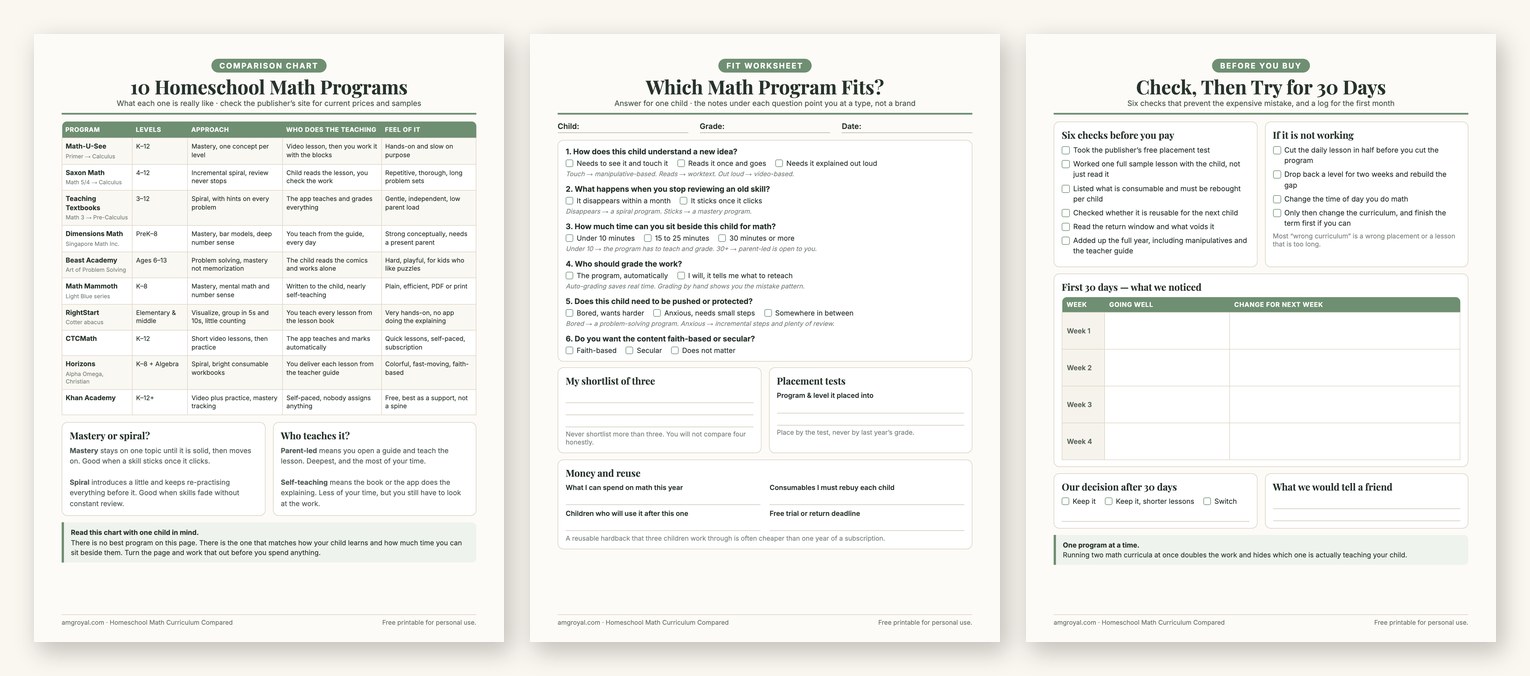
Free printable: a one-page comparison chart of all ten programs, a worksheet that narrows them down for your child, and a 30-day trial log. Three pages, no email needed.
The First Question: Mastery or Spiral?
Almost every math program sits somewhere on one line. At one end, mastery: stay on one topic until it is genuinely solid, then move on. At the other, spiral: introduce a small piece each day and keep re-practising everything that came before it.
| Mastery | Spiral | |
|---|---|---|
| How it moves | One topic at a time, until solid | A little each day, constant mixed review |
| Daily work looks like | Mostly today’s skill | A few new problems, many old ones |
| Suits a child who | Keeps a skill once it clicks | Loses a skill within weeks of stopping |
| Risk | Old skills quietly fade | Nothing feels finished, work feels long |
| In this article | Math-U-See, Dimensions Math, Math Mammoth, Beast Academy | Saxon, Teaching Textbooks, Horizons, CTCMath |
If you are not sure which your child is, there is a simple test. Stop practising something they learned two months ago. Come back three weeks later and ask for it. If it is gone, you want spiral.
The Second Question: Who Does the Teaching?
This is the question that decides whether your homeschool day survives. Be honest about the time you actually have, not the time you wish you had.
- You teach it. You open a guide and deliver the lesson. Deepest understanding, and the biggest demand on your morning. Dimensions Math, RightStart and Horizons expect this.
- A video teaches, you work alongside. Math-U-See is built this way: watch the lesson, then do it together with the blocks.
- The program teaches and grades. Teaching Textbooks and CTCMath deliver the lesson and mark every answer. You still look at the results, but you are not the teacher.
- The book teaches the child directly. Math Mammoth is written to the student and Beast Academy is written as a comic for the child to read alone.
If you have more than one child, this matters even more. Our homeschool schedule examples show how families stagger the one-on-one subjects, and math is almost always one of them.
Ten Homeschool Math Programs Compared
Here is the whole field on one screen. What each one feels like day to day is in the profiles just below, and the printable version of this chart carries all five columns.
| Program | Approach | Who does the teaching |
|---|---|---|
| Math-U-See K–12 | Mastery, one idea per level | Video, then you and the blocks |
| Saxon Math Grades 4–12 | Spiral, constant review | Child reads, you check the work |
| Teaching Textbooks Grades 3–12 | Spiral, hints on every problem | The app teaches and grades |
| Dimensions Math PreK–8 | Mastery, bar models | You teach from the guide |
| Beast Academy Ages 6–13 | Problem solving, not drilling | The child reads the comics |
| Math Mammoth K–8 | Mastery, mental math | Written to the child |
| RightStart Elementary, middle | Abacus, grouping in 5s and 10s | You teach every lesson |
| CTCMath K–12 | Short video lessons | The app teaches and marks |
| Horizons K–8 + Algebra | Spiral, consumable workbooks | You deliver each lesson |
| Khan Academy K–12+ | Video plus practice | Self-paced, nothing assigned |
A Closer Look at Each Program
Math-U-See
A K-12 mastery program that runs on letter-named levels, Primer through Calculus, with integrated manipulative blocks. Each lesson has a video, then practice worksheets and systematic review. Suits a child who needs to see and hold a concept, and a parent willing to sit with the blocks. Less good if your child finds one topic for weeks on end tedious.
Saxon Math
The classic incremental spiral, running from Math 5/4 up through Calculus. A small new piece each day, then a problem set mixing it with everything learned before. Reviewers note it needs virtually no preparation and suits students who pick up concepts without much explanation, but it is a weaker fit for a child who wants manipulatives or a strongly conceptual approach. Suits an independent learner whose skills fade without constant review.
Teaching Textbooks
An app that covers Math 3 through Pre-Calculus, does the teaching itself and grades every problem as the child enters it. Hints are available on each question. The first 15 lessons of any level are free to try. Suits a parent with no time to teach or grade math, and a child who does well with gentle pacing. Less good for a child who needs to be pushed.
Dimensions Math (Singapore Math Inc.)
The Singapore approach, PreK through grade 8, built on bar models and deep number sense. A level is a textbook, a workbook, a home instructor’s guide and tests. Suits a parent who wants the strongest conceptual foundation and is ready to teach daily. Less good if nobody has time to open the guide, because the teaching is not in the child’s book.
Beast Academy
From Art of Problem Solving, for ages 6 to 13 across five levels, delivered as comic-style books or an online platform with more than 20,000 problems and puzzles. It explicitly aims at mastery rather than memorization. Suits a child who is bored by ordinary math and enjoys a puzzle. Less good as a first curriculum for a child who is already anxious about math.
Math Mammoth
A K-8 mastery worktext, available as PDF or print, written directly to the student with matched videos from the author. The publisher describes it as nearly self-teaching and open-and-go. Suits a reader who can work through a page alone, and a budget that prefers a download. Less good for a child who cannot yet learn from written instructions.
RightStart Mathematics
An elementary and middle school program built on the Cotter abacus, on visualising quantities and grouping in fives and tens rather than counting, with card games for practice. Suits a young child who needs to see quantity, and a parent with time. Less good if you need something the child can do while you teach a sibling, because there is no app doing the explaining.
CTCMath
A K-12 subscription of short video lessons with interactive questions and worksheets that are marked and recorded automatically. Suits a family that wants lessons kept short and a record kept for them, and works well as a second explanation alongside a book. Less good as the only maths a very hands-on young child ever sees.
Horizons (Alpha Omega)
A spiral program in bright consumable workbooks, K through 8 plus Pre-Algebra and Algebra I, written from a Christian perspective. The parent delivers each lesson from the teacher’s guide. Suits a family that wants faith-based content and a fast pace. Less good if you need a reusable book, since the workbooks are consumed.
Khan Academy
Free, covering K-12 and beyond, with videos, practice and mastery tracking. Nothing is assigned and nobody tells you what comes next. Suits review, filling a gap, or a second way of hearing an explanation. Less good as your only spine, because keeping the sequence on track falls entirely to you.
Which Program by Grade
What matters changes as a child grows. Here is what to weigh at each stage, and which of the ten fit it.
Preschool and kindergarten
At this age the job is number sense, not worksheets. Keep a sitting to ten or fifteen minutes and let most of it be counting, sorting and games. Dimensions Math, RightStart and Math-U-See all start here and lean on things the child can move with their hands. Horizons works if you want workbook pages from the start. A formal program is optional this year.
Grades 1 to 2
Addition, subtraction and place value get built or they do not. This is the stage where manipulatives earn their price. Math-U-See, RightStart and Dimensions Math are strong here. Math Mammoth works if your child already reads comfortably. Our free name tracing worksheets can carry the handwriting side so math time stays about math.
Grades 3 to 5
Multiplication, division and fractions arrive, and this is where most families first consider switching. It is also where independence becomes possible. Teaching Textbooks starts at Math 3, Saxon at Math 5/4, and Beast Academy is at its best with a child who finds ordinary fourth-grade math dull.
Grades 6 to 8
Pre-algebra decides how the next four years feel. Gaps in fractions and ratios show up now, so run a placement test rather than assuming the next book in the series is right. Saxon, Teaching Textbooks, CTCMath, Math Mammoth and Dimensions Math all cover this range.
Grades 9 to 12
High school math runs on courses rather than grade levels, and the field narrows. Math-U-See, Saxon, Teaching Textbooks and CTCMath all continue through algebra, geometry and beyond. Many families also move to an outside class for one subject, which is worth planning into your week.
How to Choose Without Buying Twice
Six checks, in this order. They take an evening and they save the most expensive homeschool mistake there is.
- Take the free placement test from the publisher you are leaning toward. Place by the test, not by age.
- Work one full sample lesson with your child, out loud. Reading a sample tells you almost nothing.
- List what is consumable and must be bought again for the next child.
- Check the return window and what voids it, especially for opened teacher guides.
- Add up the whole year, including manipulatives, the teacher guide and tests, not just the student book.
- Ask one family who quit it why they quit. Reviews from people who stayed tell you half the story.
Signs You Picked the Wrong One
Before you conclude the curriculum is wrong, rule out the three things that look identical from the outside.
| What you see | Most likely cause | Try this first |
|---|---|---|
| Tears most days | The lesson is too long for the age | Cut the lesson in half for two weeks |
| Every problem needs you | Placed a level too high | Drop back a level and rebuild the gap |
| Fine on Monday, lost by Friday | Mastery program, spiral child | Add ten minutes of mixed review daily |
| Bored, careless mistakes | Not enough challenge | Move faster, or add a problem-solving program |
| You keep skipping math | It is scheduled at the wrong time | Move math to the first block of the day |
That last row catches more families than any curriculum flaw. Our guide on how to homeschool day by day puts math right after the morning start, while attention is at its best.
If you have tried all of those and it is still wrong, switch. Finish the term if you can, and carry the placement test result across so you do not restart your child a level too low.
Homeschool Math Curriculum FAQ
What is the most popular homeschool math curriculum?
There is no single answer, and popularity is a poor guide. The names that come up most often in homeschool circles are Math-U-See, Saxon, Teaching Textbooks, Singapore-style Dimensions Math and Math Mammoth. They teach in very different ways, so the useful question is which one matches your child, not which one has the most users.
Is mastery or spiral better for math?
Neither is better in general. Mastery stays on one topic until it is solid and suits a child who keeps a skill once it clicks. Spiral introduces a little and keeps re-practising everything before it, which suits a child who loses a skill within a few weeks of stopping.
What is the best homeschool math curriculum for a struggling child?
Usually a program with small steps, plenty of built-in review and something to touch or see. Before switching, check the placement first. A great many “this curriculum is wrong” problems turn out to be a child working a level too high.
Which homeschool math programs teach the child so I do not have to?
Teaching Textbooks and CTCMath both deliver the lesson and mark the work automatically. Math Mammoth is written to the child and needs little preparation. Beast Academy is designed to be read by the child. Programs like RightStart, Dimensions Math and Horizons expect you to teach.
Do I need a boxed math curriculum at all?
For elementary years you can teach math from living books and manipulatives if you know what comes next in the sequence. Most families find a curriculum saves more time than it costs, because the sequence and the practice are already built.
Can I use a free homeschool math curriculum?
Khan Academy is free and covers the whole K-12 range, and it works well as practice, review or a second explanation. It does not assign anything or tell you what to do next, so most families use it alongside a spine rather than as one.
The Bottom Line
The best homeschool math curriculum is the one you will still be using in March. Decide mastery or spiral, decide who teaches, place your child by the test, and try one program properly for thirty days before you judge it. New to all of this? Start with Homeschooling 101, then how to start homeschooling. All of our free planners and tools are on the homeschool printables page.
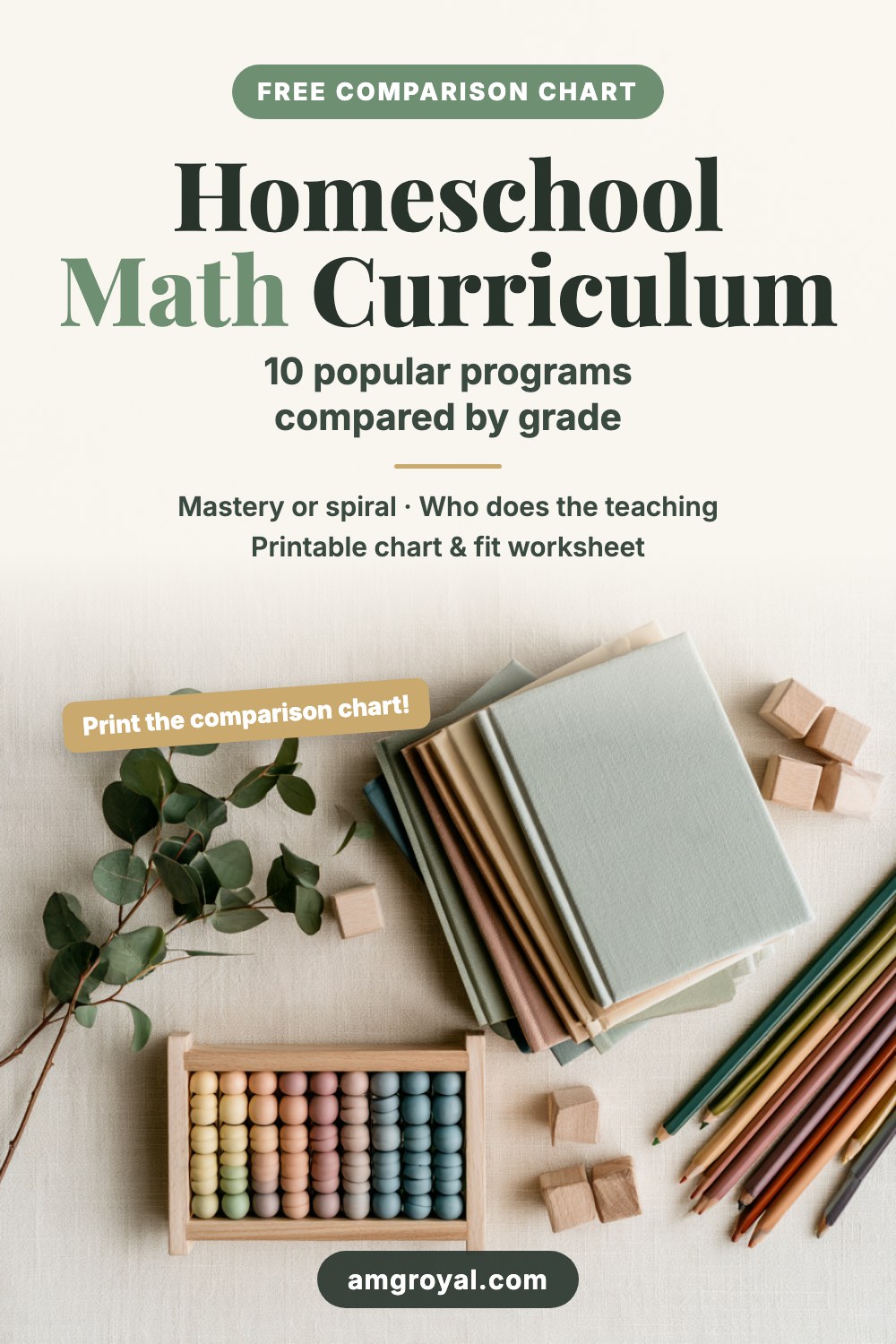
Comparing programs? Pin this image to your homeschool board so you can find the chart again.
This article is for general information only. Program details were taken from each publisher’s own site in September 2026 and can change, so confirm levels, formats and prices before you buy. Homeschool requirements also differ by state, so check the rules that apply to you.
Sources
- Math-U-See: curriculum overview and levels
- Cathy Duffy Reviews: Saxon Math 5/4 through Calculus
- Teaching Textbooks: levels, automatic grading and free trial
- Singapore Math Inc.: Dimensions Math and Primary Mathematics
- Beast Academy, by Art of Problem Solving: levels and format
- Math Mammoth: the Light Blue series
- RightStart Mathematics: the Cotter abacus approach
- CTCMath: video lessons and automatic marking
- Alpha Omega Publications: Horizons Math
- Khan Academy: free math, K-12 and beyond