You have decided to homeschool. Now comes the real question: how to homeschool on an ordinary Tuesday, with a child who would rather be outside and a load of laundry waiting.
This guide shows you what a homeschool day actually looks like, how long lessons should take by age, and how to run your very first week, one day at a time. New to all this? Start with Homeschooling 101 and how to start homeschooling.
About this guide: it is written for first-year homeschool parents. The daily time ranges are published guidelines, not legal minimums, and the legal side comes from HSLDA. Every source is linked at the end. This is general information, not legal advice.
Key Takeaways
- Learning how to homeschool starts with a rhythm: short lessons, reading, and real breaks, not a six-hour school day.
- Focused lesson time runs from about 1–2 hours in kindergarten to 4–5 hours in high school.
- A rhythm (the same order every day) works better than a strict clock schedule.
- Add one new thing per day in week one. Aim for a good day, not a perfect one.
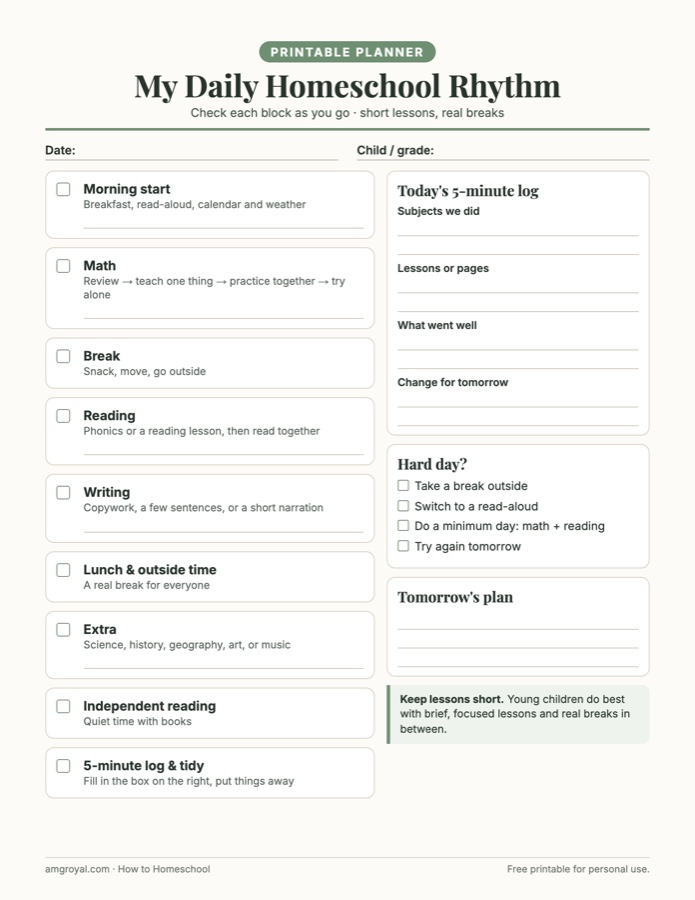
Free printable planner: a one-page daily rhythm with a 5-minute log, plus a day-by-day plan for your first week.
What a Homeschool Day Really Looks Like
Most first-year parents are surprised by how short the school part is. Lessons are one-on-one, so there is no waiting, no lining up, and no classroom management.
- Short lessons, often 10 to 30 minutes each depending on age.
- Real breaks between subjects: snack, outside, movement.
- A lot of reading, together and alone.
A Simple Daily Rhythm You Can Copy
Here is an example rhythm for an elementary-age child. Treat the times as a shape for the day, not a timetable to obey.
| Block | What happens |
|---|---|
| 8:30 · Morning start | Breakfast, a read-aloud, the plan for the day |
| 9:00 · Math | One short lesson, then practice |
| 9:40 · Break | Snack and outside time |
| 10:00 · Reading | A reading or phonics lesson, then read together |
| 10:30 · Writing | Copywork, a few sentences, or a narration |
| 11:00 · Extra | Science, history, geography, art, or music |
| 12:00 · Lunch and outside | A real break for everyone |
| Afternoon · Quiet and free time | Independent reading, projects, errands, activities |
| End of day · 5-minute log | Write down what you did, then tidy up |
Older children shift more of the day to independent work, and you become the person who explains, checks, and discusses.
How Long Should Homeschool Take Each Day?
This is the question every new homeschool parent asks. These ranges, published by Outschool, cover focused lesson time only, not reading for fun, play, or activities.
| Grade | Focused lesson time per day |
|---|---|
| Kindergarten | 1 to 2 hours |
| Grades 1–2 | 2 to 2.5 hours |
| Grades 3–5 | 2.5 to 3.5 hours |
| Grades 6–8 | 3 to 4 hours |
| Grades 9–12 | 4 to 5 hours |
- These are guidelines, not legal minimums. Some states count school days or hours, so check yours on HSLDA’s state law map.
- Short beats long for young children. Educator Charlotte Mason, whose method many homeschoolers follow, wrote that lessons should be “seldom more than twenty minutes in length for children under eight.”
How to Teach a Lesson in 5 Steps
Every subject can follow the same simple loop. Teachers call it “I do, we do, you do.”
- Review what you did last time, in two minutes.
- Teach one new idea, and only one.
- Do it together while your child watches and joins in.
- Let your child try alone while you stay nearby.
- Wrap up: one sentence about what went well, then note the lesson in your log.
If your child is lost at step four, go back to step three. That is the whole advantage of teaching one child instead of thirty.
How to Homeschool in Week One, Day by Day
Here is how to homeschool in your first week: add one new thing each day. Ending early on a good note beats pushing through a meltdown.
Day 1: short and fun
- A morning read-aloud
- One short math lesson
- One short reading lesson
- Set up the learning spot together, then stop early
Day 2: add writing
- Math and reading again, same order as yesterday
- Add a short writing task: copywork or a few sentences
- Start your 5-minute daily log
Day 3: add one extra
- A science read-aloud or a simple experiment
- Notice when your child focuses best, and protect that hour tomorrow
Day 4: try working alone
- History or geography with a picture book or a map
- One task your child does alone for 10 to 15 minutes
- Stop a lesson when attention drops instead of pushing
Day 5: light day and look back
- Math review and free reading
- A library trip, a park day, a field trip, or a co-op
- Ask yourself two questions: what worked, and what will we change on Monday?
In week two, keep the same rhythm and add one new subject or activity. That is how a homeschool year is built.
What Your First Year Can Look Like
| When | Focus |
|---|---|
| Month 1 | Build the daily rhythm. Core subjects only: math, reading, writing. |
| Month 2 | Add one extra subject. Start a simple folder of work samples. |
| Months 3–4 | Add outside life: co-op, library programs, sports, clubs. |
| Mid-year | Look back at your goals. Keep what works, change what does not. |
| Last months | Finish any testing or evaluation your state requires, then plan next year. |
Homeschooling More Than One Child
- Teach together what you can: read-alouds, science, history, art, and music work well for mixed ages.
- Stagger the one-on-one subjects. Math and reading usually need you alone with one child.
- Give older children independent work while you teach the younger ones.
- Keep a busy box of puzzles and quiet toys for the youngest.
What to Do on a Hard Day
- Stop and go outside for fifteen minutes.
- Switch to a read-aloud on the couch.
- Do a minimum day: math and reading only.
- Remember that one bad day is not a bad year.
- If hard days repeat, change the time of day, the order of subjects, or the curriculum, in that order.
Keep a 5-Minute Daily Log
The easiest record is the one you actually keep. At the end of each day, write down the date, the subjects you covered, the lessons or pages, and one short note.
- It shows progress when the days feel messy.
- It makes any state report or evaluation much easier.
- It helps if your child ever returns to school.
The free planner below has a log box built in, plus the day-by-day plan for your first week.
How to Homeschool: FAQ
Do I have to homeschool five days a week?
Not always. Some states count school days or hours per year. Within your state’s rules, you choose how to spread them, and a four-day week with a flexible fifth day is common.
What time should we start?
Whenever your family is at its best. What matters is a consistent start, so the day feels predictable to your child.
Do I need a strict schedule?
No. A rhythm, meaning the same order of blocks each day, is easier to keep than clock times and survives late mornings and appointments.
How do I homeschool while I work?
Teach the core subjects when you are available, leave independent work and reading for other hours, and use online classes, a tutor, or a co-op where you need help.
How do I know my child is learning?
Look at their work over a few weeks, ask them to tell back what they read, use the reviews built into your curriculum, and complete any testing your state requires.
The Bottom Line
Learning how to homeschool is mostly learning a rhythm: short lessons, real breaks, one new thing at a time, and a five-minute log at the end. Start simple, watch your child, and adjust weekly. Your first year is a learning year for you, too.
Starting soon? Pin this image to your homeschool board on Pinterest so you can find this guide again.
This article is for general information only and is not legal advice. Homeschool requirements change, so always confirm them with your state.