Most first-year parents build a homeschool schedule that looks like a school timetable, then feel like a failure by Wednesday. The fix is not more discipline. It is a shorter day, built for your child’s age.
Below are real schedule examples for every grade, from preschool through high school, with the hours each one takes and why the blocks fall where they do. Copy the one that matches your child, then print the daily and weekly planners to fill in. Brand new to this? Start with Homeschooling 101 and how to start homeschooling.
About this guide: the hour ranges come from published homeschool guidelines and the lesson lengths from child attention-span research, both linked at the end. They are planning guidelines, not legal minimums, and this is general information rather than legal advice.
Key Takeaways
- A homeschool day is much shorter than a school day: roughly 1–2 hours in kindergarten and 4–5 hours in high school.
- Set the length of one sitting by age, not by the subject. A six-year-old holds focus for about 15 minutes.
- Pick a schedule shape first: a morning block, a loop, or a four-day week.
- Write your anchors (start, lunch, stop) before you fill in any subject.
- Run it for five days, then change one thing. Never rebuild the whole schedule at once.
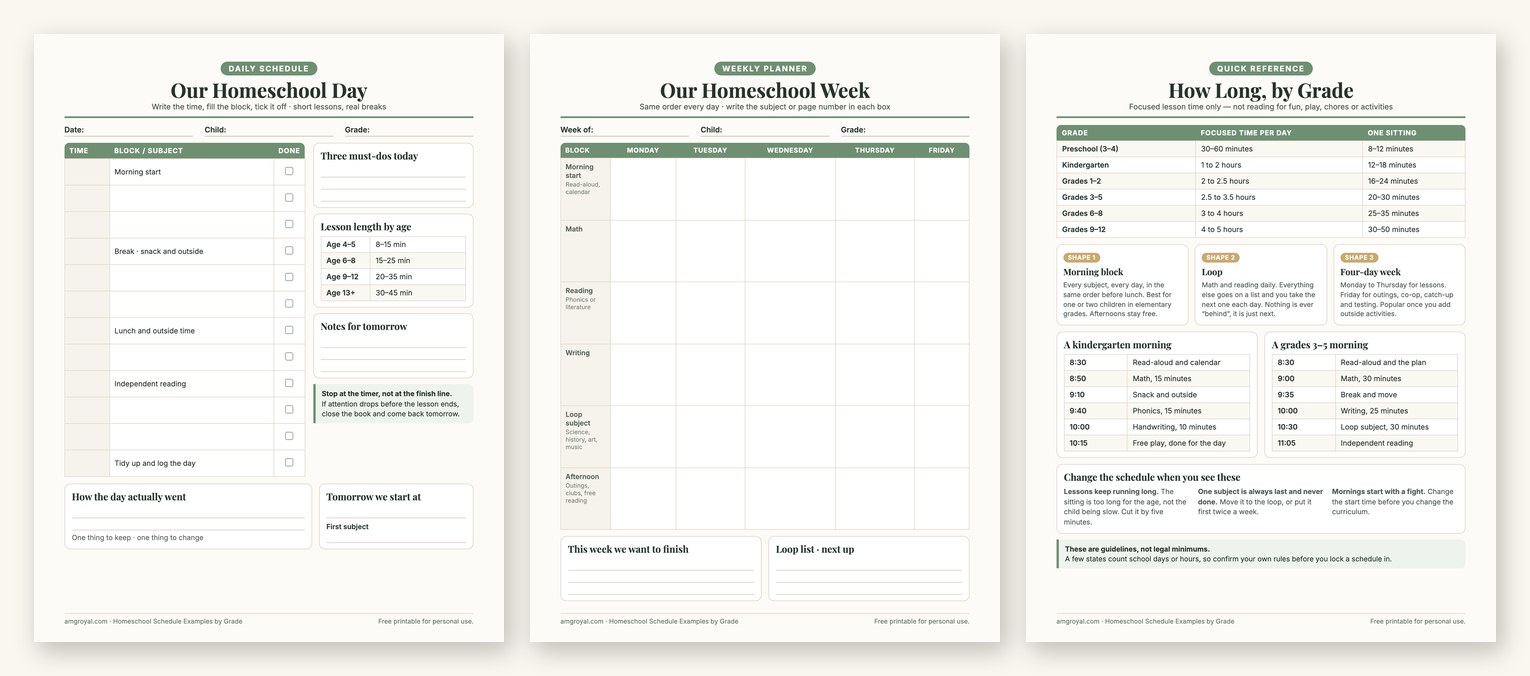
Free printables: a fill-in daily schedule, a Monday-to-Friday weekly planner, and a one-page reference card with the hours by grade. Three pages, no email needed.
How Long Should Each Grade Take?
This is the number everyone wants first. These ranges, published by Outschool, cover focused lesson time only. Reading for pleasure, free play, chores, sports and co-op do not count.
The second column is the one most schedules get wrong. It is how long a child can concentrate in a single sitting, based on the attention-span ranges published by Happiest Baby. Build your blocks from that number and the day fits. Ignore it and every lesson runs long.
| Grade | Focused time per day | One sitting |
|---|---|---|
| Preschool (3–4) | 30–60 minutes | 8–12 minutes |
| Kindergarten (5–6) | 1 to 2 hours | 12–18 minutes |
| Grades 1–2 (6–8) | 2 to 2.5 hours | 16–24 minutes |
| Grades 3–5 (8–11) | 2.5 to 3.5 hours | 20–30 minutes |
| Grades 6–8 (11–14) | 3 to 4 hours | 25–35 minutes |
| Grades 9–12 (14–18) | 4 to 5 hours | 30–50 minutes |
Charlotte Mason, whose method a lot of homeschoolers follow, put it more bluntly over a century ago: lessons should be “seldom more than twenty minutes in length for children under eight.” Short lessons are not a shortcut. They are the reason one-on-one teaching works.
Pick a Schedule Shape Before You Pick Times
Almost every workable homeschool schedule is one of three shapes. Choose the shape that matches your family, then drop your subjects into it.
1. The morning block
Every subject, every day, in the same order, finished before lunch. It is the simplest shape and the best starting point for one or two children in the elementary grades. Afternoons stay completely free.
2. The loop
Math and reading happen daily. Everything else (science, history, art, music, geography) goes on a list, and each day you take the next item. Nothing is ever “behind”, it is simply next. This is the shape to switch to when you keep skipping the same subject.
3. The four-day week
Lessons Monday through Thursday. Friday is for co-op, the library, outings, catch-up and any testing. Most families drift toward this shape once outside activities start.
Homeschool Schedule Examples by Grade
Here is what each shape looks like as a real day. Treat the clock times as spacing, not as orders. What matters is the order of the blocks and the length of each sitting.
Preschool schedule (ages 3–4)
There are no lessons yet. The goal is a predictable rhythm and roughly half an hour of gentle, structured time.
| Time | Block |
|---|---|
| 9:00 | Morning basket: a song, the calendar, a picture book |
| 9:15 | One activity: letters, counting, or sorting · 10 minutes |
| 9:30 | Free play |
| 10:15 | Outside |
| 11:15 | Craft, playdough, or a sensory bin · 15 minutes |
| Afternoon | Lunch, rest, play, library or park |
Why it works: two short structured moments in a morning of play. If your preschooler asks for more, add a third. If they wander off after four minutes, that is normal and you stop.
Kindergarten schedule (ages 5–6)
Two short sittings before the break and two after. The whole thing is done before 10:30.
| Time | Block |
|---|---|
| 8:30 | Morning start: read-aloud and calendar · 15 minutes |
| 8:50 | Math · 15 minutes |
| 9:10 | Snack and outside · 30 minutes |
| 9:40 | Phonics or reading · 15 minutes |
| 10:00 | Handwriting · 10 minutes |
| 10:15 | Free play, and the school part is done |
| Afternoon | Read-aloud on the couch, outing, or quiet time |
Why it works: about 55 minutes of focused time, inside the 1-to-2-hour range, with a real break in the middle. Handwriting goes last because it is the most tiring. Our free name tracing worksheets generator makes that 10-minute block in about a minute.
Grades 1–2 schedule
Reading and writing join math as daily subjects, and one loop subject appears at the end.
| Time | Block |
|---|---|
| 8:30 | Morning start and read-aloud · 15 minutes |
| 8:45 | Math · 25 minutes |
| 9:15 | Break and move · 20 minutes |
| 9:35 | Reading or phonics · 20 minutes |
| 10:00 | Writing or copywork · 20 minutes |
| 10:20 | Snack and outside · 30 minutes |
| 10:50 | Loop subject: science, history, art or music · 25 minutes |
| 11:15 | Independent reading · 20 minutes |
| 11:35 | Done for the day |
Why it works: about 2 hours 5 minutes of focused time in five sittings, none longer than 25 minutes, with two proper breaks. The day still ends before lunch.
Grades 3–5 schedule
Sittings stretch to about half an hour and independent reading becomes a real block.
| Time | Block |
|---|---|
| 8:30 | Morning start and read-aloud · 20 minutes |
| 8:50 | Math · 35 minutes |
| 9:25 | Break and move · 20 minutes |
| 9:45 | Writing · 25 minutes |
| 10:10 | Grammar or spelling · 15 minutes |
| 10:25 | Snack and outside · 30 minutes |
| 10:55 | Loop subject: science, history or geography · 35 minutes |
| 11:30 | Independent reading · 25 minutes |
| 11:55 | Lunch, afternoon free |
Why it works: roughly 2 hours 35 minutes of focused time. Math sits first because it is the subject that needs the freshest brain, and the loop keeps science and history from being permanently skipped.
Grades 6–8 schedule
Middle school is where the day starts crossing lunch and where your child does more of it alone.
| Time | Block |
|---|---|
| 8:00 | Independent reading · 20 minutes |
| 8:30 | Math · 45 minutes |
| 9:15 | Break · 15 minutes |
| 9:30 | Writing and literature · 40 minutes |
| 10:10 | Break and snack · 20 minutes |
| 10:30 | Science · 40 minutes |
| 11:10 | History or a foreign language · 30 minutes |
| 11:40 | Lunch and a long break |
| 1:00 | Elective or project work · 30 minutes |
Why it works: about 3 hours 25 minutes across the day, with the hardest work in the morning and the elective after lunch, when concentration is lowest anyway.
Grades 9–12 schedule
High school runs on credits, so the schedule looks more like blocks of subjects than a family rhythm. Many families alternate: four subjects on Monday and Wednesday, four others on Tuesday and Thursday.
| Time | Block |
|---|---|
| 8:00 | Math · 60 minutes |
| 9:00 | Break · 15 minutes |
| 9:15 | English · 60 minutes |
| 10:15 | Break and snack · 20 minutes |
| 10:35 | Science, with a longer lab twice a week · 60 minutes |
| 11:35 | Lunch and a real break |
| 12:30 | History or social studies · 50 minutes |
| 1:20 | Foreign language, elective or dual-credit class · 45 minutes |
| 2:05 | Independent study, work, or sport |
Why it works: about 4 hours 35 minutes of focused time, which matches the 4-to-5-hour range, with two of the eight blocks left flexible for outside classes.
Turning a Daily Schedule into a Weekly One
A daily schedule tells you what happens today. A weekly one is what stops you drifting. Keep the same block order every day and change only what goes inside the blocks.
- Write the blocks down the left, the days across the top. The weekly planner in the free PDF is already laid out this way.
- Fill in page numbers, not subjects. “Math p. 42” is a plan. “Math” is a wish.
- Keep one loop list beside the grid. Whatever you did not reach is simply next week’s first item.
- Leave one column lighter. Friday, or whichever day your outside activities land on.
If you want the day-by-day version of this with a five-minute log, that lives in our guide on how to homeschool day by day.
A Schedule for Two or More Children
Trying to run two full schedules side by side is what burns families out. Run one schedule with staggered one-on-one blocks instead. Here is a fourth grader and a kindergartener in the same morning.
| Block | Grade 4 child | Kindergartener |
|---|---|---|
| Morning start | Read-aloud together | Read-aloud together |
| Block 1 | Math with you | Puzzles, blocks, or a busy box |
| Block 2 | Writing on their own | Phonics with you |
| Break | Outside together | Outside together |
| Block 3 | Independent reading | Math with you · 15 minutes |
| Block 4 | Loop subject together | Loop subject together |
| After lunch | Finishes any leftover work | Free play, done for the day |
The younger child finishes first, which is exactly right. Science, history, art and music are taught to both at once, at the older child’s level, and the younger one absorbs what they absorb.
If You Work During the Day
A working parent’s homeschool schedule is not a shorter version of the same day. It is a different shape: the subjects that need you move to the edges of the day.
| When | What happens |
|---|---|
| 6:30–7:30 a.m. | The two subjects that need you most, usually math and reading |
| During the day | Independent work, assigned reading, an online class, a co-op or a sitter |
| 5:30–6:30 p.m. | You check the day’s work, teach writing, and read aloud |
| Saturday morning | Loop subjects, a project, a museum or a library trip |
Two things make this workable: a four-day or year-round calendar, so a missed day is not a crisis, and curriculum that is designed to be done independently. Choose that before you choose the hours.
Build Your Own Schedule in 15 Minutes
Open the printable daily page and do this in order. It takes about a quarter of an hour.
- Take your total from the hours table above, by grade.
- Pick your shape: morning block, loop, or four-day week.
- Write the anchors first: what time you start, when you eat, when you stop. Nothing else yet.
- Put the hardest subject first, right after the morning start. For most children that is math.
- Add a break after every two sittings, and make one of them outside.
- Run it for five days, then change exactly one thing. One change, one week.
The most common mistake is the opposite: a beautiful schedule, three bad days, then a complete rebuild on Sunday night. Change one block at a time and you keep what was already working.
Homeschool Schedule FAQ
How many hours a day should we homeschool?
Plan 1 to 2 hours in kindergarten, 2 to 2.5 hours in grades 1–2, 2.5 to 3.5 hours in grades 3–5, 3 to 4 hours in middle school and 4 to 5 hours in high school. That is focused lesson time only. Reading for fun, play, chores and activities are not counted.
Do we have to homeschool five days a week?
Not necessarily. A four-day week with a flexible Friday is one of the most common homeschool schedules, and many families school year-round in shorter stretches instead. A few states count school days or hours, so confirm your own rules before you drop a day.
What time should a homeschool day start?
Start when your family is actually at its best, then keep that time. A consistent start matters far more than an early one. If mornings are a fight, move the start later before you change anything else.
What if we never finish the whole schedule?
You are scheduling too much, or your sittings are too long for the age. Cut every lesson by five minutes first. If a subject is always the one left undone, move it to a loop list instead of a daily slot.
How do I schedule two children in different grades?
Teach together whatever can be taught together, usually read-alouds, science, history, art and music. Stagger only the subjects that need you one-on-one, which are normally math and reading, and give the older child independent work during the younger one’s lesson.
Can I homeschool while working full time?
Many families do it with a split schedule: the subjects that need you happen before or after work, and independent work, reading and online classes fill the day. A four-day or year-round calendar gives you more room than a strict Monday-to-Friday one.
The Bottom Line
A homeschool schedule that works is shorter than you think, shaped before it is timed, and adjusted one block at a time. Take the hours for your child’s grade, choose one of the three shapes, write your anchors, and let the first week be the test. You can find all of our free planners and tools on the homeschool printables page.
Planning your year? Pin this image to your homeschool board so you can find these schedules again.
This article is for general information only and is not legal advice. Homeschool requirements differ by state and change over time, so always confirm the rules that apply to you.