Choosing a homeschool reading curriculum can feel like the biggest decision of the early years, because reading unlocks every other subject. The good news: the best-known programs all teach systematic phonics in short daily lessons. What separates them is price, parent prep, screen time and whether faith is built in.
Below, 10 popular ways to teach reading at home are compared on exactly those points, from free printables to $250 kits, with a simple way to choose and a free printable Reading Progress Pack. Every price was read on the publisher’s or official distributor’s site on October 23, 2026. No company paid to be listed and there are no affiliate links.
Key Takeaways
- Look for systematic phonics: sounds taught in a planned order, blended into words, then read in decodable books.
- Plan on 15 to 20 minutes a day, as most of these publishers suggest.
- Free options are real: The Good and the Beautiful Level K PDF, Starfall and Progressive Phonics.
- Parent-led kits cost more but come with scripted lessons and hands-on pieces.
- Use a placement test or a free sample week before you buy anything over $50.
Homeschool Reading Curriculum at a Glance
Prices are list or regular prices in US dollars on the day they were checked; sales and shipping change the final number.
| Program | Price, approach and faith |
|---|---|
| All About Reading Pre-reading to Level 4 | $159.95 for Level 1 materials Multisensory, lightly scripted, open-and-go No faith content stated |
| Logic of English Foundations Ages 4–7 | $97.96 for the Level A bundle Phonics, handwriting and spelling together No faith content stated |
| The Good and the Beautiful Level K | Free PDF, or $69.97 printed 120 open-and-go language arts lessons Faith-based |
| Teach Your Child to Read in 100 Easy Lessons | $29.99 list price One scripted book, 20 minutes a day No faith content stated |
| Explode the Code Workbook series | $10.09 per workbook Independent phonics practice pages No faith content stated |
| Hooked on Phonics Pre-K to 2nd grade | $249.99 Learn to Read kit App lessons plus mailed books and workbooks No faith content stated |
| Reading Eggs Ages 3–7 | $13.99 a month or $99.99 a year Online lessons and games No faith content stated |
| Starfall Pre-K and up | Learn-to-Read free; membership $35 a year Online, nonprofit, no ads No faith content stated |
| Progressive Phonics | Free Printable books you read together No faith content stated |
| Abeka K5 Phonics and reading | Check current price Video lessons or parent-led kits Christian |
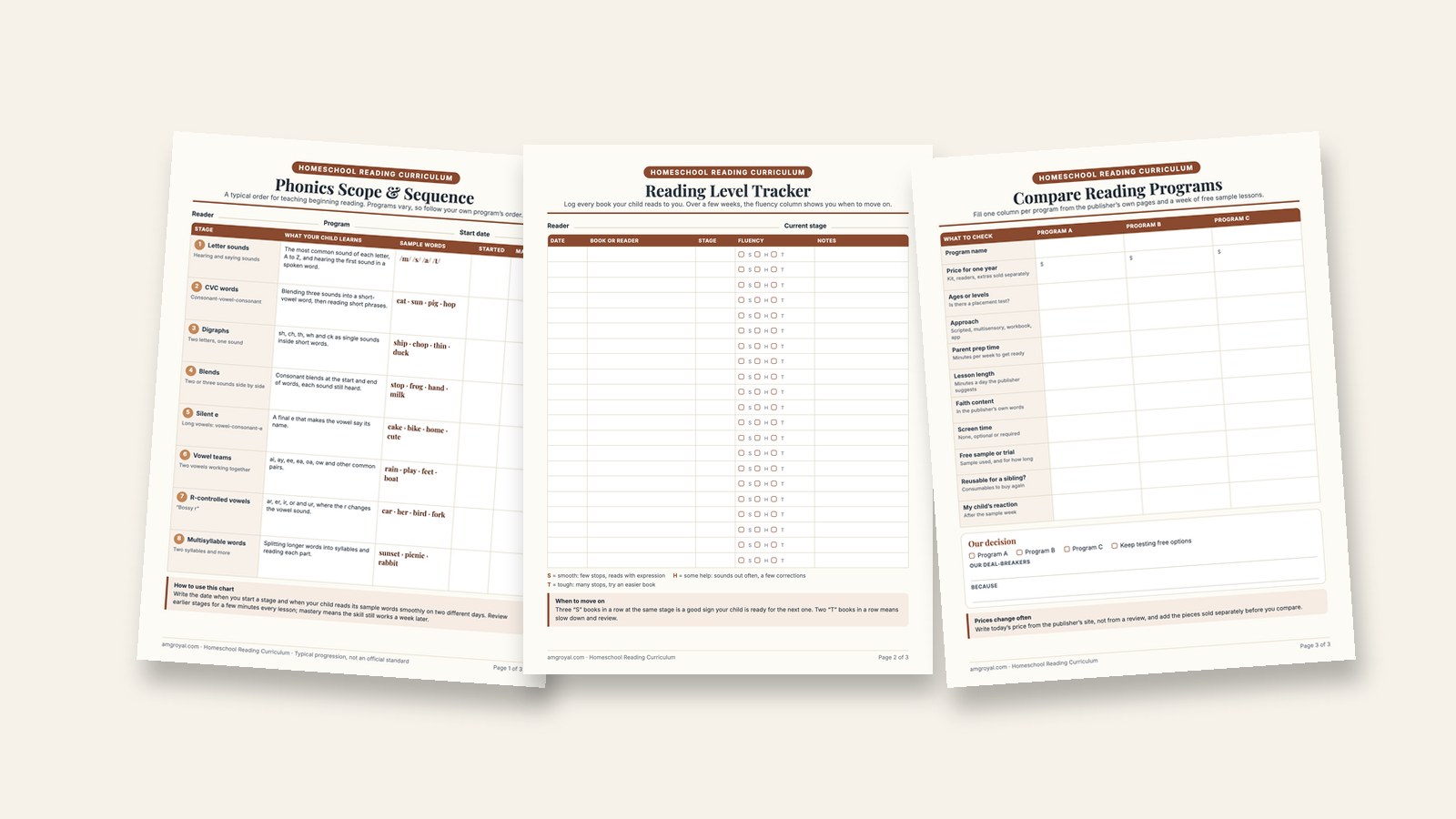
“No faith content stated” means the publisher pages read for this guide make no religious claim. For more on that question, see the guide to secular homeschool curriculum. Page 3 of the free Reading Progress Pack is a blank grid to compare your top three.
Printing outside the US? Get the A4 version of the Reading Progress Pack.
The 10 Reading Programs, One by One
1. All About Reading
All About Reading is scripted, open-and-go, multisensory and mastery-based, and the publisher says it takes “only 20 minutes a day.” Levels are placed by skill, not grade, with a placement test for each level. Level 1 materials cost $159.95, plus a one-time $25.95 letter tile set and a $17.95 review box. A one-year money-back guarantee applies. Good fit: parents who want every word of the lesson written for them. Think twice: each level is bought separately.
2. Logic of English Foundations
Foundations teaches phonemic awareness, phonics, handwriting and spelling together and is designed for ages 4 to 7. Each of its four levels has 40 lessons, eight assessments, controlled readers and games, with no memorized sight words. The Level A bundle lists at $97.96, and the reusable core materials set at $153.90. Good fit: families who like knowing the rules behind English spelling. Think twice: budget for the core materials too.
3. The Good and the Beautiful Language Arts
The Level K course combines reading, phonics, writing, spelling, grammar, geography and art in 120 parent-led, open-and-go lessons. The publisher says it “incorporates God, family, nature, beautiful art, and strong moral values.” It is a free PDF after an email sign-up, or $69.97 printed. Your child should already know letters and their sounds. Good fit: one gentle, low-cost language arts block. Think twice: if you want faith-neutral materials.
4. Teach Your Child to Read in 100 Easy Lessons
This single book is a step-by-step, phonics-based program adapted from Direct Instruction, with color-coded scripts the publisher says take “twenty minutes a day.” The revised edition lists at $29.99. Good fit: a tight budget and a parent happy to read a script. Think twice: there are no games, so try ten lessons before you judge.
5. Explode the Code
Explode the Code is a series of black-and-white workbooks based on the Orton-Gillingham approach. Book 1 covers short vowels and CVC words; later books continue the phonics sequence. Each workbook is $10.09 at School Specialty, which lists Book 1 for grades 1 to 4. Good fit: independent practice next to another program. Think twice: it is practice pages, not a full parent-led course.
6. Hooked on Phonics
Hooked on Phonics pairs app lessons with storybooks and workbooks mailed to your door, built on 15 to 20 minutes a day. The Learn to Read Kit with Spelling (Pre-K to 2nd grade) is $249.99. Good fit: families who want the next lesson chosen for them. Think twice: part of the teaching happens on a screen.
7. Reading Eggs
Reading Eggs is an online program of lessons and games for ages 3 to 7, plus Fast Phonics for ages 5 to 10. One US plan covers up to four children for $13.99 a month or $99.99 a year, after a 30-day free trial. Good fit: independent practice for siblings. Think twice: it works best next to real books read with you.
8. Starfall
Starfall is a nonprofit whose four-step Learn-to-Read program is “free for every child, forever,” with no advertising. A home membership at $35 a year unlocks activities through 5th grade. Good fit: a free, playful start for preschool and kindergarten. Think twice: use it as a supplement to lessons with you.
9. Progressive Phonics
Progressive Phonics is a free program of printable books you read with your child, with matching handwriting sheets, and it also teaches common sight words. Good fit: spending nothing while reading real books together. Think twice: you print and organize everything yourself.
10. Abeka K5 Phonics and Reading
Abeka describes itself as “Excellence in Education from a Christian Perspective.” Its K5 program covers phonics, reading and writing through 170 video lessons or parent-led kits with 170 days of lesson plans. No current kit price was shown on the publisher’s site, so check the current price directly. Good fit: a traditional, structured Christian school day. Think twice: the amount of seatwork suits some five-year-olds better than others.
How to Choose a Homeschool Reading Curriculum
Four questions narrow the list to two or three programs. Then teach a free sample of each finalist, as explained in the guide to homeschool curriculum reviews.
By age and stage
| Where your child is | What to look for |
|---|---|
| Not yet reading Learning letters | A pre-reading level or letter-sound play: All About Reading Pre-reading, Starfall, Reading Eggs |
| Knows letter sounds Ready to blend | A full phonics program that starts with CVC words: Logic of English, The Good and the Beautiful, 100 Easy Lessons |
| Reads short words Needs practice | Decodable books and practice pages: Explode the Code, Progressive Phonics |
| Older and behind Needs a reset | A placement test first, then a mastery-based program at the right level |
By teaching style
- Scripted and hands-on: All About Reading, Logic of English.
- Open-and-go or one book: The Good and the Beautiful, 100 Easy Lessons, Abeka parent-led kits.
- Screen-based with you nearby: Reading Eggs, Starfall, Hooked on Phonics, Abeka video lessons.
By budget
- Free: The Good and the Beautiful Level K PDF, Starfall Learn-to-Read, Progressive Phonics.
- Under $100: 100 Easy Lessons, a few Explode the Code books, a yearly Reading Eggs plan.
- $100 and up: All About Reading, Logic of English with core materials, Hooked on Phonics kits.
By parent time
Open-and-go books take a quick glance to prepare; multisensory kits take longer at first while you set up tiles and cards. Our homeschool schedule examples show where a 20-minute reading block fits, and the day-by-day guide explains how to keep lessons short.
What a 15–20 Minute Reading Lesson Looks Like
Most beginning reading lessons follow a similar rhythm. This is a typical shape, not a rule.
| Minutes | What happens |
|---|---|
| 0–3 | Quick review of sounds already learned, with cards or tiles |
| 3–8 | One new sound or rule, shown and said out loud |
| 8–12 | Blending: building and reading words with the new sound |
| 12–17 | Reading a short decodable story aloud |
| 17–20 | Writing a few words, then stop on a success |
Read-aloud time comes on top of this lesson: picture books and chapter books build the vocabulary that phonics alone does not. For handwriting practice with your child’s own name, try the free name tracing worksheet maker.
The Phonics Order Most Programs Follow
A phonics curriculum teaches sounds in a planned sequence, from simple to complex. A typical progression looks like this:
- Letter sounds, A to Z
- CVC words: cat, sun, pig
- Digraphs: sh, ch, th, ck
- Blends: st, fr, nd
- Long vowels with silent e: cake, bike
- Vowel teams: ai, ee, oa
- R-controlled vowels: ar, er, or
- Multisyllable words: sunset, picnic
This is a common teaching order, not an official standard; some programs swap digraphs and blends. Follow your own program’s scope and sequence.
Free Printable Reading Progress Pack
The free three-page Reading Progress Pack turns this guide into paper. Page 1 is a phonics scope and sequence chart with sample words and dates to fill in. Page 2 is a reading level tracker for every book your child reads to you, with a quick fluency check. Page 3 is a comparison grid for up to three programs. It comes in US Letter and A4.
Printing outside the US? Get the A4 version of the Reading Progress Pack.
Frequently Asked Questions
What is the best homeschool reading curriculum?
The one that matches your child’s stage and the time you really have each day. For scripted, hands-on lessons, look at All About Reading or Logic of English. On a tight budget, start with Teach Your Child to Read in 100 Easy Lessons or the free Good and the Beautiful Level K PDF. Teach a free sample for a week before you decide.
What is the best free homeschool reading curriculum?
Three options cost nothing: The Good and the Beautiful Level K language arts PDF (after an email sign-up), Starfall’s Learn-to-Read program and the printable Progressive Phonics books. Add library books for daily read-alouds and you have a full plan.
At what age should I start a phonics curriculum?
There is no single right age. Publishers describe readiness instead: All About Reading Pre-reading is designed for preschoolers and kindergarteners, Logic of English Foundations for ages 4 to 7, and The Good and the Beautiful Level K expects a child to know all letters and their sounds first.
How long should a homeschool reading lesson be?
Most publishers here plan 15 to 20 minutes a day: All About Reading says about 20, 100 Easy Lessons says twenty, Hooked on Phonics 15 to 20 and Reading Eggs 15. Stopping while your child is still doing well matters more than finishing the page.
Do I need a separate spelling program?
It depends. Logic of English Foundations and The Good and the Beautiful teach spelling inside the same lessons. All About Reading has a companion program, All About Spelling, that uses the same letter tiles. With a workbook series like Explode the Code, plan your own spelling practice.
What if my child is struggling to learn to read?
A curriculum cannot tell you whether a child has a reading difficulty. The International Dyslexia Association explains that dyslexia is identified through a comprehensive evaluation, and that people with dyslexia benefit from “a systematic and explicit method that involves several senses.” If you have concerns, talk with a qualified professional rather than switching programs again and again.
Your Next Step
Pick two programs, download their free samples or placement tests and print page 3 of the pack. One week of short lessons will show you more than any review. Planning the rest of the year? See the kindergarten homeschool curriculum guide, the homeschool math curriculum comparison, and, if you are just starting, homeschooling 101 and how to start homeschooling. All the free planners are on the homeschool printables page.
Teaching reading this year? Pin this image to your homeschool board so you can find the Reading Progress Pack again.
This article is for general information only and is not educational, medical or diagnostic advice. Prices and program details were read on each publisher’s or official distributor’s site on October 23, 2026 and can change at any time.
Sources
- All About Learning Press: All About Reading
- All About Learning Press: All About Reading Level 1
- Logic of English: Foundations
- The Good and the Beautiful: Level K Language Arts Course Set
- The Good and the Beautiful: free Level K language arts download
- Simon & Schuster: Teach Your Child to Read in 100 Easy Lessons
- School Specialty: Explode the Code Book 1
- Hooked on Phonics: shop
- Reading Eggs: pricing (US)
- Starfall: Learn-to-Read
- Starfall: membership
- Progressive Phonics
- Abeka: K5 curriculum overview
- International Dyslexia Association: Dyslexia Basics