
Reading homeschool curriculum reviews is how most families shop, and it is also how most families end up with a shelf of books they stopped using in October. The problem is rarely a bad program. It is a review written for a different child, a different parent, or by someone paid to like it.
This guide shows you how to read reviews with a critical eye, which eight things to compare between programs, and how to test a curriculum for free before you pay. It ends with a free printable scorecard and a one-week sample test log. We read every source quoted here on its own site in October 2026; no publisher paid to be mentioned and none of the links are affiliate links.
Key Takeaways
- A review is one family’s experience. It tells you about their child, not yours.
- A reviewer who got the program free or earns a commission should say so clearly, near the recommendation.
- Compare programs on eight points: who teaches, prep time, style, scope and sequence, faith, cost per child, trial options and returns.
- Teach a week of free sample lessons before you buy, and take the placement test when one exists.
- Read the return policy before you open the box: windows and condition rules vary a lot.
- Buy one subject first when you are unsure. It is cheaper to undo.
Where Homeschool Curriculum Reviews Come From
Not all reviews are built the same way. Knowing who wrote one, and why, tells you how much weight to give it.
| Source | Good for, and what to watch |
|---|---|
| Publisher pages and samples | Real pages, the scope and sequence, and how a lesson is laid out. Remember the page is written to sell. |
| Independent review sites | Long, comparative reviews by people who look at many programs. Check whether they receive free copies. |
| Blog reviews with buy links | Detailed use over time. Look for a clear disclosure if the writer earns a commission. |
| Video flip-throughs | Seeing print size, color and how busy a page is. They say little about months of use. |
| Parent groups and co-ops | Honest “we quit in week six” stories. Ask what the child was like, not only what they used. |
| Store star ratings | Shipping and condition problems. Too short to judge teaching quality. |
Independent reviewers are a good starting point, but read their rules. Cathy Duffy Reviews, one of the best-known sites, states that “publishers, authors, and service providers never pay to be reviewed,” and that they “do provide free review copies or online access.” That is normal and fine, as long as you know it.
What the FTC Says About Paid and Free Reviews
In the United States, reviews with a financial link are covered by the Federal Trade Commission’s Endorsement Guides. Its plain-language FAQ says a reviewer who was paid or “given something of value” should disclose it, that a free product counts, and that “the closer the disclosure is to your recommendation, the better.” It also says a label like “affiliate link” on its own is not clear enough, and suggests wording such as “I get commissions for purchases made through links in this post.”
You do not need to distrust every review with a buy link. You just need to know it is there, so you can weigh the praise accordingly.
6 Red Flags in a Curriculum Review
- Only praise. It never says who the program is not for.
- No inside pages. You see the box and the cover, never a real lesson.
- Hidden money. Buy links with no clear disclosure, or only a vague label.
- A free copy nobody mentions. Free review copies are common; hiding them is not.
- “The best” with no child attached. Best for which grade, which learner, which parent?
- Written after a week. First impressions are not a school year.
A useful review does the opposite: it names the grade and the child, shows real pages, lists the downsides, says who should skip it, and explains how the reviewer got the program.
The 8 Things to Compare Between Programs
Two programs can both be excellent and still be wrong for you. Score each one on these eight points, from your own sample lessons rather than from marketing copy.
| What to compare | What to look for |
|---|---|
| 1. Who teaches | You from a guide, a video teacher, or an app. Does it fit the hours you actually have? |
| 2. Parent prep time | Minutes per week to gather materials and read ahead. “Open and go” is not the same as independent. |
| 3. Teaching style | Mastery or spiral, hands-on or workbook, short lessons or long ones. |
| 4. Scope and sequence | What is taught and in what order. Does it match your goals and skip what your child already knows? |
| 5. Faith content | Read the publisher’s own words: Christian, faith-neutral or secular. |
| 6. Cost per child per year | Reusable guides versus consumable workbooks, add-ons sold separately, and siblings. |
| 7. Try before you buy | Free sample lessons, free downloads, and placement tests. |
| 8. Return and resale | Return window, condition rules, who pays shipping, and how well it resells. |
For the faith question in more depth, see our guide to secular homeschool curriculum, which shows where religious content tends to sit in each subject.
How to Test a Curriculum Before You Buy
Teach a week of free samples
Many publishers give away real lessons. The Good and the Beautiful offers its Level K language arts course as a free download, and Oak Meadow lets you download sample lessons for its kindergarten program. Teach the samples of your top two choices for five days each, and write down the minutes, your prep time and how it went the same day.
Take the placement test
A placement test tells you where to start, which matters more than which program you pick. Math Mammoth, for example, offers free placement tests for grades 1 to 8 plus kindergarten. They are end-of-year tests, and the publisher gives a simple rule: 80 to 89 percent means the child can move on to the next grade, and under 50 percent means trying the next lower test.
Compare two scope and sequence lists
Print the scope and sequence of both programs and highlight what your child already knows. The program with the least repetition and the fewest gaps is usually the better fit for that year.
Read the Return Policy Before You Pay
Return policies range from generous to none at all, and the details matter. Sonlight’s policy is a useful example of what to look for: you can take up to one year to use the first 18 weeks of an eligible package and return the whole package for a full refund of the purchase price, but return shipping is not included. Individual items fall under a separate six-month policy: they must be unused and resalable, and a 10 percent handling fee is taken from the refund.
For any publisher, check four things before you open the box: the time window, the condition the items must be in, who pays shipping, and whether downloads can be returned at all.
Count the Real Cost, Not the Price Tag
Two programs with the same price can cost very different amounts over three years. Reusable teacher guides and readers can serve every sibling; consumable workbooks must be bought again for each child. Add the pieces sold separately, then divide by the number of children and years you will use it. We do not list prices here because they change often; the scorecard has a line for your own numbers.
A Worked Example: Three Kindergarten Reading Programs
Here is how the method works with three phonics programs we compared in our kindergarten homeschool curriculum guide, for a family that wants short lessons and almost no prep. The notes come from each publisher’s own page; the fit is our reading for this family, not a ranking.
| Program | What the publisher says, and the fit |
|---|---|
| The Good and the Beautiful Language Arts Level K | 120 parent-led, open-and-go lessons, free PDF. Strong fit on prep and cost; faith-based content, which matters to some families. |
| All About Reading Pre-reading | Lightly scripted, multisensory, about 20 minutes a day. Strong fit on lesson length; check the placement guidance first. |
| Logic of English Foundations | 40 lessons per level, phonics with handwriting, cursive or manuscript. Strong fit for families who want the rules of English explained. |
Sources: The Good and the Beautiful, All About Reading and Logic of English. After a sample week, this family would score each one on the eight points and buy the one that wins on their deal-breakers, not the one with the most five-star reviews.
Use Our Subject-by-Subject Guides
Once you know how to compare, our guides apply the same method to specific subjects and grades: math curriculum, science curriculum, secular options, kindergarten and high school. Each one compares programs on teaching style, parent time and faith content, with a free printable chart.
Free Printable Curriculum Review Scorecard
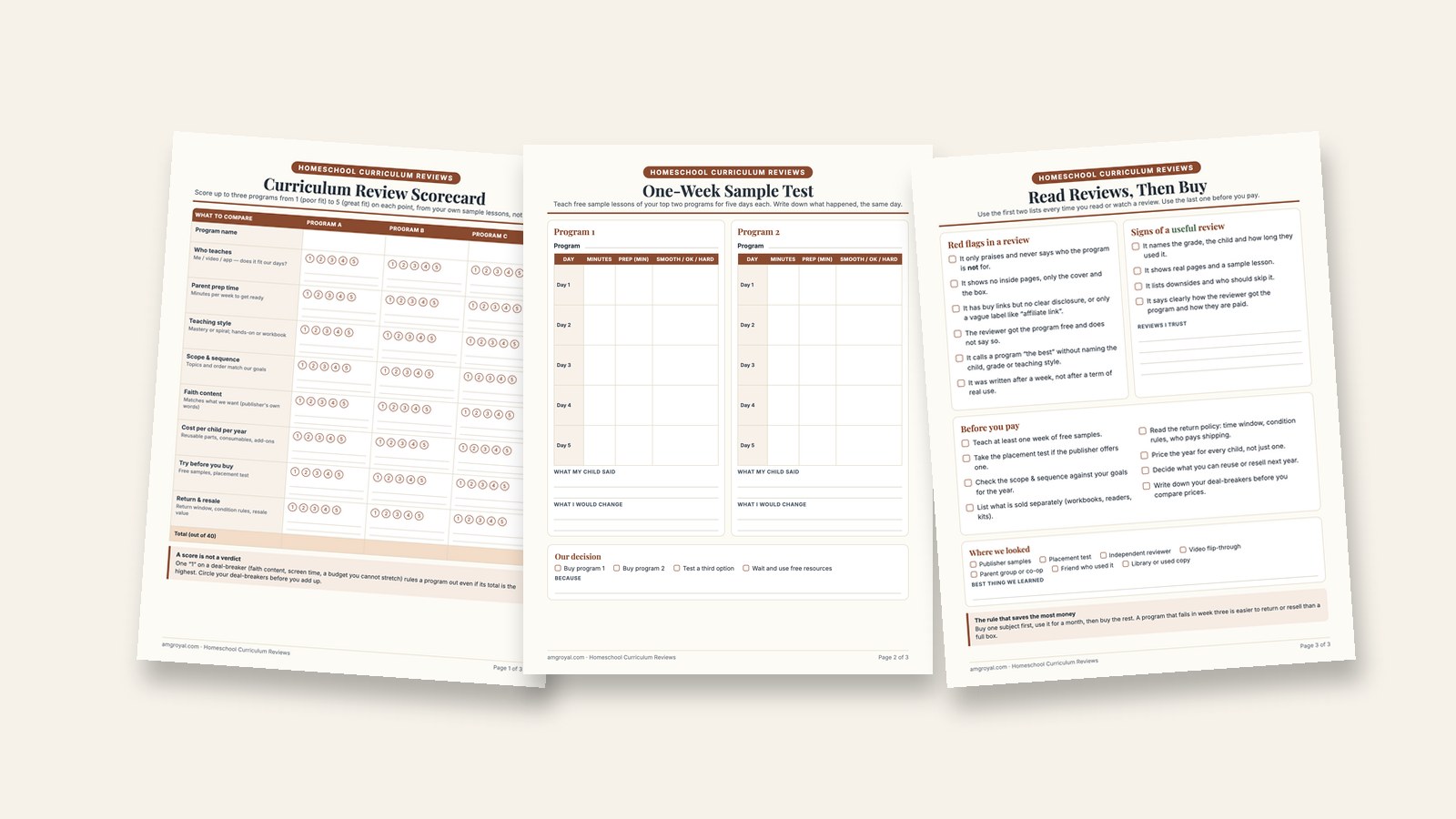
Our free three-page printable turns this guide into paper. Page 1 is a scorecard to rate up to three programs on the eight points. Page 2 is a one-week sample test log for your top two choices. Page 3 is a red-flags checklist for reading reviews and a before-you-pay checklist.
Frequently Asked Questions
Where can I find honest homeschool curriculum reviews?
Look for reviews that show inside pages, name the child’s grade and say how long the family used the program. Independent review sites, parents who used it for a full term, and your own week of free sample lessons are the most reliable sources. Treat any single review as one data point, not a verdict.
Are homeschool curriculum review sites paid by publishers?
It depends on the site. Cathy Duffy Reviews, for example, states that publishers “never pay to be reviewed” but do send free review copies. Under FTC guidance, a reviewer who gets a free product or earns a commission should disclose it clearly, close to the recommendation.
Are YouTube flip-through reviews worth watching?
Yes, for seeing real pages, the size of the print and how busy a lesson looks. They tell you less about how a program works over months. Check the description and the video itself for a clear disclosure if the creator links to the product.
How long should we try a curriculum before deciding?
Give free samples about one week to choose between programs. After you buy, give the new program about a month before switching, and try shortening the lessons first, because most early trouble is lesson length, not the program itself.
Can I return homeschool curriculum if it does not work?
Sometimes. Policies vary a lot between publishers. Sonlight, for instance, lets you use the first 18 weeks of an eligible package within a year and return the whole package for a full refund, minus shipping. Many companies only accept unused items, so read the policy before you open anything.
What is a scope and sequence?
It is the publisher’s list of what a program teaches (the scope) and in what order (the sequence). Comparing two scope and sequence documents side by side is the fastest way to see whether a program matches your goals for the year, and whether it repeats what your child already knows.
Your Next Step
Pick your top two programs, download their free samples and print page 2 of the scorecard. One honest week at your own table will tell you more than fifty reviews. New to homeschooling? Start with homeschooling 101 and how to start homeschooling, and see our homeschool schedule examples to know how much time each subject really gets. All of our free planners are on the homeschool printables page.
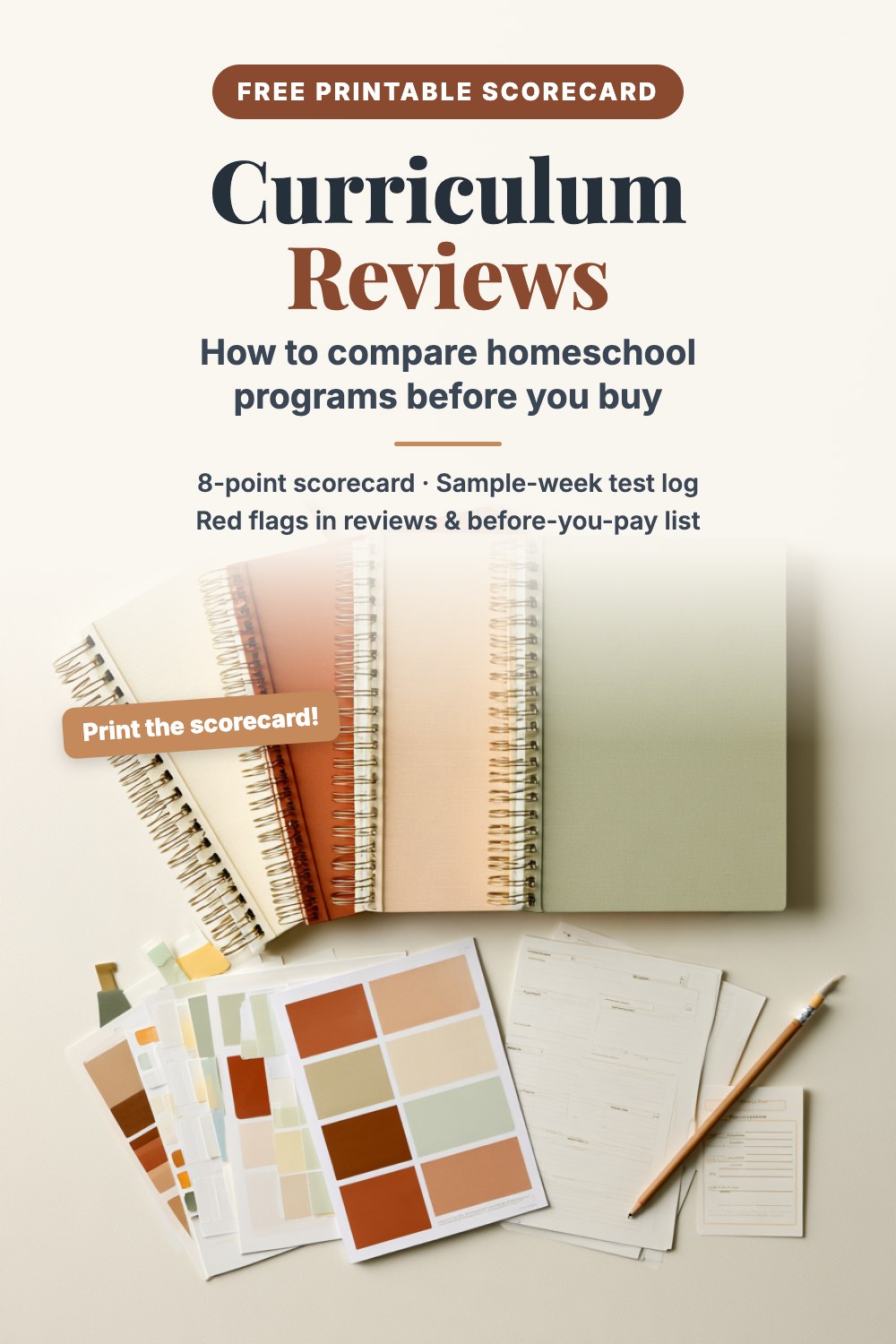
Shopping for curriculum this year? Pin this image to your homeschool board so you can find the scorecard again.
This article is for general information only. Policies and offers were read on each organization’s own site in October 2026 and can change. Homeschool law is set by each state, so check the rules that apply to you.
Sources
- Federal Trade Commission: FTC’s Endorsement Guides, What People Are Asking
- Cathy Duffy Reviews: About Cathy Duffy
- Sonlight: return policy
- Math Mammoth: placement tests
- The Good and the Beautiful: free Level K language arts download
- Oak Meadow: Kindergarten
- All About Learning Press: All About Reading
- Logic of English: Foundations