
Picking a kindergarten homeschool curriculum is mostly about one question: who is going to teach, for how long, and with what? A five-year-old needs short lessons in reading, math and handwriting, a lot of read-aloud time and plenty of play. Almost every program on the market covers that. The real differences are how much the parent teaches, how much prep it takes, and whether faith is built in.
Below you will find 14 well-known options compared on exactly those points, the best pick for each type of family, and a free printable chart you can keep next to you while you look at samples. We read each publisher’s own page in October 2026; no company paid to be here and none of the links are affiliate links.
Key Takeaways
- Kindergarten at home needs three short daily lessons: phonics and reading, math, handwriting, plus read-alouds.
- Expect about one to two hours of focused work a day, in sittings of 10 to 20 minutes.
- All-in-one programs save planning; a phonics book plus a math program costs less and works just as well.
- Check readiness first: most kindergarten reading programs expect your child to know letters and their sounds.
- Free options exist: Easy Peasy, Khan Academy Kids and The Good and the Beautiful Level K language arts PDF.
- Try a sample lesson for a week before you buy anything big.
What a Kindergarten Homeschool Year Really Needs
Before comparing boxes, it helps to know how small the core really is. A kindergarten year at home is built on four blocks, and everything else is a bonus.
| Block | What it looks like | Time per sitting |
|---|---|---|
| Phonics and reading | Letter sounds, blending, first short words and simple readers | 10–20 minutes |
| Math | Counting, number sense, shapes, simple adding with objects | 10–15 minutes |
| Handwriting | Pencil grip and forming letters and numbers | 5–10 minutes |
| Read-aloud | Picture books and simple chapter books you read to them | 15–20 minutes |
Science, art, music and history fit into play, nature walks and library books at this age. Our homeschool schedule examples include a full kindergarten day, and the day-by-day guide shows how to keep lessons short enough that they end before the tears start.
How to Choose: Three Questions That Decide It
Most curriculum regret comes from a mismatch on one of these three points, not from the quality of the program. Answer them first and the list gets much shorter.
| Question | If your answer is… | Look at |
|---|---|---|
| Who teaches? | Me, from a guide | Sonlight, BookShark, Oak Meadow, My Father’s World, Timberdoodle |
| A video teacher | Abeka K5 video lessons | |
| An app, with me nearby | Time4Learning, Khan Academy Kids | |
| How much prep? | Almost none | Open-and-go guides: The Good and the Beautiful, All About Reading |
| I enjoy gathering crafts and books | Oak Meadow, My Father’s World units | |
| Faith content? | Built in | Sonlight, Abeka, My Father’s World, Easy Peasy, The Good and the Beautiful |
| None | Oak Meadow (secular), BookShark (faith-neutral), Timberdoodle Nonreligious kit |
If you are paying with a charter school or state funding program, check its rules before you choose: Timberdoodle notes that most funding programs require non-religious materials. For a deeper look at the faith question, see our guide to secular homeschool curriculum.
Best Kindergarten Homeschool Curriculum: Top Picks by Family Type
These picks are based on what each publisher says its program includes and how it is taught. They are starting points for your sample-lesson week, not a ranking.
| Best for | Pick | Why |
|---|---|---|
| Literature lovers who want everything planned | Sonlight All-Subjects Package K | Every subject plus read-alouds, with an Instructor’s Guide |
| Faith-neutral, literature-based | BookShark Level K | Faith-neutral by its own description, 4-day weeks |
| Gentle, secular and screen-free | Oak Meadow Kindergarten | Waldorf-inspired, print-based, 36 weekly lessons |
| A traditional classroom feel | Abeka K5 | Video teacher or parent-led kits, 170 days of lessons |
| Hands-on families with a big budget | Timberdoodle Kindergarten Kit | Games, STEM and art, plus a day-by-day scheduler |
| Short, independent screen time | Time4Learning Kindergarten | Animated lessons that grade themselves |
| Spending nothing | Easy Peasy + Khan Academy Kids | Both free; Easy Peasy is Christian |
| Teaching reading well | All About Reading or Logic of English | Systematic phonics in short, scripted lessons |
All-in-One Kindergarten Programs Compared
An all-in-one program hands you the whole year: books, lesson plans and a schedule. You pay more, but you plan less. Here is what each one says it includes.
Sonlight: All-Subjects Package K
Sonlight’s Level K is designed for ages 5 to 7. The All-Subjects Package bundles history, Bible, geography, read-alouds, readers, language arts, phonics, handwriting, spelling, math and science with an Instructor’s Guide, and several subjects come in 4-day or 5-day versions. It is Christian and built around books you read together. Good fit: families who love read-aloud time and want every day mapped out. Think twice: if you want to choose each subject yourself, you may end up not using parts of the package.
BookShark: Level K
BookShark’s literature-based program uses read-alouds and readers to introduce history, and its FAQ says plainly: “BookShark is faith-neutral”, and its science and history programs do not teach evolution, creationism or intelligent design. Schedules run four days a week, with day five left open for co-ops and outings. Good fit: Sonlight-style families who want faith left to the parents. Think twice: check which subjects your package includes before you order.
Oak Meadow: Kindergarten
Oak Meadow Kindergarten is a Waldorf-inspired, secular program for ages 5 to 6 built on stories, letters and phonics, play-based math, science, crafts, music and movement. You get a coursebook and a resource book with 36 weekly lessons, and the K–3 years can be taught without electronic devices. Oak Meadow even suggests waiting until age 5 to start. Good fit: gentle, creative, screen-free homes. Think twice: if you want worksheets and a fast reading pace.
Abeka: K5
Abeka describes itself as “Excellence in Education from a Christian Perspective.” Its K5 program covers phonics, reading, cursive or manuscript writing, numbers and Bible, with 170 days of lessons. You can teach it yourself with the Parent Led kits or use Abeka Academy video lessons with a classroom teacher. Good fit: families who want a traditional, structured school day. Think twice: the pace and amount of seatwork suit some five-year-olds better than others.
My Father’s World: Kindergarten
My Father’s World Kindergarten, “God’s Creation from A to Z”, is a Christian unit study with 26 hands-on units, one letter and one science topic each week. It covers Bible, reading and language arts, math, science, art and music, and plans about 90 minutes a day, including a read-aloud and outside time. Good fit: families who like themes and crafts. Think twice: some items, like student sheets, are sold separately.
Timberdoodle: Kindergarten Curriculum Kit
The Timberdoodle kit is the most hands-on box here: reading with All About Reading, math with Math-U-See, thinking skills, STEM building sets, art, history and science, plus a scheduler that lays out every subject day by day. It comes in a Classic edition and a Nonreligious edition, and parents it surveyed reported spending one to three hours a day. Good fit: busy hands and families using funding programs. Think twice: it is a lot of material for one year, so plan to skip freely.
Online and Free Kindergarten Options
Screens and free curricula can carry a big share of kindergarten, as long as an adult stays close and the sittings stay short.
| Program | How it works | Good to know |
|---|---|---|
| Time4Learning Kindergarten | Animated online lessons in language arts, math and science; grading is automatic | Early learners spend about 30 minutes to 1 hour a day |
| Easy Peasy All-in-One | Free online lessons from preschool to 8th grade, 180 days per level | Describes itself as a Christian curriculum |
| Khan Academy Kids | Free app with reading, writing, math and social-emotional skills | Ages 2 to 8, no ads, no subscriptions |
Time4Learning is easy to start and hands you progress reports, which helps if you work. Easy Peasy says “it’s all free” and uses free online materials, with optional printed workbooks. Khan Academy Kids calls itself “100% free – forever”, which makes it a good extra for practice even if you buy something else.
Best Kindergarten Reading Curriculum
If you buy only one thing for kindergarten, make it a phonics program. Each of these teaches reading systematically, in short daily lessons with a parent.
The Good and the Beautiful: Language Arts Level K
The Level K course has 120 parent-led, open-and-go lessons that combine reading, phonics, writing, spelling, literature, grammar, geography and art. The publisher says it “incorporates God, family, nature, beautiful art, and strong moral values.” Your child should know all letters and their most common sounds first, and the course is offered as a free PDF download, with printed books sold separately.
All About Reading: Pre-reading
All About Reading calls Pre-reading “designed for preschoolers and kindergarteners.” Lessons are lightly scripted, multisensory and open-and-go, and the publisher recommends about 20 minutes a day. It is a natural pick for a child who is not quite ready to read yet.
Logic of English: Foundations
Foundations teaches phonics, reading, spelling and handwriting together. Each level has 40 lessons, eight assessments, controlled readers and games, and you can teach either cursive or manuscript first. Families who like understanding the rules of English tend to love it.
Teach Your Child to Read in 100 Easy Lessons
This single book by Siegfried Engelmann and co-authors is a step-by-step, phonics-based program that the publisher says takes “twenty minutes a day.” It is the lowest-cost route on this list. The scripted format suits some children perfectly and bores others, so try the first ten lessons before you decide.
Handwriting: Handwriting Without Tears
Handwriting Without Tears teaches print from transitional kindergarten to second grade with multisensory letter formation. Many all-in-one programs include their own handwriting, so check before you add it. For free tracing practice with your child’s own name, use our name tracing worksheet maker.
What About Kindergarten Math?
Kindergarten math is mostly counting, comparing and handling real objects. Most all-in-one programs above include it. If you are building your own year, our homeschool math curriculum guide compares ten programs and has a section just for preschool and kindergarten, including which ones use manipulatives. For science, our homeschool science curriculum guide shows how little you need at this age.
Can You Do Kindergarten Without a Curriculum?
Yes, and many families do. A library card, a phonics book, a deck of cards for counting games and a daily read-aloud cover the essentials. Buying a full program mostly saves you planning time. A good middle path is to buy only a reading program and use free resources for everything else, then add more in the spring if you feel you need it.
6 Checks Before You Buy
- Do one sample week. Most publishers offer free sample lessons. Teach them before you order.
- Check readiness. Many reading programs expect letters and sounds already. If not, start with a pre-reading level.
- Count the parent minutes. Open-and-go is not the same as independent at age five.
- Read the faith label in the publisher’s own words, especially if a funding program is paying.
- Look for what is sold separately, such as student sheets, readers or craft kits.
- Plan for a sibling. Non-consumable guides can be reused; workbooks usually cannot.
Free Printable Kindergarten Curriculum Chart
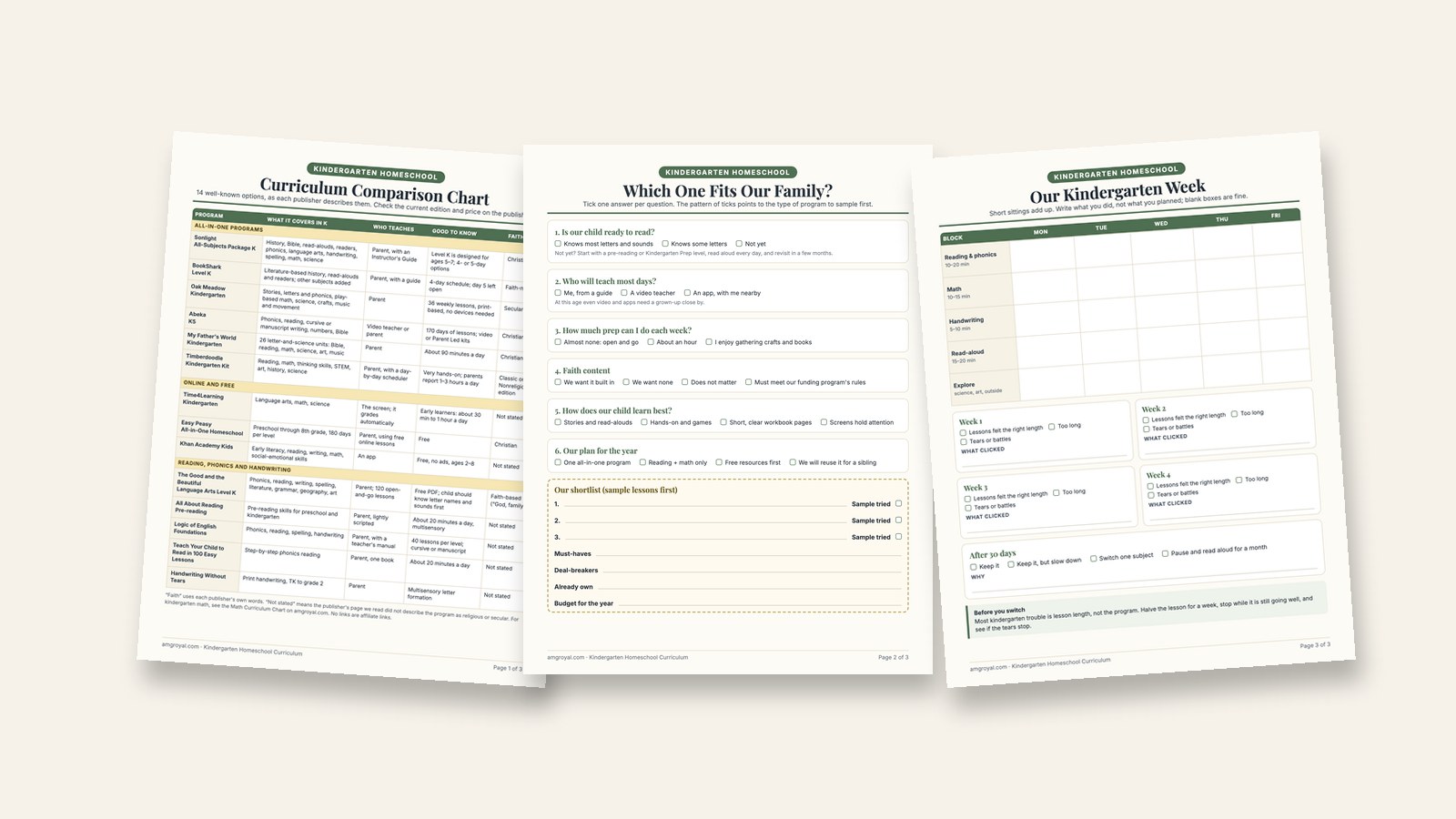
Our free three-page printable puts all of this on paper. Page 1 is the comparison chart of the 14 programs above. Page 2 is a “which one fits our family” worksheet with six questions and a shortlist. Page 3 is a weekly kindergarten plan and a 30-day trial tracker to see if your choice is working before you commit for the year.
Frequently Asked Questions
What is the best homeschool curriculum for kindergarten?
There is no single winner, because the best one is the one you will actually open every day. If you want one box that covers everything, look at the all-in-one programs. If you want the least spending, a phonics program plus a math program plus daily read-alouds covers the essentials of kindergarten.
What is the best free kindergarten homeschool curriculum?
Easy Peasy All-in-One Homeschool says its lessons are “all free” and describes itself as a Christian curriculum. Khan Academy Kids is a free app for ages 2 to 8 with no ads. The Good and the Beautiful offers its Level K language arts course as a free PDF. Add your library card and you can run a full year for very little.
How many hours a day should kindergarten homeschool take?
Much less than school. Most families do about one to two hours of focused work, split into short sittings, plus read-alouds and play. Publishers vary: Time4Learning says early learners spend about 30 minutes to 1 hour a day online, while My Father’s World plans about 90 minutes.
What is the best reading curriculum for kindergarten?
Choose a systematic phonics program and use it for 15 to 20 minutes a day. All About Reading, Logic of English Foundations, The Good and the Beautiful Level K and the book Teach Your Child to Read in 100 Easy Lessons all take that approach in different styles. Check the readiness skills first: letters and their sounds.
Do I need an accredited curriculum for kindergarten?
Usually not. Accreditation applies to schools, not to books. BookShark, for example, says it cannot be accredited because it is a curriculum provider, not a school. Some companies run separate accredited online schools. What you must follow is your state’s homeschool law, so check it before you start.
Do I need to buy a curriculum for kindergarten at all?
No. Many families start with daily read-alouds, a phonics book, simple counting games and outside time, then buy a program only for the subject that feels shaky. A curriculum is mostly a time-saver for you, not a requirement for your child.
Your Next Step
Print the chart, answer the six questions on page 2, and request samples from your top two programs. One week of sample lessons will tell you more than any review. New to homeschooling? Start with homeschooling 101 and how to start homeschooling. All of our free planners are on the homeschool printables page.
Choosing kindergarten curriculum this year? Pin this image to your homeschool board so you can find the chart again.
This article is for general information only. Program details were read on each publisher’s own site in October 2026 and can change with new editions; prices are not listed because they change often. Homeschool law is set by each state, so check the rules that apply to you before you start.
Sources
- Sonlight: Level K
- BookShark: frequently asked questions
- Oak Meadow: Kindergarten
- Abeka: K5 curriculum overview
- My Father’s World: Kindergarten
- Timberdoodle: Kindergarten Curriculum Kit
- Time4Learning: Kindergarten curriculum
- Easy Peasy All-in-One Homeschool
- Khan Academy Kids
- The Good and the Beautiful: Level K Language Arts
- All About Learning Press: All About Reading
- Logic of English: Foundations
- Simon & Schuster: Teach Your Child to Read in 100 Easy Lessons
- Learning Without Tears