

Planning a homeschool high school curriculum feels bigger than any year before it, and for a good reason: these four years end in a transcript that someone else will read. The good news is that you do not need to choose every book now. You need a goal, a way to count credits, and a rough map of grades 9 to 12 that you adjust every summer.
This guide works backward from what your teen wants to do next. You get the course lists that real targets publish, three sample four-year plans, a grade-by-grade checklist with the testing dates homeschoolers miss most often, and a free printable planner to fill in at the kitchen table.
About this guide: every rule and number below was read on the official page of the organization that sets it, in October 2026, and every page is linked in the sources. There are no affiliate links. Homeschool law is set by each state, so check yours first; this guide does not replace it.
Key Takeaways
- Start with the goal, not the curriculum. A UC applicant, a future athlete and a teen heading for a trade need different plans.
- A credit is a decision you document. Hours, a finished textbook or a college course all work, as long as you write down which one you used.
- The core is predictable: four years of English, three to four of math, two to three of lab science, history, and often two years of one language.
- Testing runs through schools. Homeschoolers must ask a school weeks ahead for the PSAT and by mid-November for AP exams.
- Records beat diplomas. A clear transcript and course descriptions are what admissions offices actually read.
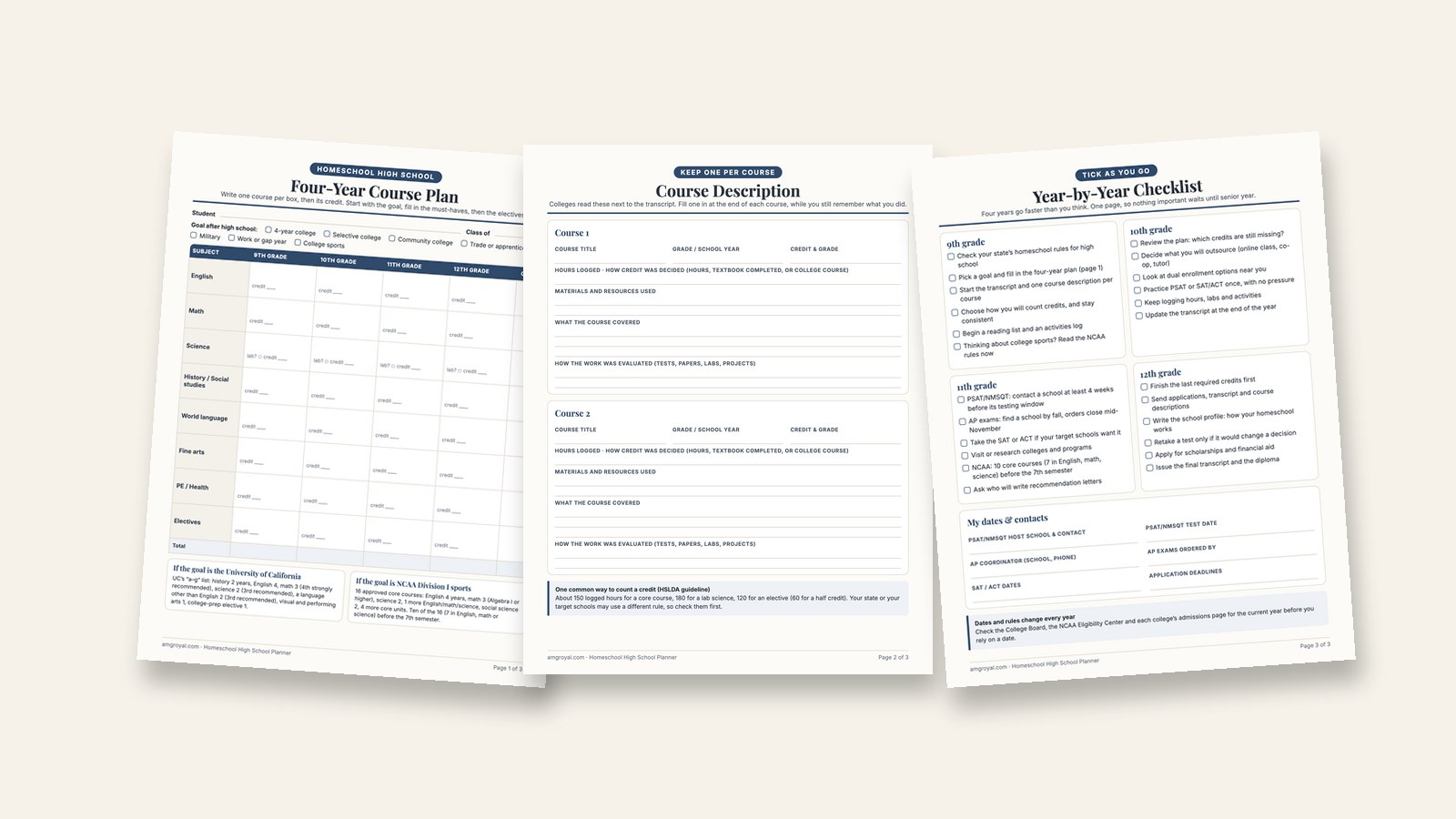
Free printable: a four-year course plan with the UC and NCAA course lists on the page, a course description sheet, and a year-by-year checklist with a box for your test dates. Three pages, no email needed.
Start With the Goal, Then Work Backward
Most planning guides hand you one list of credits. The trouble is that the list depends on where your teen is going. Pick the likeliest goal now (it can change), then let it decide which courses are non-negotiable. Here is what two common targets publish, plus where to look for the rest.
| Goal after high school | What it asks for | Where to confirm |
|---|---|---|
| University of California | History 2 years, English 4, math 3 (a 4th strongly recommended), science 2 (a 3rd recommended), a language other than English 2 (a 3rd recommended), visual and performing arts 1, college-prep elective 1. | UC’s a–g subject requirement page |
| NCAA Division I sports | 16 approved core courses: English 4, math 3 (Algebra I or higher), science 2, 1 more English, math or science, social science 2, 4 more core units. Minimum 2.3 core GPA. | NCAA Eligibility Center |
| Another 4-year college | Its own course list, which may differ from UC’s. Look for a homeschool section describing the transcript and tests it wants. | Each college’s admissions page |
| Community college, trade or military | Varies by program. Ask which records and placement tests they require before 11th grade. | The program or recruiter you are aiming for |
One detail matters for every homeschool family. UC’s page for home-schooled students says that families using an accredited or state-approved curriculum with an official transcript follow the normal requirements, while students without one “may still be considered for admission by exception.” In other words, an independent homeschool is not shut out, but its records have to speak for it. That is why the course description sheet in the printable exists.
If college sports are even a possibility, read the NCAA Division I requirements in 9th grade. The rule that catches families late is timing: ten of the sixteen core courses, seven of them in English, math or science, must be finished before the seventh semester.
How a High School Credit Works at Home
At home, you are the one who decides when a course is worth a credit. That sounds loose, but it becomes solid the moment you pick a rule and apply it the same way every time. HSLDA describes three common methods:
| Method | How it works | Good for |
|---|---|---|
| Finish the textbook | A full-year text is 1.0 credit, a one-semester text 0.5. HSLDA suggests completing at least 75 to 80 percent of the assignments. | Math, language and any course with a structured book |
| Log the hours | At least 150 hours for a core course, 180 for a lab science, 120 for an elective (60 for a half credit). | Literature, history, electives, self-designed courses |
| Convert a college course | A 3- to 5-credit college course taken in one term becomes a 1.0 high school credit. | Dual enrollment and online college classes |
Honors and AP work take more time, but HSLDA notes they do not earn extra credit hours; some families show them with a weighted GPA instead. Whatever you choose, write the method on each course description. An admissions reader does not need your method to match theirs, only to be clear and consistent.
Your state may define a credit for you, or set graduation requirements of its own. Check the HSLDA state law summaries or your state’s education department before you finalize the plan.
A Typical Four-Year Course Map
Once the goal is set, most college-bound plans look surprisingly alike. The table below uses the UC and NCAA lists as anchors, so you can see where the numbers come from instead of trusting a round total.
| Subject | Years most plans aim for | Notes |
|---|---|---|
| English | 4 | Literature and writing every year. Both UC and the NCAA ask for four. |
| Math | 3 to 4 | Algebra I and above. UC strongly recommends a fourth year. |
| Science | 2 to 3, with labs | UC asks for two and recommends three. Log lab hours as you go. |
| History / social studies | 2 to 3 | UC asks for two years of history; the NCAA, two of social science. |
| World language | 2 to 3 | Two years of the same language, a third recommended by UC. |
| Fine arts | 1 | One full-year course: art, music, theater or dance. |
| PE, health and electives | Varies | Set by your state and your teen’s interests. |
Totals vary more than the core. Guides from Outschool and HomeschoolFox suggest roughly 22 to 28 credits over four years. Treat that as a sanity check, not a rule, and let your state and your target schools have the final word.
Three Sample Four-Year Plans
These are examples, not requirements. They show how the same core spreads across four years for three different teens. Swap any course for the one your student actually takes.
1. College-prep plan (UC-style)
| Year | Core courses | Electives and outside classes |
|---|---|---|
| 9th | English 9, Algebra I, Biology with lab, World History, Spanish I | Art I, PE |
| 10th | English 10, Geometry, Chemistry with lab, U.S. History, Spanish II | Music or theater, health |
| 11th | American Literature, Algebra II, Physics with lab, Government and Economics, Spanish III | Dual enrollment: one college writing course |
| 12th | British or World Literature, Precalculus or Statistics, an advanced science | Senior project, a second college course |
2. Flexible plan (community college start)
| Year | Core courses | Electives and outside classes |
|---|---|---|
| 9th | English 9, Algebra I, Physical Science, World History | Keyboarding, PE |
| 10th | English 10, Geometry, Biology with lab, U.S. History | Personal finance, a language I |
| 11th | English 11, Algebra II, a second lab science, Government | Language II, part-time job logged as work experience |
| 12th | English 12, Consumer Math or Statistics, Economics | Dual enrollment in the program your teen plans to finish |
3. Career and trade plan
| Year | Core courses | Electives and outside classes |
|---|---|---|
| 9th | English 9, Algebra I, Physical Science, World History | Shop or drafting, PE |
| 10th | English 10, Geometry, Biology with lab, U.S. History | Intro to the chosen trade, first-aid course |
| 11th | Technical writing, Algebra II or applied math, Government | Apprenticeship hours or a career-tech class |
| 12th | English 12, Personal finance, Economics | Certification course, internship log |
Notice that all three keep four years of English and at least three of math. That one habit keeps doors open if the goal changes in 11th grade, which happens more often than anyone plans for.
Grade by Grade: What to Do Each Year
9th grade: set the system
Choose the goal, fill in the four-year plan and start the transcript in the first month, not the last. Decide how you will count credits and keep a course description for every class. Start a reading list and an activities log now; rebuilding three years of them in 12th grade is miserable. If sports are in the picture, read the NCAA rules this year.
10th grade: check the gaps
Hold the plan next to the goal and look for what is missing: a lab science, a second year of the same language, the next math course. This is the right year to decide what you will outsource and to look at dual enrollment near you. A practice PSAT, SAT or ACT, with no pressure, shows where your teen stands.
11th grade: the testing year
Junior year carries the deadlines. For the PSAT/NMSQT, the College Board treats homeschoolers as “away students” who must contact a participating school or district at least four weeks before its testing window. For AP exams, you find an authorized school and its coordinator orders your exam; the order deadline is mid-November. Add the SAT or ACT if your target schools want it, and start asking who will write recommendation letters.
12th grade: finish and send
Finish the last required credits first, then the fun electives. Send applications with the transcript, the course descriptions and a short school profile explaining how your homeschool works. Retake a test only if a better score would change a decision. At the end of the year, issue the final transcript and the diploma.
Choosing Curriculum for Each Subject
High school is where most parents stop teaching everything themselves, and that is normal. The best homeschool high school curriculum is often a mix: for each course, decide who leads it before you decide which book to buy.
| Who teaches | Best for | Watch for |
|---|---|---|
| You, with a textbook | English, history, electives you enjoy | Grading time for essays and tests |
| Video or online course | Math and science you no longer feel sure about | Whether a real person checks the work |
| Live online class or co-op | Languages, labs, discussion-heavy courses | Schedules, fees and the teacher’s grading |
| Dual enrollment | Advanced or career courses in 11th and 12th | Pace, transfer rules and how it shows on the transcript |
For subject-by-subject choices, our guides cover the details: the homeschool math curriculum comparison explains mastery versus spiral programs through Algebra II and beyond, and the homeschool science curriculum guide shows how to log lab hours properly. If you want non-religious materials, start with the secular homeschool curriculum swap table.
What to Outsource, and When
Outsourcing is not giving up. It is how one parent covers chemistry, calculus and a second language in the same year. A simple rule: outsource the courses where a mistake costs the most, and keep the ones you teach with joy.
- Lab sciences: a co-op or online class with real labs takes the pressure off logging 180 hours alone.
- Upper math: Precalculus and Calculus are where a video course or tutor pays for itself.
- World language: a live teacher gives your teen someone to speak with, which a book cannot.
- Dual enrollment: per HSLDA, a one-term college course converts to 1.0 high school credit, so one class counts twice.
Records Colleges Will Ask For
A homeschool transcript is only as strong as the paper behind it. Keep these five records as you go, not at the end:
- Transcript: every course with its year, credit and grade, plus a GPA.
- Course descriptions: what was covered, the materials, how work was graded and how the credit was decided. The printable has a ready-made sheet.
- Reading list: titles and authors by year.
- Activities and work log: jobs, volunteering, sports, music, with hours.
- School profile: one page on how your homeschool runs, written in 12th grade.
If you are still choosing a homeschool approach overall, our Homeschooling 101 guide covers the basics, and the homeschool schedule examples include a sample high school day.
Common Planning Mistakes, and How to Fix Them
| Mistake | Why it hurts | Fix |
|---|---|---|
| Planning only one year ahead | A missing math or language year shows up in 12th grade | Fill all four years now, in pencil |
| No rule for credits | The transcript looks improvised | Pick hours, textbook or college course, and write it down |
| Course descriptions written in senior year | Details are forgotten | One sheet at the end of each course |
| Asking for the PSAT or AP too late | Schools are full or orders closed | Contact schools in the summer before |
| Ignoring the NCAA until 12th grade | The 10/7 timing rule cannot be fixed late | Read the rules in 9th grade |
Free Printable: Homeschool High School Planner
The planner is three US Letter pages built for a home printer. Page 1 is the four-year course plan with the UC and NCAA course lists printed right under it. Page 2 is a course description sheet, two courses per page. Page 3 is the 9th to 12th grade checklist, with a box for your PSAT host school, AP coordinator and application deadlines.
Frequently Asked Questions
How many credits does a homeschooled high school student need?
There is no single national number. Your state may set one, and colleges set their own course lists. Popular homeschool guides suggest about 22 to 28 credits over four years. The University of California, for example, lists minimums that add up to 15 years of a–g courses, so start from your state and your target schools, not from a generic total.
How do you count a high school credit at home?
HSLDA describes three ways: finish a full-year textbook (about 75 to 80 percent of the work), log hours, or convert a college course. For logged hours it suggests at least 150 for a core course, 180 for a lab science and 120 for an elective. Pick one method per course and write it on the course description.
Can a homeschooler get into a university without an accredited diploma?
Many do, but check each school. The University of California says students without an accredited curriculum or an official transcript and diploma “may still be considered for admission by exception.” Other colleges have their own homeschool pages, and they usually ask for a transcript, course descriptions and test scores.
When should we start planning homeschool high school?
Ideally the summer before 9th grade. That is when you choose the goal, rough out the four-year plan and start the transcript. Courses taken in 8th grade, such as Algebra I, can sometimes count, but decide that early and record it the same way as every other credit.
How do homeschoolers take the PSAT, SAT or AP exams?
Through a school. The College Board calls homeschooled PSAT/NMSQT takers “away students” who must contact a participating school at least four weeks before its testing window. For AP exams you find an authorized school and its AP coordinator orders your exam, and orders close in mid-November.
What if my teen wants to play college sports?
Look at the NCAA rules in 9th grade, not 12th. Division I asks for 16 approved core courses and a minimum 2.3 core-course GPA, and ten of those courses, seven of them in English, math or science, must be done before the seventh semester.
Your Next Step
Print page 1 tonight, tick the goal and pencil in 9th grade. Every other piece of your homeschool high school curriculum is easier to choose once that one page exists. New to homeschooling altogether? Read how to start homeschooling and what a homeschool day looks like. All of our free planners are on the homeschool printables page.
Planning high school this year? Pin this image to your homeschool board so you can find the planner again.
This article is for general information only. Requirements and dates were read on each organization’s own site in October 2026 and can change every year. Homeschool law is set by each state, so check the rules that apply to you before you finalize your plan.
Sources
- University of California: a–g subject requirements
- University of California: home-schooled students
- NCAA Eligibility Center: Division I initial-eligibility requirements
- HSLDA: 3 ways to determine your teen’s high school course credit
- HSLDA: homeschool laws by state
- College Board: PSAT/NMSQT for homeschooled students
- College Board: how homeschooled students take AP Exams
- Outschool: how to homeschool high school
- HomeschoolFox: how to homeschool high school