
Finding a secular homeschool curriculum is harder than it should be. Most of the best-known programs are faith-based, and the ones that are not often use the word “secular” to mean very different things. One publisher teaches evolution. Another leaves it out and calls itself secular anyway.
This guide goes subject by subject: math, reading, handwriting, writing, history and science. For each one you get the secular options, what each publisher actually says about itself, and where religious content tends to hide. There is also a swap table: if you keep hearing about a popular Christian program, it shows the closest secular match that teaches the same way.
About this guide: every label below comes from the publisher’s own website, checked in October 2026, and every one is linked in the sources. No publisher paid to be here and there are no affiliate links. Prices change often, so this guide compares how programs teach, not what they cost. Check current pricing on each publisher’s site.
Key Takeaways
- “Secular” and “neutral” are not the same. Secular teaches evolution and religions as history. Neutral leaves both out.
- Religion hides in different places in each subject: word problems in math, copywork in handwriting, the timeline in history, the origins chapter in science.
- Math and phonics are low risk. History and science are where your vetting time pays off.
- Mixing publishers is normal. Most secular families end up with one program per subject.
- A label is a claim, not a test. Open a free sample before you buy, every time.
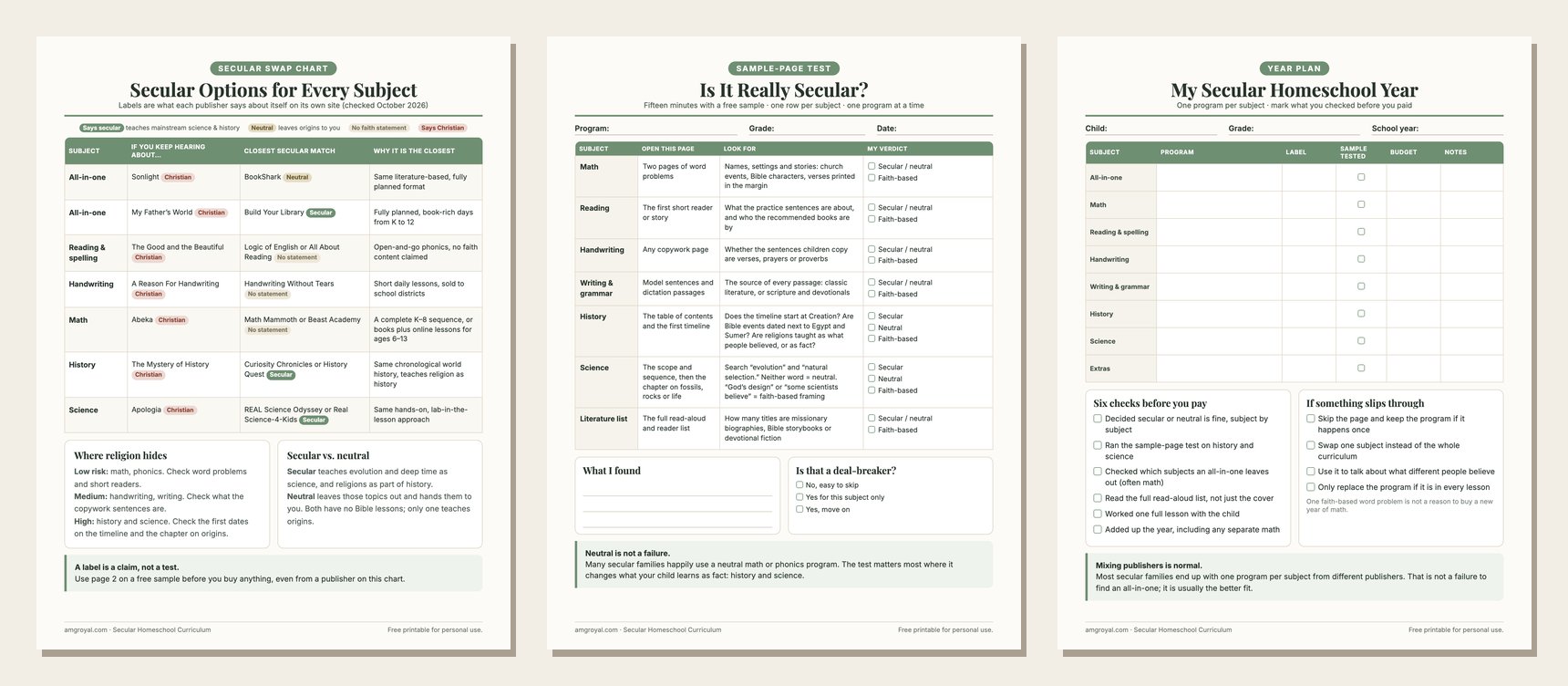
Free printable: a one-page secular swap chart, a sample-page test you can run on any program in fifteen minutes, and a year plan with one line per subject. Three pages, no email needed.
Secular, Neutral or Faith-Based: Read the Label Behind the Label
Every publisher in this guide falls into one of four groups, based only on what it says about itself. We did not guess from a logo or a review.
| What the publisher says | What it means for you | Examples in this guide |
|---|---|---|
| Says secular and teaches evidence | Mainstream science, including evolution. Religions taught as part of history. | Oak Meadow, Build Your Library, Torchlight, Pandia Press, Curiosity Chronicles |
| Says secular, leaves origins to you | No faith content, but evolution and the origins of life are left for you to teach. | BookShark |
| No faith statement either way | Usually a subject where faith rarely comes up. Check a sample anyway. | Math Mammoth, Beast Academy, Logic of English, All About Reading, Handwriting Without Tears |
| Says Christian | Faith is part of the lessons, sometimes in every subject. | Sonlight, My Father’s World, The Good and the Beautiful, Abeka, A Reason For, Apologia |
The second row is the one that catches people. BookShark’s own secular page says it “does not espouse or oppose any faith” and suits families “who prefer that parents teach the origins of life and matters of spirituality.” That is an honest description, and a good fit for many families. It is also neutral science, not secular science. If you want evolution taught, you will add it yourself.
Where Religion Hides, Subject by Subject
Faith content is not spread evenly. In some subjects it almost never appears. In others it shapes what your child learns as fact. Spend your checking time where the risk is.
| Subject | Where to look | Risk |
|---|---|---|
| Math | Word problems and margin notes | Low |
| Phonics and reading | Practice sentences and the first short readers | Low |
| Handwriting | The sentences children copy | Medium |
| Writing and grammar | Model sentences and dictation passages | Medium |
| Literature | The full read-aloud list | Medium |
| History | The first timeline and the table of contents | High |
| Science | The chapter on fossils, rocks or the origins of life | High |
Handwriting is the one most families forget to check. A Reason For Handwriting’s own site describes its programs as “Bible-based,” and its reviews mention children writing out Bible verses. That is exactly what its families want. It is also the opposite of what a secular family is looking for, and it only shows up on the copywork page.
History is the highest-stakes subject. The Mystery of History says it “integrates sacred and secular history on one continuous timeline—to reveal God’s sovereign hand in history.” A secular history program, by contrast, teaches what people in each era believed, without telling your child which belief is true.
The 15-Minute Sample-Page Test
Almost every publisher offers a free sample. Before you buy anything, open it and go straight to the pages below. This works on any program, including the ones in this guide.
- Math: read two full pages of word problems. Look at the names, the settings and any notes printed in the margin.
- Reading: read the first short reader or story. Look at what the practice sentences are about.
- Handwriting: open any copywork page. Are children copying verses, prayers, or ordinary sentences?
- Writing and grammar: check where the model passages come from: classic literature, or scripture and devotionals.
- History: find the first timeline. Does it start at Creation? Are Bible events dated next to Egypt and Sumer? Are religions taught as what people believed, or as fact?
- Science: search the scope and sequence for “evolution” and “natural selection.” If neither appears, the program is neutral. Phrases like “God’s design” or “some scientists believe” signal faith-based framing.
Page 2 of the free printable turns this into a worksheet, with a verdict box for each subject. Run it on one program at a time.
Secular Swaps: If You Keep Hearing About…
Homeschool groups, co-ops and social media are full of recommendations for a handful of faith-based programs. If one keeps coming up, this table shows the closest secular match, one that teaches the same way, so you keep the method you liked and lose the parts you did not want.
| Faith-based program | Closest secular match | Why it is the closest |
|---|---|---|
| Sonlight All-in-one | BookShark | Same literature-based, fully planned format, without the Bible strand Sonlight packages with history |
| My Father’s World All-in-one | Build Your Library | Fully planned, book-rich days from K to 12 |
| The Good and the Beautiful Language arts | Logic of English or All About Reading | Open-and-go phonics and spelling, no faith content claimed |
| A Reason For Handwriting | Handwriting Without Tears | Short daily lessons, used by school districts and occupational therapists |
| Abeka Math | Math Mammoth or Beast Academy | A complete K–8 sequence, or books plus online lessons for ages 6–13 |
| The Mystery of History | Curiosity Chronicles or History Quest | Same world history told in order, with religion taught as history |
| Apologia Science | REAL Science Odyssey or Real Science-4-Kids | Same hands-on approach, with an experiment built into the lessons |
Secular All-in-One Programs
An all-in-one program plans most of your day from one box. That is a relief in year one. Just check which subjects are actually inside, because math is often sold separately.
Oak Meadow
Oak Meadow covers PreK through 12th grade and states plainly that “our curriculum is secular and joyful.” The approach is experiential and creative, with a gentle start to letters and numbers in the early grades. It also runs an accredited distance-learning school, where students earn official credit with support from a teacher. Suits a family that wants one secular publisher from kindergarten to graduation. Less good for a family that wants a heavily scripted, workbook-style day.
Build Your Library
Build Your Library calls itself a “secular homeschool curriculum” for kindergarten through 12th grade. It is Charlotte Mason inspired and literature-based, with narration, copywork, dictation and memory work, plus art study tied to the history period. The subjects it lists are history, literature, science and language arts. Plan on a separate math program. Suits a family that loves reading aloud together.
Torchlight
Torchlight says it takes “a distinctively secular approach with Humanist underpinnings.” It runs from Pre-K through Level 5, with separate literature studies for older children. Lessons mix hands-on activities, games and discussion, and the parent guides by asking questions rather than handing out answers. Suits a family that wants secular values stated openly, not just religion left out. Less good past the elementary years, where it stops.
BookShark
BookShark is fully planned and literature-based. Its site says students read roughly 50 books a year, and it sells packages for all subjects or for science, history, math and language arts separately. As covered above, it leaves the origins of life to parents, so pair it with a secular science program if that matters to you. Suits a family that wants Sonlight’s style without the Bible. Less good if you want evolution taught directly.
Time4Learning
Time4Learning is an online program for preschool through 12th grade, built from videos, activities and quizzes. It is often listed as secular. We could not find a live statement about faith on its site in October 2026, so run the sample-page test on its science and social studies before you commit. Suits a parent who needs the child to work on screen while they work too.
Secular Options for Each Subject
Building your own year from different publishers is the most common secular path, and often the best fit. Here are the options we verified for each subject.
Math
Math Mammoth’s Light Blue series is a complete mastery-based curriculum for grades K–8, with word problems in nearly every lesson and very little teacher prep. Beast Academy offers math books and online lessons for ages 6–13, from the team behind Art of Problem Solving. Neither publisher makes a faith statement, and math is the lowest-risk subject anyway. For ten programs compared in depth, see our homeschool math curriculum guide.
Reading, phonics and spelling
Logic of English offers Foundations, which covers phonics, spelling, vocabulary, grammar and handwriting for ages 4–7, and Essentials for ages 8 and up. All About Reading is scripted and multisensory, based on Orton-Gillingham, with a pre-reading program plus four levels. Its companion, All About Spelling, runs seven levels. Neither makes a faith statement. Read the first short reader before you buy, as the test above suggests.
Handwriting
Handwriting Without Tears, from Learning Without Tears, was started by an occupational therapist and is sold to school districts for Pre-K to grade 5. Logic of English’s Rhythm of Handwriting covers cursive or print. For extra practice with your child’s own name or word list, our free name tracing worksheet generator lets you choose every word on the page.
Writing and grammar
Logic of English Essentials includes grammar, and Build Your Library builds writing through narration, copywork and dictation. Whatever you choose, run the copywork check: the model sentences are where faith content most often slips into an otherwise neutral program.
History
Curiosity Chronicles calls itself “a truly secular history curriculum” and says “we teach the role of religion in history, but do not teach (or preach) from a religious worldview.” It covers Ancient History (grades 1–6), Medieval (2–7), Early Modern (3–8) and Modern (5–10), from a global, non-Eurocentric point of view. Pandia Press publishes History Quest (Early Times, Middle Times and United States) and History Odyssey, and describes its books as “Secular & Facts-Based.”
Science
Science is where secular and neutral differ most. REAL Science Odyssey (Pandia Press), Real Science-4-Kids and Mystery Science are all secular, with real hands-on work built in. Our homeschool science curriculum guide compares ten programs by how much hands-on work actually happens, and explains the high school lab-hour rule.
How to Build a Secular Year Without Buying Twice
Six steps, in this order. They take one evening.
- Decide, subject by subject, whether neutral is good enough. For most families it is for math and phonics, and it is not for science and history.
- Choose all-in-one or mix-and-match. If all-in-one, list which subjects are missing from the box. Math usually is.
- Run the sample-page test on history and science first. Those two decide the whole year.
- Read the full read-aloud list, not just the cover of the box.
- Work one full lesson with your child before you buy a full year.
- Add up the whole year, including any separate math or science you are adding.
Once you have your programs, our homeschool schedule examples show how families fit them into a real day at every grade.
Signs It Is Not as Secular as Promised
Sometimes faith content shows up after you have already bought the program. Here is what it looks like and what to do before you replace anything.
| What you see | What it means | Try this first |
|---|---|---|
| “God’s design” in a science chapter | Faith-based framing of science | Swap science only. Keep the rest. |
| “Some scientists believe” about evolution | Evolution presented as one opinion | Add a secular science program alongside. |
| Bible verses as copywork | Faith content in handwriting | Replace copywork with your own sentences. |
| Timeline starts at Creation | Faith-based history | Switch history. This one is hard to patch. |
| Missionary biographies on the reading list | Faith-leaning literature | Swap those titles for others from the same era. |
| One church event in a word problem | A single faith-based example | Skip the page. Not a reason to switch. |
The last row matters. One example is not a pattern. Only replace a program when the content is in the lessons themselves, not on one page.
Secular Homeschool Curriculum FAQ
What is the difference between a secular and a neutral homeschool curriculum?
A secular curriculum teaches mainstream science, including evolution and the age of the earth, and teaches religions as part of history. A neutral one simply leaves those topics out and hands them back to you. Neither includes Bible lessons. The difference only really shows up in science and history.
Is there a secular all-in-one homeschool curriculum?
Yes. Oak Meadow (PreK to 12), Build Your Library (K to 12) and Torchlight (Pre-K to Level 5) all describe themselves as secular on their own sites. BookShark also uses the word secular, but says it leaves the origins of life to parents, which makes it neutral in practice. Check which subjects each one includes, because math is often bought separately.
Is BookShark secular or neutral?
Both words fit, depending on the subject. BookShark’s own page says it “does not espouse or oppose any faith” and is for families “who prefer that parents teach the origins of life and matters of spirituality.” That is secular history and neutral science. If you want evolution taught directly, add a secular science program alongside it.
Can religious families use a secular homeschool curriculum?
Many do. Some want to teach faith separately from academics, and some find that faith-based programs weave in a doctrine that is not their own. A secular or neutral program leaves room for whatever you teach at home, on your own schedule.
Is there secular homeschool curriculum for high school?
Fewer options exist than for the elementary years. Oak Meadow covers grades 9 to 12 and also runs an accredited distance school with teacher support. Curiosity Chronicles’ Modern History reaches 10th grade. For science, check the real lab-hour rule in our homeschool science curriculum guide before you pick anything.
Do I need a secular math curriculum?
Math is the lowest-risk subject. The only place faith content usually appears is in word problems or margin notes. Open two pages of word problems in a free sample. If they are about shopping, sports and baking, the program is fine for a secular family whatever its publisher believes.
The Bottom Line
The best secular homeschool curriculum is usually not one box. It is a mix: a neutral math and phonics program you like, and a truly secular history and science program you have checked yourself. Read the label behind the label, test a sample in the subjects where religion hides, and keep the method you liked when you swap. New to homeschooling? Start with Homeschooling 101, then how to start homeschooling and what a homeschool day looks like. All of our free planners and tools are on the homeschool printables page.
Planning your secular year? Pin this image to your homeschool board so you can find the swap chart again.
This article is for general information only. Labels and program details were taken from each publisher’s own site in October 2026 and can change, so confirm them before you buy. Homeschool requirements also differ by state, so check the rules that apply to you.
Sources
- BookShark: Secular Homeschool Curriculum Packages
- Oak Meadow: PreK–12 curriculum and accredited school
- Build Your Library: secular, literature-based K–12 curriculum
- Torchlight Curriculum: secular approach with Humanist underpinnings
- Time4Learning: online preschool through 12th grade
- Math Mammoth: Light Blue series, grades K–8
- Beast Academy: math books and online learning, ages 6–13
- Logic of English: Foundations, Essentials and Rhythm of Handwriting
- All About Learning Press: All About Reading and All About Spelling
- Learning Without Tears: Handwriting Without Tears
- Curiosity Chronicles: secular, global history levels
- Pandia Press: History Quest, History Odyssey and REAL Science Odyssey
- Real Science-4-Kids (Gravitas Publications)
- Mystery Science: K–5 lessons and hands-on labs
- Sonlight: Christian homeschool curriculum
- My Father’s World: Christian curriculum, preschool to 12th grade
- The Good and the Beautiful: homeschooling overview
- A Reason For: Bible-based handwriting and other programs
- Abeka: education from a Christian perspective
- The Mystery of History: integrated sacred and secular history
- Apologia: Exploring Creation science