Choosing a homeschool preschool curriculum is less about academics than about fit. A three- or four-year-old learns mostly through play, picture books, songs and real tasks around the house. What a program really decides is how much planning you do, how much it costs, whether faith is built in, and whether your child spends time on a screen.
Below, ten well-known options are compared side by side, from free apps to boxed kits, with a sample preschool week and a free printable starter pack. We read each publisher’s own page on October 23, 2026; no company paid to be here and none of the links are affiliate links.
Key Takeaways
- Preschool at home can be short: about 20 to 45 minutes of table time a day, plus play and outside time.
- Free options exist: Easy Peasy’s preschool course and the Khan Academy Kids app.
- Gentle, literature-based guides like Blossom and Root, The Peaceful Preschool and Torchlight cost under $50.
- Boxed programs (Sonlight, My Father’s World, Abeka, Timberdoodle) save planning but cost hundreds of dollars.
- Check the faith label in the publisher’s own words and try a free sample before you buy.
Homeschool Preschool Curriculum Compared
Prices are those shown on each publisher’s site that day. They change often, so check the current price.
| Program | Ages, approach, faith and price |
|---|---|
| Sonlight Preschool Package | Ages 3–4. Picture books and Montessori-type activities, 3 days a week. Christian. $466.73 list. |
| My Father’s World Voyage of Discovery | Pre-K for 4s. Hands-on, very low prep. Christian. $370.25 list. |
| Abeka K4 | Age 4. Traditional phonics and numbers, parent-led or video. Christian. Kits from $106.25. |
| Timberdoodle Preschool Kit | Ages 2–4. Games, puzzles and hands-on, with a scheduler. Classic or Nonreligious. From $354.80. |
| The Peaceful Preschool | Ages 2–5. A letter a week, books, baking, crafts and nature. No religious lessons. From $49. |
| Blossom and Root Early Years | Ages 2–4 (Vol. 1), 4–5 (Vol. 2). Charlotte Mason and Waldorf inspired. Secular. $22 PDF. |
| Torchlight Level Pre-K | Ages 4–5. Picture-book inquiry, art and science. Secular. $32 PDF. |
| The Good and the Beautiful Preschool Language Arts | Ages 3 and up. 90 open-and-go letter and number lessons. Faith-based. $48.97 set. |
| Easy Peasy Preschool | Age 4. 180 online lessons with printables. Christian. Free. |
| Khan Academy Kids | Ages 2–8. App with early literacy and math games, no ads. Not religious. Free. |
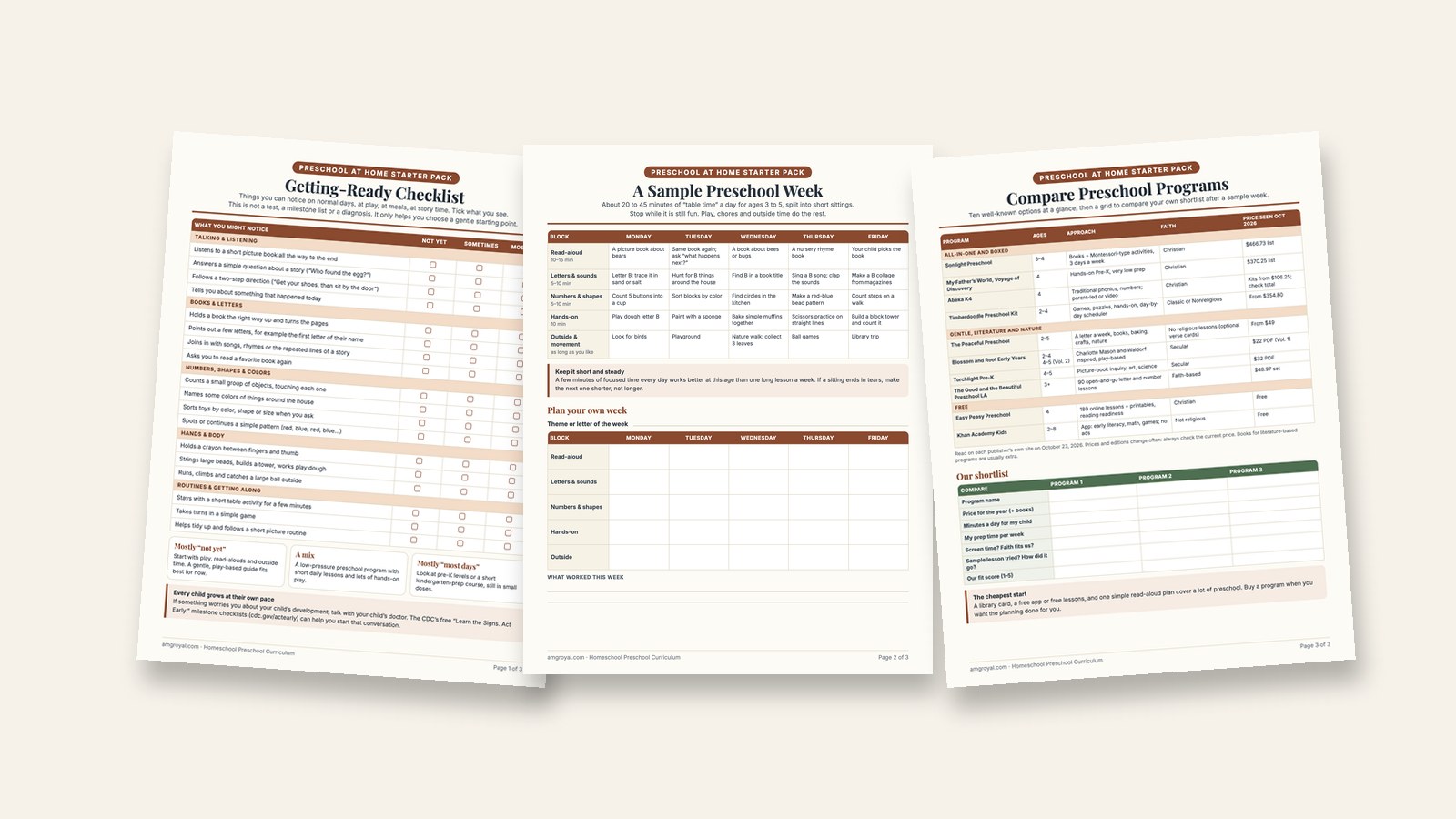
Outside the US? Get the same three pages in A4 size.
Boxed and All-in-One Preschool Programs
These programs hand you a plan for the year and most of the materials. You pay more, and you plan less.
Sonlight: Preschool Package
Sonlight’s preschool package (ages 3 to 4) is built around classic picture books, rhymes and fairy tales, with “hands-on Montessori-type materials and activities” and a Bible storybook. The guide schedules everything three days a week for 30 weeks. It listed at $466.73. Good fit: Christian families who love reading aloud. Think twice: if you want worksheets at this age.
My Father’s World: Voyage of Discovery
Voyage of Discovery is a full-year Christian Pre-K for 4s, with a separate program for 2s and 3s. The publisher promises “almost no preparation needed.” It covers the alphabet, numbers, read-alouds and motor skills; the package listed at $370.25 (on sale for $296.20 that day). Good fit: faith and hands-on activities in one box. Think twice: bought item by item, student sheets are extra.
Abeka: K4
Abeka’s K4 program is the most traditional option here: phonics, early reading, writing and numbers over 170 days, from a Christian perspective. Parent-led kits started at $106.25 for the child kit and $188.40 for the parent kit; video lessons ran $243 to $589. Abeka says the core subjects take less than an hour a day. Good fit: a structured, school-like year. Think twice: more seatwork than play-based programs.
Timberdoodle: Preschool Curriculum Kit
The Timberdoodle kit (ages 2 to 4) teaches phonics, counting, thinking skills and art “through games, puzzles, and hands-on projects rather than worksheets,” with a day-by-day scheduler. Classic and Nonreligious editions share the same materials at this level. Kits started at $354.80; the top tier was $941.48. Good fit: busy hands that learn by doing. Think twice: it is a lot of stuff, so skip freely.
Gentle, Literature and Nature-Based Options
These affordable digital guides are built around picture books, play and the outdoors. Most books can come from the library.
The Peaceful Preschool
The Peaceful Preschool offers 26 weeks of “read-alouds, phonics, baking, crafts, and nature walks,” one letter a week, for ages 2 to 5. The publisher says it has no religious instruction (Bible verse cards are an optional free download). It started at $49. Good fit: a cozy book-and-kitchen rhythm. Think twice: you source the books.
Blossom and Root: Early Years
Early Years Vol. 1 is a strictly secular, Charlotte Mason and Waldorf inspired program for ages 2 to 4: 36 weeks of nature study, art, music, books and early math prompts. The publisher says a week usually takes under half an hour to prepare. The PDF was $22; Vol. 2 covers ages 4 to 5. Good fit: secular, outdoorsy families on a budget. Think twice: digital sales are final.
Torchlight: Level Pre-K
Torchlight Pre-K (ages 4 to 5) uses a weekly picture book to launch art, science, math and feelings lessons, with plans and prep pages for 32 weeks. It calls itself secular “with Humanist underpinnings.” The PDF was $32, plus books. Good fit: curious kids. Think twice: the book list adds cost.
The Good and the Beautiful: Preschool Language Arts
This course set for ages 3 and up has 90 open-and-go lessons on letters, sounds, numbers and fine motor skills, with letter videos. It aims to help children “connect learning to God.” The set was $48.97 (course book PDF $15). Good fit: short, colorful, faith-based lessons. Think twice: it is language arts, not a full program.
Free Preschool Homeschool Curriculum
Looking for a preschool homeschool curriculum free of charge? These two are the most complete. Keep an adult nearby and screen time short.
Easy Peasy: Preschool
Easy Peasy offers a free preschool course of 180 lessons “mainly meant to prepare students as readers,” with counting, shapes, colors and crafts. It is recommended for age 4 and describes itself as a “free online Christian homeschool curriculum.”
Khan Academy Kids
Khan Academy Kids is a free app for ages 2 to 8 from a nonprofit, with early literacy and math games. It is “100% free – forever,” with no ads and no subscriptions.
How to Choose Your Preschool Curriculum
Most regret comes from a mismatch on one of these points, not from a bad program.
| If you want… | Look at |
|---|---|
| Spending nothing | Easy Peasy Preschool, Khan Academy Kids, plus your library |
| Under $50 and secular | Blossom and Root, Torchlight |
| Under $50 with books and crafts | The Peaceful Preschool, The Good and the Beautiful |
| Everything in one box | Sonlight, My Father’s World, Timberdoodle |
| A school-like year | Abeka K4 (parent-led or video) |
| Few or no screens | The Peaceful Preschool, which promises “no screens” |
| Faith built in | Sonlight, My Father’s World, Abeka, Easy Peasy, The Good and the Beautiful |
If faith content matters either way, our guide to secular homeschool curriculum explains where it tends to show up, and our article on homeschool curriculum reviews shows how to test a program for free before you pay.
Before you pick a level, watch your child for a week with page 1 of our starter pack. It is not a test: the CDC notes that its own milestone checklists describe what “most children (75% or more)” do by a given age and are “not a substitute for standardized, validated developmental screening tools.” If something worries you, talk with your child’s doctor.
What Preschool at Home Looks Like: A Sample Week
Play does most of the work at this age. The National Association for the Education of Young Children states that “play is essential for all children, birth through age 8.” A simple week can rest on five short blocks: a read-aloud, letters and sounds, numbers and shapes, something hands-on, and time outside.
| Day | What it can look like |
|---|---|
| Monday | A picture book about bears, trace the letter B in sand, count 5 buttons, play dough. |
| Tuesday | Reread the book, hunt for B things at home, sort blocks by color, sponge painting. |
| Wednesday | A book about bugs, find circles in the kitchen, bake muffins, collect 3 leaves. |
| Thursday | A nursery rhyme book, a B song, a red-blue bead pattern, scissors practice. |
| Friday | Your child picks the book, a B collage, count steps on a walk, a library trip. |
That is about 20 to 45 minutes of table time a day, in short sittings. Stop while it is still fun. Our homeschool schedule examples show how a full day fits around it.
Free Preschool Tools to Use Alongside Any Program
These free tools on our site work in the browser and print as worksheets, so they fit next to any curriculum above:
- Name tracing worksheet maker: type your child’s name and print it in dotted letters.
- Counting and number recognition: count the shapes, then tap the right number.
- Shapes and colors matching: tap the matching shape or color, no reading needed.
- Visual routine chart: a picture-based morning or bedtime routine your child can follow.
- Math facts practice: for later, when your child is ready for simple adding.
All our free planners and tools are on the homeschool printables page.
Free Printable: Preschool at Home Starter Pack
Our free three-page starter pack puts this guide on paper: a getting-ready checklist of everyday skills you can observe (no scores, no diagnosis), a sample week plus a blank one, and the comparison grid of the ten programs with a shortlist table.
Outside the US? Get the same three pages in A4 size.
Frequently Asked Questions
What is the best homeschool preschool curriculum?
There is no single winner. The best homeschool preschool curriculum fits your time, budget and faith choice, and is one you will open most days. Boxed programs save planning; gentle guides like Blossom and Root or The Peaceful Preschool cost far less.
Is there a free preschool homeschool curriculum?
Yes. Easy Peasy All-in-One Homeschool runs a free online preschool course of 180 lessons and describes itself as a Christian curriculum. Khan Academy Kids is a free app for ages 2 to 8 with no ads and no subscriptions. Add a library card and a daily read-aloud and you can do preschool at home for almost nothing.
How long should preschool at home take each day?
Not long. Our sample week plans about 20 to 45 minutes of table time a day, split into short sittings, plus play and outside time. Publishers vary: Blossom and Root suggests about half an hour to an hour a day, and Abeka says its K4 core subjects can be taught in less than an hour.
At what age can I start a preschool curriculum?
Publishers set their own ranges: Blossom and Root Vol. 1 and Timberdoodle say ages 2 to 4, Sonlight says 3 to 4, and most pre-K levels target 4 to 5. Many families simply follow their child’s interest and keep it playful.
What is the difference between preschool and pre-K curriculum?
Most publishers use “preschool” for younger children and “pre-K” for the year before kindergarten. My Father’s World, for example, sells a program for 2s and 3s and a Pre-K for 4s. Trust the age range and samples more than the label.
Do I need to buy a curriculum for preschool at all?
No. Picture books, songs, counting games, play dough and outside time cover a lot. A program mostly saves planning time. Start free for a month if you are unsure.
Your Next Step
Print the starter pack, watch your child for a week, then try a free sample for a month. When your child is ready for the next year, our kindergarten homeschool curriculum guide compares 14 programs the same way. New to homeschooling? Start with homeschooling 101 and how to start homeschooling.
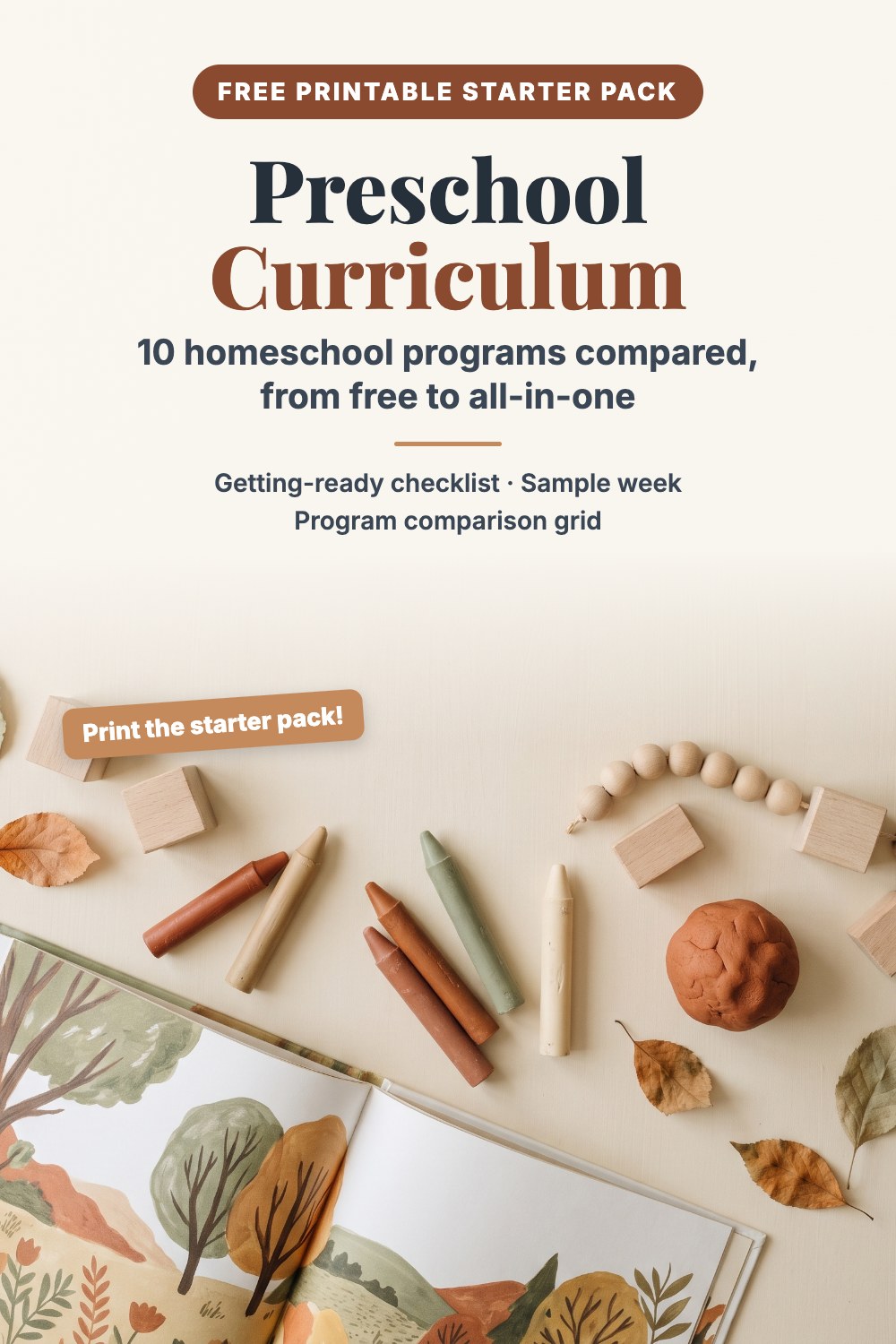
Planning preschool at home this year? Pin this image to your homeschool board so you can find the starter pack again.
This article is for general information only. Program details and prices were read on each publisher’s own site on October 23, 2026 and can change with new editions. It is not medical or developmental advice.
Sources
- Sonlight: Preschool Homeschool Curriculum Package
- My Father’s World: Voyage of Discovery (Pre-K for 4s)
- My Father’s World: Christian preschool overview
- Abeka: K4 curriculum overview
- Timberdoodle: Preschool Curriculum Kit
- The Peaceful Press: The Peaceful Preschool Bundle
- Blossom and Root: Early Years Vol. 1
- Torchlight: Level Pre-K
- The Good and the Beautiful: Preschool Language Arts Course Set
- Easy Peasy All-in-One Homeschool: Preschool
- Khan Academy Kids
- CDC: Learn the Signs. Act Early. Milestones
- NAEYC: Play