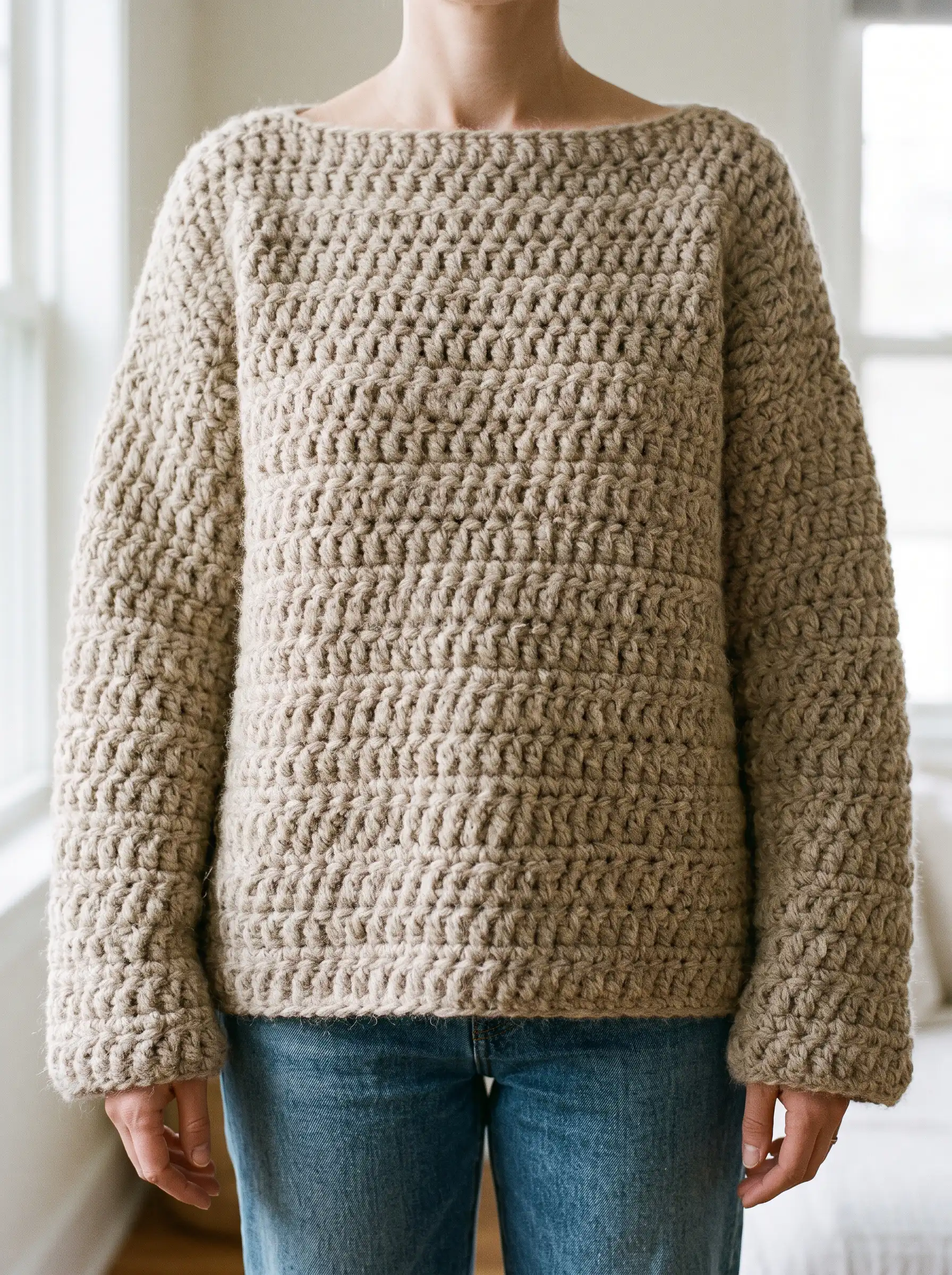
Your sweater will differ: the real fit, drape and texture depend on your yarn, your hook and your tension.
No one has crocheted this pattern. Fit, weight, yarn amount and time are estimates. Buy 1 or 2 skeins, make the swatch, then buy the rest.
Advanced beginner to intermediate pattern · sizes S to 2X · bulky (#5) yarn, US L-11 hook. A winter sweater for yourself or as a gift.
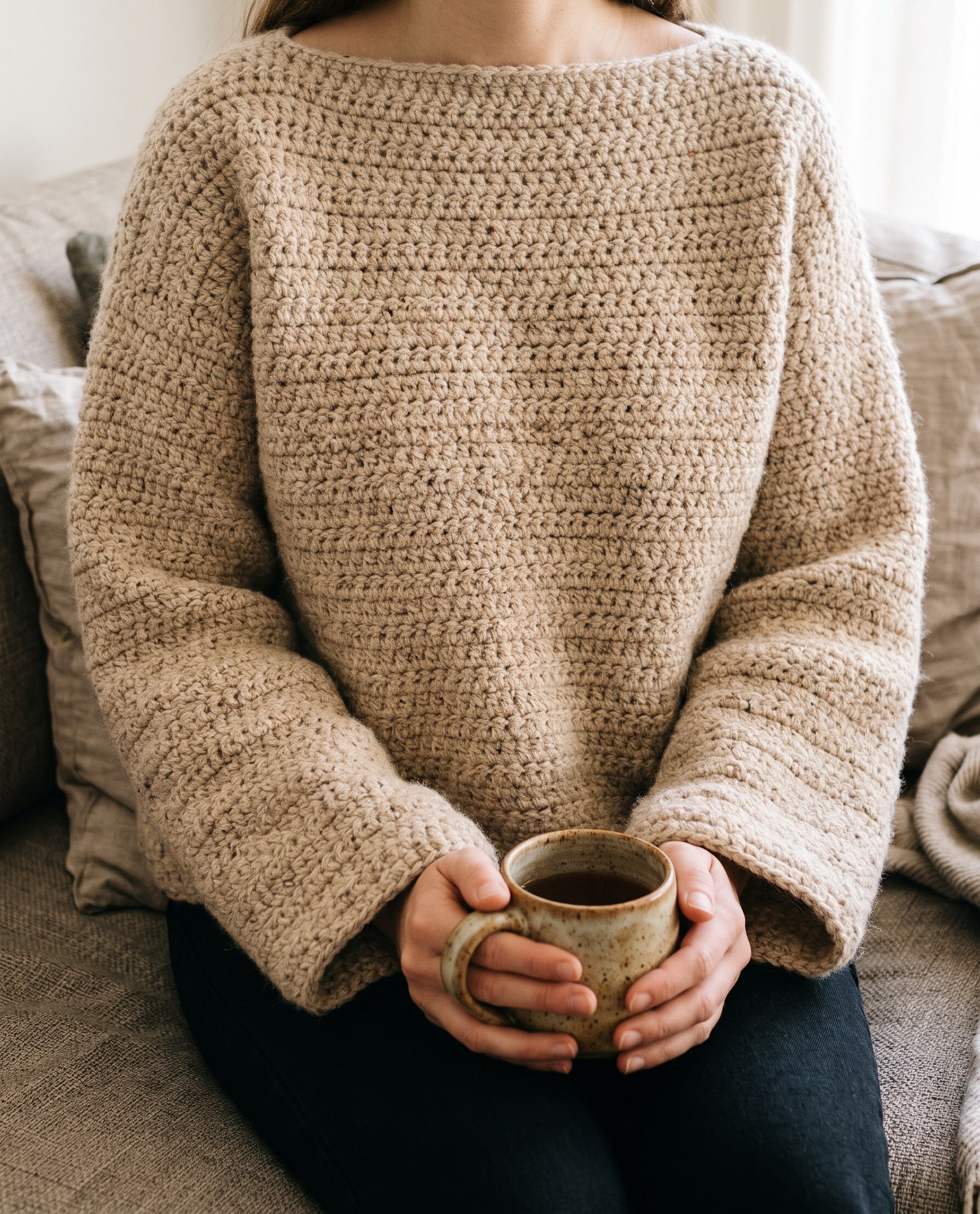
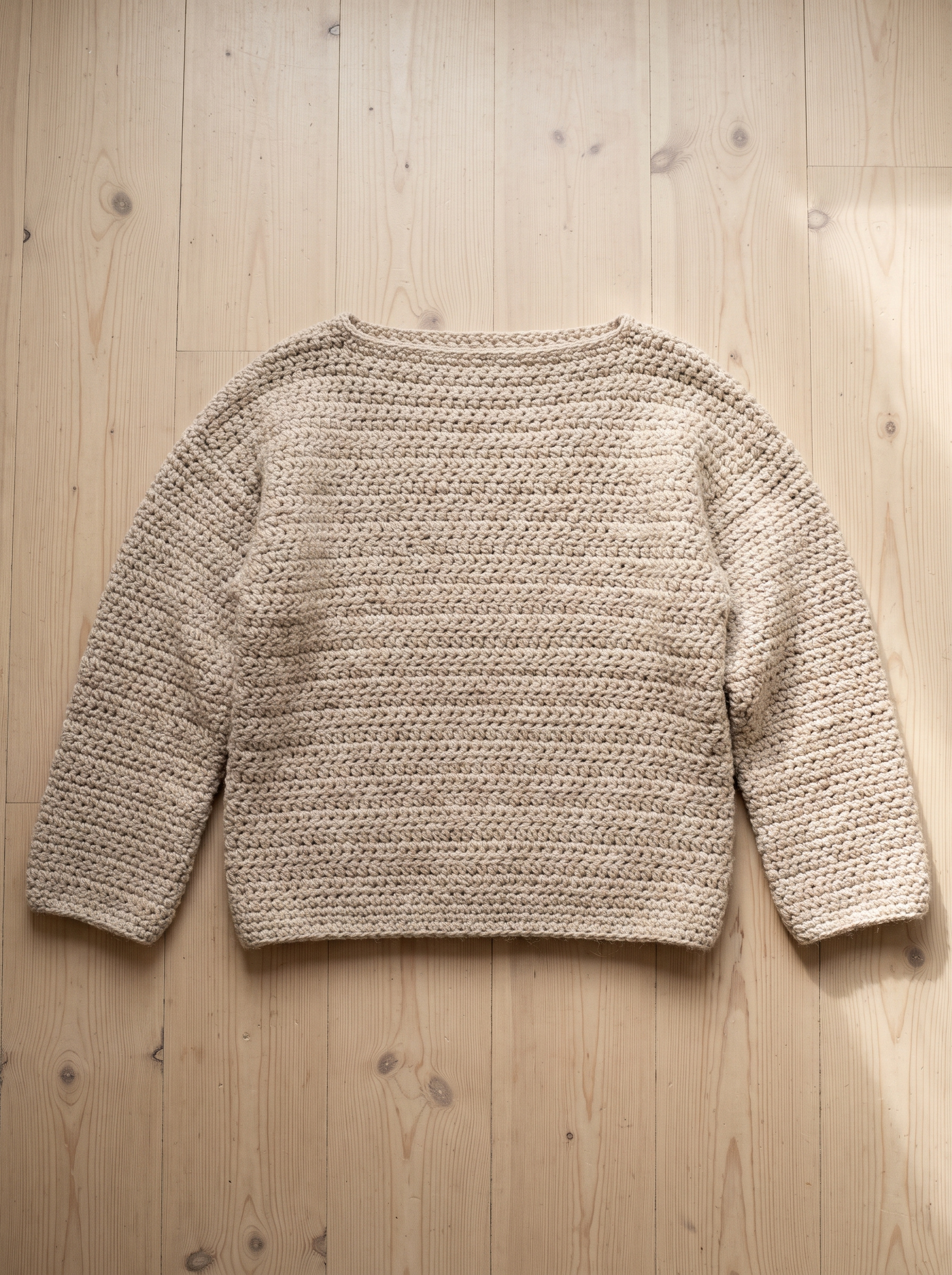
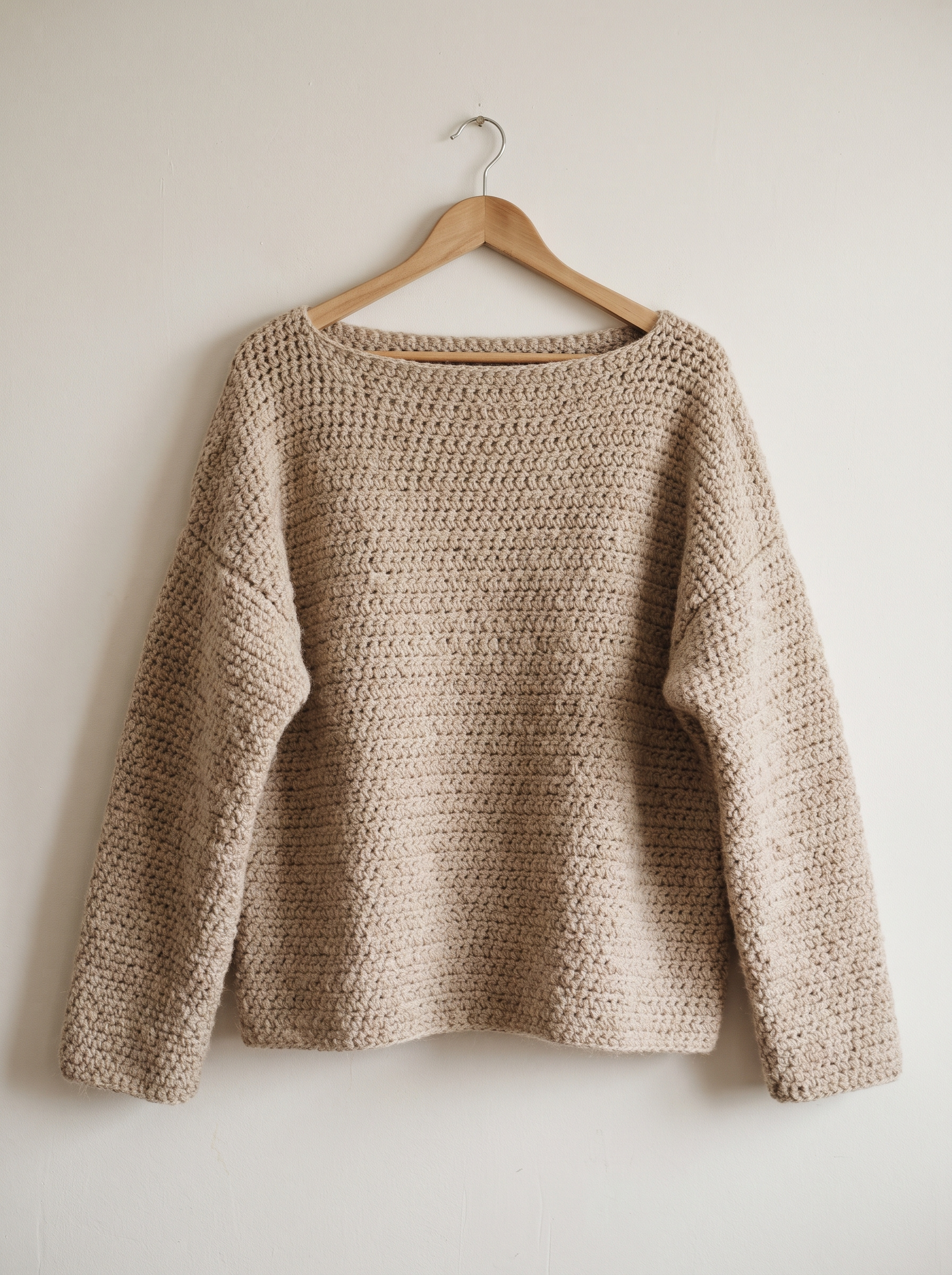
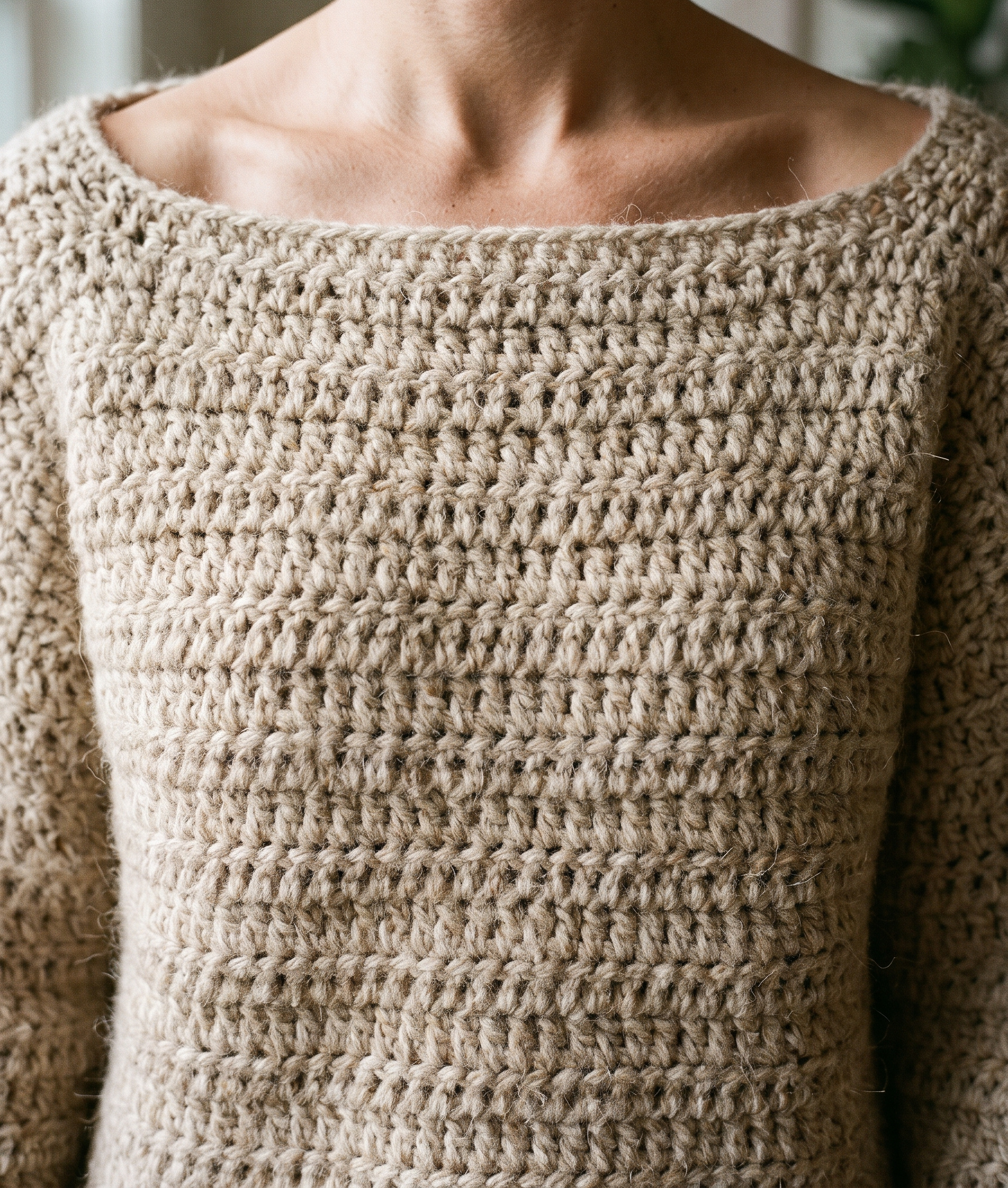
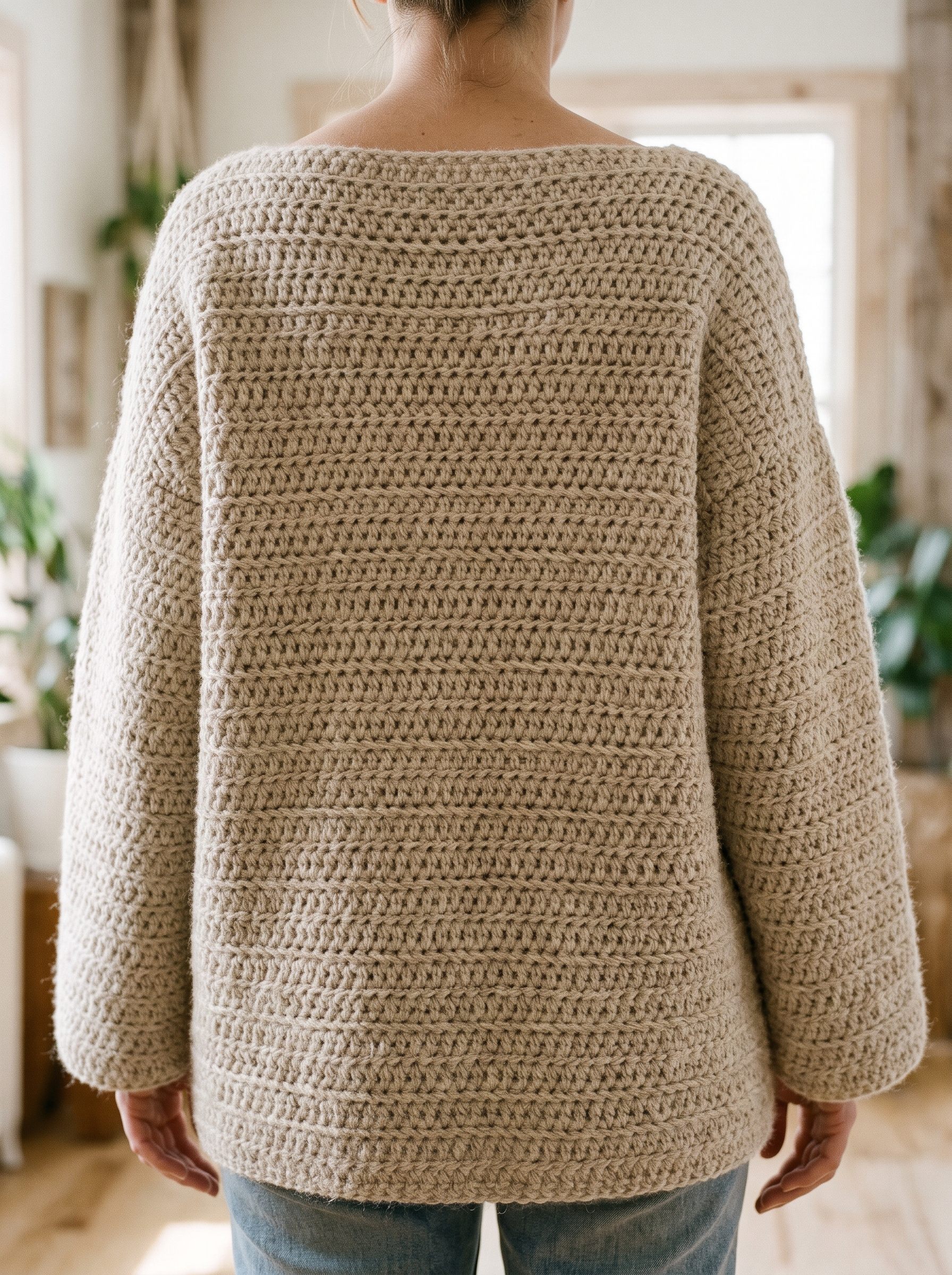
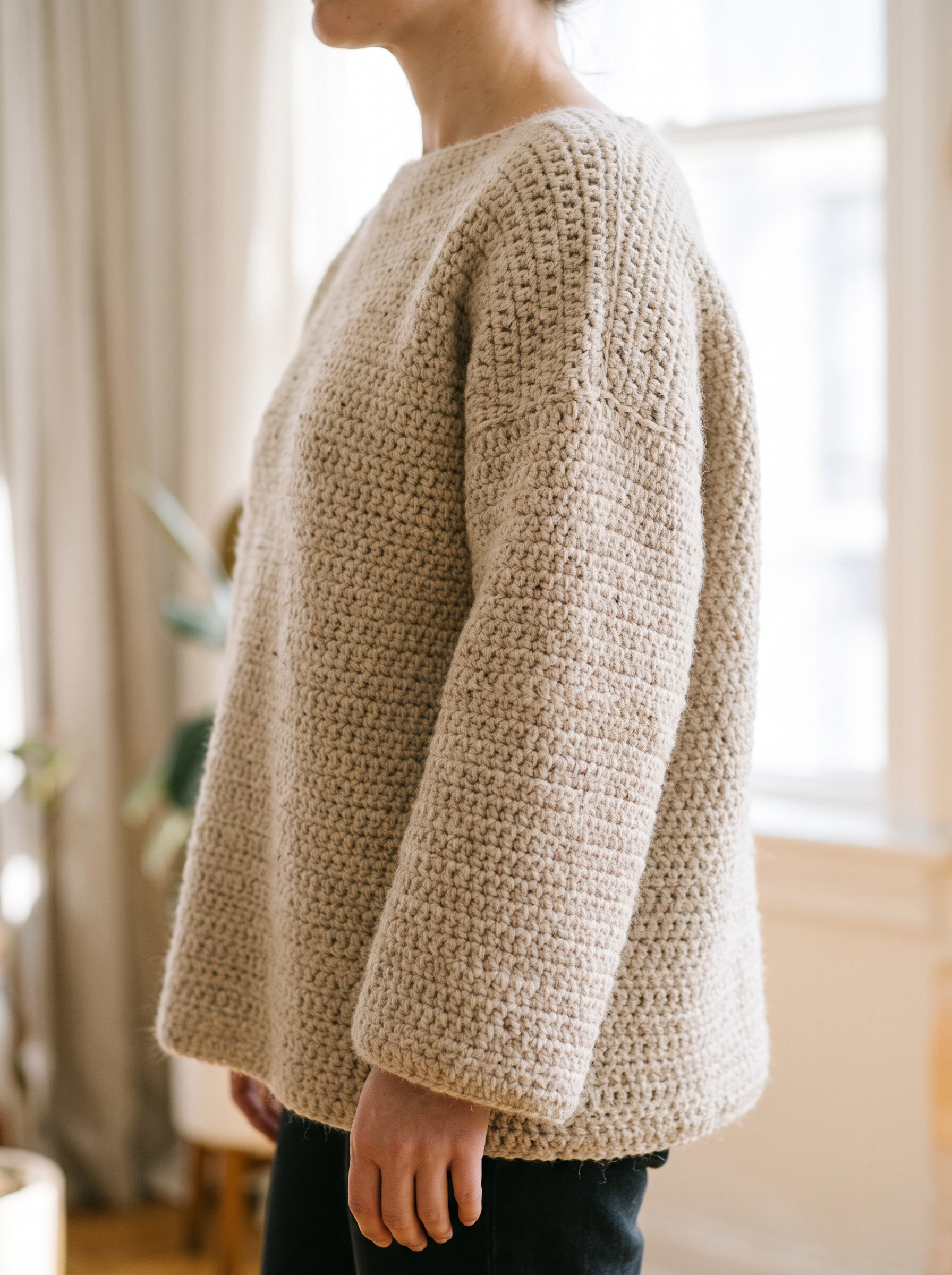
This chunky crochet sweater is made of four rectangles: a front, a back and two sleeves. They are all worked in half double crochet (hdc), in one color, so there is no shaping to count and no color chart. It has a wide boat neck, a straight hem and drop shoulders. It is very roomy: the shoulder seam sits low on your upper arm, the body is loose and the sleeves are wide, also at the cuff.
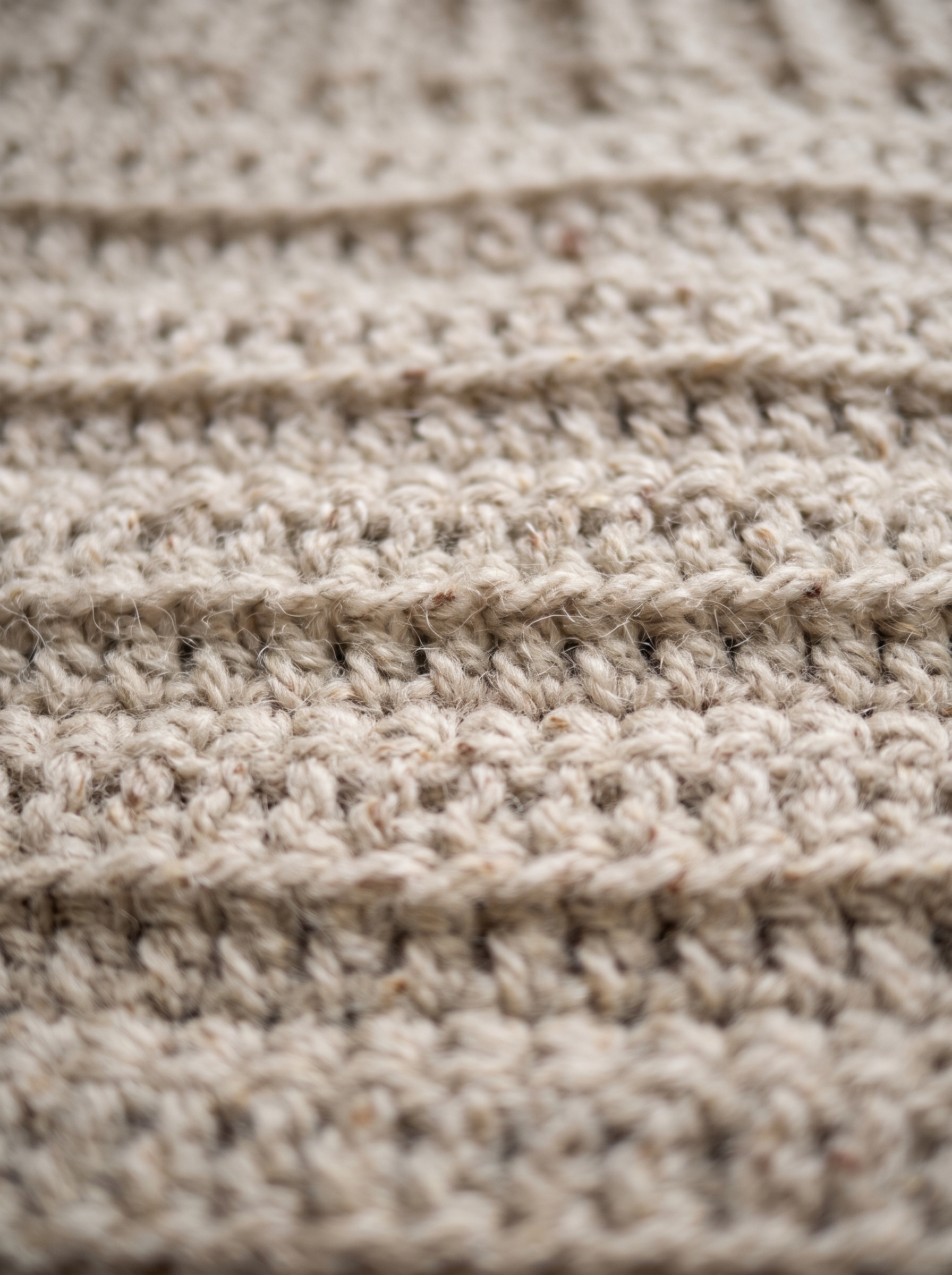
We chose hdc because it makes a dense fabric with few gaps that should hold its shape, and the V on top of every stitch gives you a clear place to sew (our design choice, not a test result). We chose bulky (#5) yarn and a US L-11 (8 mm) hook so the fabric stays soft and bends; a super bulky (#6) yarn with a bigger hook would make a heavier, stiffer sweater and a cuff that is hard to fold (our design choice, not a test result).
Counts were checked by software. This pattern has not been crocheted and swatched by a person before publication. Sizes, yarn and time are estimates from a suggested gauge: make a swatch and adjust.
Time: About 24 to 27 hours (S) to 34 to 37 hours (2X), estimated, not timed. Not a first project. At 5 hours a week that is about 5 to 5.5 weeks for S and 7 to 7.5 weeks for 2X. These times are calculated, not timed by a person: the crochet and the swatch at 6 hdc a minute, plus 4 to 6 hours for weaving in ends, blocking, pinning and seaming. Many people crochet 4 hdc a minute: add about 50 % to the crochet part (about 10 hours in S). Compared with our Christmas sweater, with the same method for both (crochet at 6 hdc a minute, plus 4 to 6 hours of finishing): in S this sweater has 7200 stitches against 11632 (38 % fewer), so about 24 to 27 hours against about 38 to 41 hours. Colorwork is probably slower, but we did not time either. These are calculated times, not measured. We do not promise it will be done by any date.
- Level
- Advanced beginner to intermediate: hdc in rows and seaming of heavy pieces. Not a first project
- Time
- About 24 to 27 hours (S) to 34 to 37 hours (2X), estimated, not timed. Not a first project
- Finished size
- Chest 44 in (S) to 60 in (2X), boxy fit with about 10 to 11 in of ease over the largest bust of each range (approximate). Ease = room added over your bust. This sweater adds about 10 to 11 in over the largest bust of each range: it is very roomy, with a low shoulder seam, a loose body and wide sleeves. Measure your bust at the fullest part. Between sizes, size down.
- Yarn
- Bulky weight (#5), one color: about 1070 yd (S) to 1600 yd (2X). Skeins = yards / yards per skein, rounded up, plus 1. Example (S, 1070 yd): 100-yd skeins = 11 + 1; 150-yd skeins = 8 + 1. Check the label for yards, not grams. Use soft acrylic or wool-blend #5 yarn. Cotton and linen are much heavier and will stretch. We have not tried any yarn.
- Hook
- US L-11 (8 mm)
- Gauge
- Gauge swatch is required, not optional. Suggested only, not swatched: 10 hdc and 7 rows = 4 in (10 cm) in hdc with a US L-11 (8 mm) hook and bulky (#5) yarn. Your rows and stitches may be fewer or more than we show: measure your swatch and adjust.
- Construction
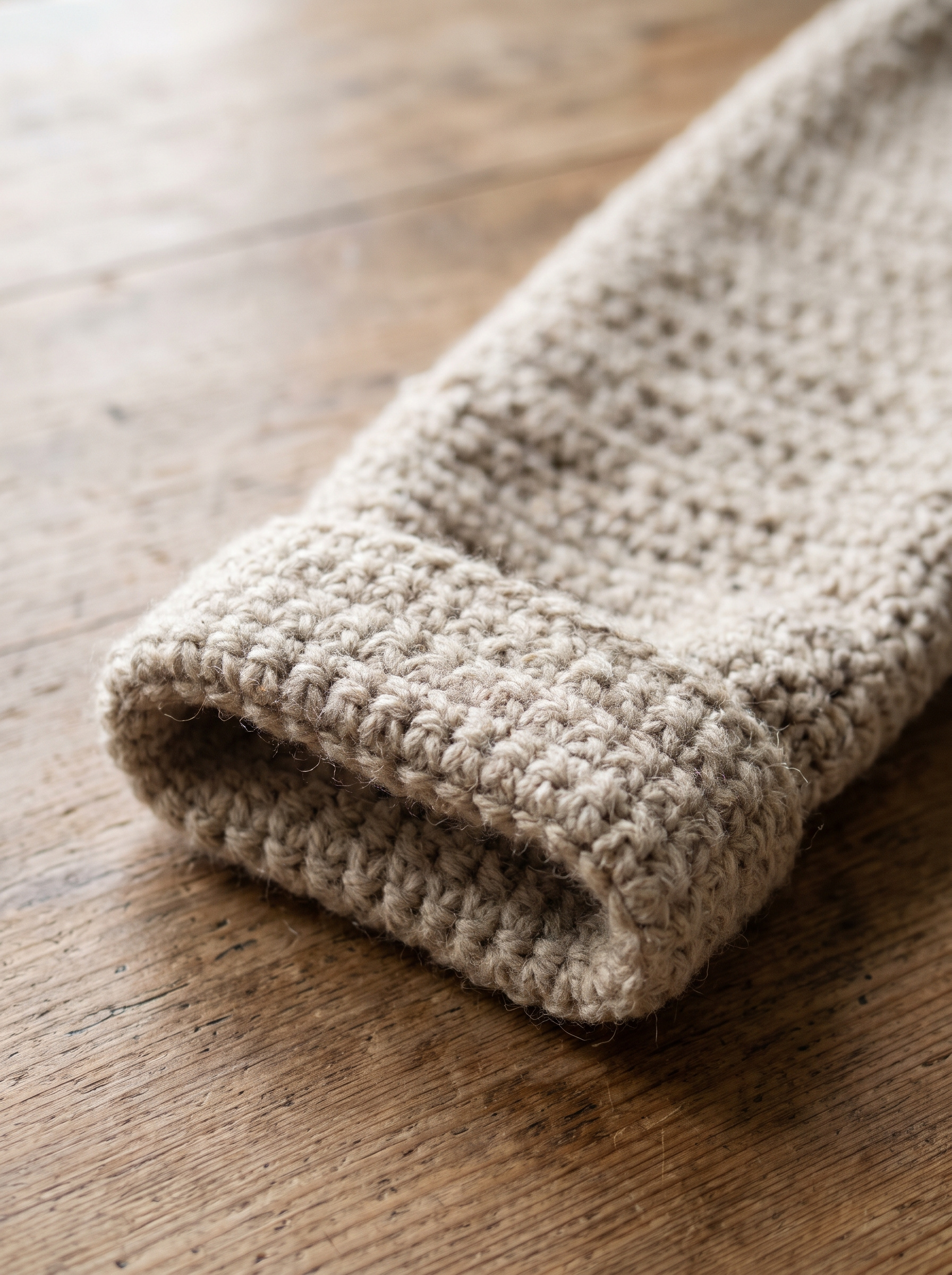
- Front, back, 2 sleeves: rectangles in hdc, seamed; drop shoulders, no shaping. Sleeves are as wide at the cuff as at the armhole (17 in in S to 20 1/2 in in 2X): a wide, loose cuff. Fold the cuff back once if you want it shorter.
Abbreviations (US)
- ch = chain
- hdc = half double crochet
- st(s) = stitch(es)
- RS = right side (the outside of the sweater)
- WS = wrong side (the inside)
- yo = yarn over
- tch = turning chain (ch 2 here: never counted, never worked into)
- A / B = A is the main color; B is the optional second color for stripes
- S (M, L, XL, 2X) = numbers for each size: the first is S, the others follow in order
Materials
- Main color (Oatmeal in our drawings): about 1600 yd (size 2X)
- Optional second color for stripes: about 270 yd (size 2X)
- Yardage above is for the biggest size (2X); the other sizes are in the Sizes cards.
- Skeins = yards / yards per skein, rounded up, plus 1. Example (S, 1070 yd): 100-yd skeins = 11 + 1; 150-yd skeins = 8 + 1. Check the label for yards, not grams.
- Add 15 % to the yards you work out from your swatch. Use soft acrylic or wool-blend #5 yarn. Cotton and linen are much heavier and will stretch. We have not tried any yarn.
- Yarn needle (large eye), scissors, stitch markers (at least 4), measuring tape, pins.
- A finished sweater weighs about 0.5 to 1.4 kg (1 to 3 lb) depending on the size and the yarn (estimate, not weighed). Sew the shoulder seams firmly.
S: to fit bust 32-34 in, finished chest about 44 in
- Yarn
- Bulky weight (#5), one color (Oatmeal in our drawings)
- Hook
- US L-11 (8 mm)
- Yarn needed
- Main color 1070 yd (estimate, with a 15 % margin): 12 skeins of 100 yd or 9 of 150 yd, rounded up, plus 1. With the optional stripes buy color B 170 yd and 170 yd less of the main color. Weight about 500 to 950 g (1.1 to 2.1 lb), estimate
- Finished size
- Chest about 44 in (112 cm), length about 24 in (61 cm), armhole depth about 8 1/2 in, sleeve about 17 in underarm to cuff (measure your arm and add or remove sts in the sleeve foundation ch), sleeve width around about 17 in, neck opening about 12 1/2 in. Positive ease about 10 in over the largest bust of the range. Approximate.
- Counts
- Front and back: ch 57, 55 sts, 42 rows each. Sleeves (2): ch 45, 43 sts, 30 rows. Shoulder seams 12 sts each, neck 31 sts. Armhole 15 rows on the front and on the back. About 24 to 27 hours in all, estimated, not timed. Not a first project.
M: to fit bust 36-38 in, finished chest about 49 in
- Yarn
- Bulky weight (#5), one color (Oatmeal in our drawings)
- Hook
- US L-11 (8 mm)
- Yarn needed
- Main color 1220 yd (estimate, with a 15 % margin): 14 skeins of 100 yd or 10 of 150 yd, rounded up, plus 1. With the optional stripes buy color B 200 yd and 200 yd less of the main color. Weight about 600 to 1100 g (1.3 to 2.4 lb), estimate
- Finished size
- Chest about 49 in (124 cm), length about 25 in (64 cm), armhole depth about 9 in, sleeve about 17 1/2 in underarm to cuff (measure your arm and add or remove sts in the sleeve foundation ch), sleeve width around about 18 1/2 in, neck opening about 12 1/2 in. Positive ease about 11 in over the largest bust of the range. Approximate.
- Counts
- Front and back: ch 63, 61 sts, 44 rows each. Sleeves (2): ch 46, 44 sts, 32 rows. Shoulder seams 15 sts each, neck 31 sts. Armhole 16 rows on the front and on the back. About 27 to 30 hours in all, estimated, not timed. Not a first project.
L: to fit bust 40-42 in, finished chest about 52 in
- Yarn
- Bulky weight (#5), one color (Oatmeal in our drawings)
- Hook
- US L-11 (8 mm)
- Yarn needed
- Main color 1340 yd (estimate, with a 15 % margin): 15 skeins of 100 yd or 10 of 150 yd, rounded up, plus 1. With the optional stripes buy color B 220 yd and 220 yd less of the main color. Weight about 650 to 1200 g (1.4 to 2.6 lb), estimate
- Finished size
- Chest about 52 in (132 cm), length about 26 1/2 in (67 cm), armhole depth about 9 1/2 in, sleeve about 18 in underarm to cuff (measure your arm and add or remove sts in the sleeve foundation ch), sleeve width around about 19 1/2 in, neck opening about 12 1/2 in. Positive ease about 10 in over the largest bust of the range. Approximate.
- Counts
- Front and back: ch 67, 65 sts, 46 rows each. Sleeves (2): ch 47, 45 sts, 34 rows. Shoulder seams 17 sts each, neck 31 sts. Armhole 17 rows on the front and on the back. About 30 to 33 hours in all, estimated, not timed. Not a first project.
XL: to fit bust 44-46 in, finished chest about 57 in
- Yarn
- Bulky weight (#5), one color (Oatmeal in our drawings)
- Hook
- US L-11 (8 mm)
- Yarn needed
- Main color 1450 yd (estimate, with a 15 % margin): 16 skeins of 100 yd or 11 of 150 yd, rounded up, plus 1. With the optional stripes buy color B 250 yd and 250 yd less of the main color. Weight about 700 to 1300 g (1.5 to 2.9 lb), estimate
- Finished size
- Chest about 57 in (144 cm), length about 27 in (68 cm), armhole depth about 9 1/2 in, sleeve about 18 1/2 in underarm to cuff (measure your arm and add or remove sts in the sleeve foundation ch), sleeve width around about 19 1/2 in, neck opening about 13 in. Positive ease about 11 in over the largest bust of the range. Approximate.
- Counts
- Front and back: ch 73, 71 sts, 47 rows each. Sleeves (2): ch 48, 46 sts, 34 rows. Shoulder seams 19 sts each, neck 33 sts. Armhole 17 rows on the front and on the back. About 32 to 35 hours in all, estimated, not timed. Not a first project.
2X: to fit bust 48-50 in, finished chest about 60 in
- Yarn
- Bulky weight (#5), one color (Oatmeal in our drawings)
- Hook
- US L-11 (8 mm)
- Yarn needed
- Main color 1600 yd (estimate, with a 15 % margin): 17 skeins of 100 yd or 12 of 150 yd, rounded up, plus 1. With the optional stripes buy color B 270 yd and 270 yd less of the main color. Weight about 750 to 1450 g (1.7 to 3.2 lb), estimate
- Finished size
- Chest about 60 in (152 cm), length about 28 in (71 cm), armhole depth about 10 1/2 in, sleeve about 19 in underarm to cuff (measure your arm and add or remove sts in the sleeve foundation ch), sleeve width around about 20 1/2 in, neck opening about 14 in. Positive ease about 10 in over the largest bust of the range. Approximate.
- Counts
- Front and back: ch 77, 75 sts, 49 rows each. Sleeves (2): ch 50, 48 sts, 36 rows. Shoulder seams 20 sts each, neck 35 sts. Armhole 18 rows on the front and on the back. About 34 to 37 hours in all, estimated, not timed. Not a first project.
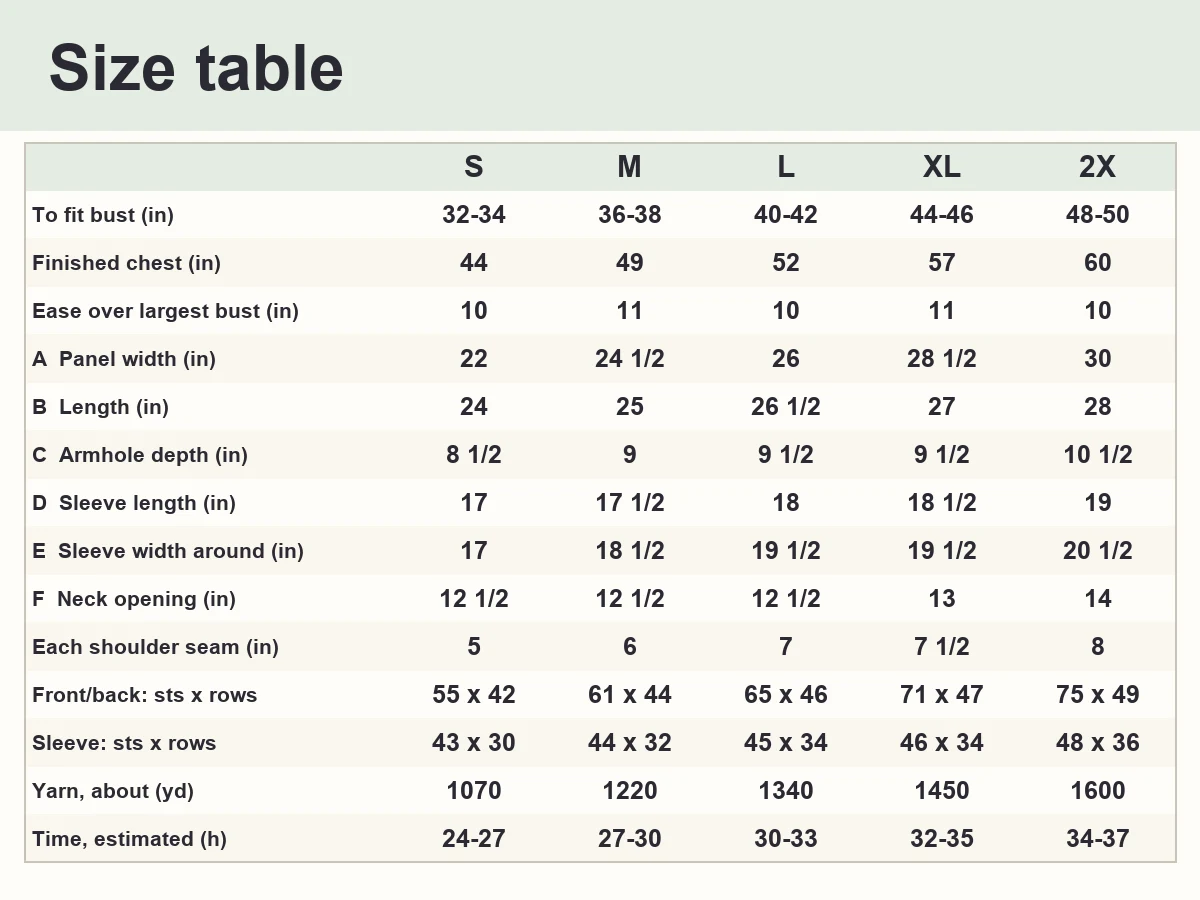
Size table
| Measure | S | M | L | XL | 2X |
|---|---|---|---|---|---|
| To fit bust (in) | 32-34 | 36-38 | 40-42 | 44-46 | 48-50 |
| Finished chest (in) | 44 | 49 | 52 | 57 | 60 |
| Ease over largest bust (in) | 10 | 11 | 10 | 11 | 10 |
| Length (in) | 24 | 25 | 26 1/2 | 27 | 28 |
| Armhole depth (in) | 8 1/2 | 9 | 9 1/2 | 9 1/2 | 10 1/2 |
| Sleeve width around (in) | 17 | 18 1/2 | 19 1/2 | 19 1/2 | 20 1/2 |
| Neck opening (in) | 12 1/2 | 12 1/2 | 12 1/2 | 13 | 14 |
| Front/back: sts x rows | 55 x 42 | 61 x 44 | 65 x 46 | 71 x 47 | 75 x 49 |
| Sleeve: sts x rows | 43 x 30 | 44 x 32 | 45 x 34 | 46 x 34 | 48 x 36 |
Gauge and swatch
Notes
- US crochet terms: see the abbreviations above. Sizes: S, M, L, XL, 2X. Numbers are written S (M, L, XL, 2X).
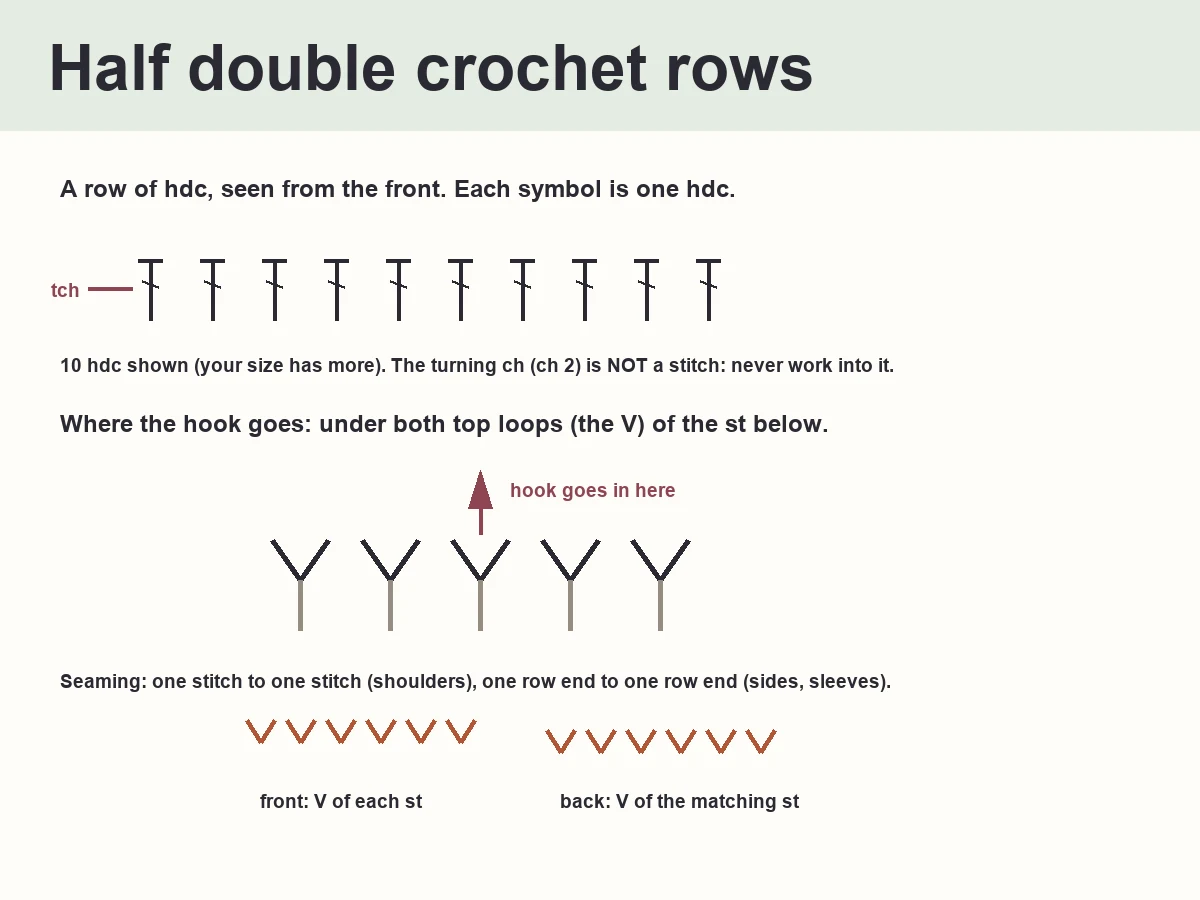
- Hdc: yarn over, insert the hook under both top loops of the next st (the V), yarn over and pull up a loop (3 loops on the hook), yarn over and pull through all 3 loops.
- Back bump: the bump on the back of each foundation ch. Row 1 goes in the back bumps. Keep the foundation chain loose: use a hook one size up for it if you tend to chain tight.
- Row 1 of every piece is a right-side (RS) row, so odd rows are RS and even rows are WS. RS = the outside of the sweater, WS = the inside. The turning ch (ch 2) does not count as a st and you never work into it.
- Join a new skein at the end of a row. Leave 6 in tails. A 100-yd skein is about 14 rows of the front or back in S and 10 in 2X, so plan for about 28 (S) to 38 (2X) ends to weave in.
- Expect the sweater to grow 1 to 2 in in length once worn or wet. Weigh your swatch when you block it.
- Glossary. Boat neck: a wide, straight opening between the shoulder seams. Drop shoulder: the shoulder seam sits low on the upper arm, and the sleeve is a rectangle. Swatch: a small test piece you crochet and measure. Gauge: how many stitches and rows make 4 in. Ease: the room added over your bust. WS: wrong side, the inside of the sweater.
How to make it
Swatch
Make this first. 24 sts and 14 rows, the same for every size.
- FoundationCh 26.Stitch count: 26 ch
- Row 1 (RS)Skip the first 2 ch from the hook (they are the turning ch and do not count as a st). Work a hdc in the back bump of the next ch and of each ch across.Stitch count: 24 hdc
- Rows 2 to 14Ch 2 (does not count as a st), turn. Hdc in each st across. The last hdc of every row goes in the first hdc of the row before, next to the turning ch, never in it.Stitch count: 24 hdc
Front
Worked from the hem up, in one color. Sizes: S, M, L, XL, 2X. Numbers are written S (M, L, XL, 2X).
- FoundationCh 57 (63, 67, 73, 77).Stitch count: 57 (63, 67, 73, 77) ch
- Row 1 (RS)Skip the first 2 ch from the hook (they are the turning ch and do not count as a st). Work a hdc in the back bump of the next ch and of each ch across.Stitch count: 55 (61, 65, 71, 75) hdc
- Rows 2 to 42 (44, 46, 47, 49)Ch 2 (does not count as a st), turn. Hdc in each st across. The last hdc of every row goes in the first hdc of the row before, next to the turning ch, never in it.Stitch count: 55 (61, 65, 71, 75) hdc
Back
Same size as the front.
- FoundationCh 57 (63, 67, 73, 77).Stitch count: 57 (63, 67, 73, 77) ch
- Row 1 (RS)Skip the first 2 ch from the hook (they are the turning ch and do not count as a st). Work a hdc in the back bump of the next ch and of each ch across.Stitch count: 55 (61, 65, 71, 75) hdc
- Rows 2 to 42 (44, 46, 47, 49)Ch 2 (does not count as a st), turn. Hdc in each st across. The last hdc of every row goes in the first hdc of the row before, next to the turning ch, never in it.Stitch count: 55 (61, 65, 71, 75) hdc
Sleeves
Make 2. The rows run along the arm.
- FoundationCh 45 (46, 47, 48, 50).Stitch count: 45 (46, 47, 48, 50) ch
- Row 1 (RS)Skip the first 2 ch from the hook (they are the turning ch and do not count as a st). Work a hdc in the back bump of the next ch and of each ch across.Stitch count: 43 (44, 45, 46, 48) hdc
- Rows 2 to 30 (32, 34, 34, 36)Ch 2 (does not count as a st), turn. Hdc in each st across. The last hdc of every row goes in the first hdc of the row before, next to the turning ch, never in it. The rows run along the arm: the short edges are the cuff and the armhole.Stitch count: 43 (44, 45, 46, 48) hdc
Assembly
Rectangles seam row end to row end, so the counts below match.
- Weave in endsWeave in the ends on the wrong side, along a row, going back on yourself for 3 in. Tails from stripes can go into the side seam.
- BlockBlock the pieces flat before you sew. Pin the shoulder seams and try the sweater on before you sew the sides. Follow the yarn label.
- Pin firstFor every seam, pin the first and the last rows (or sts) of the seam and the middle first, then add pins every 2 in and sew between the pins.
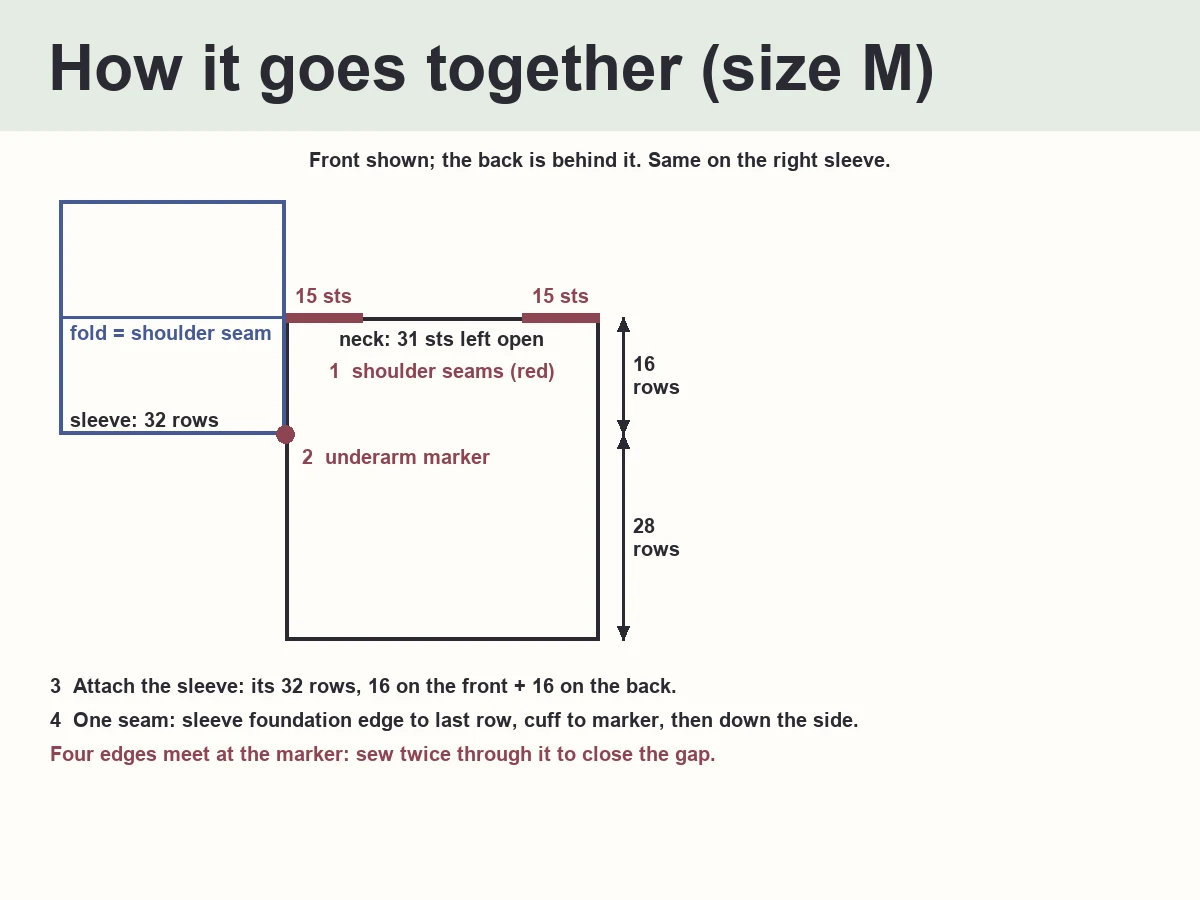
- Shoulder seamsLay the front and the back flat, right sides up, tops of the stitches touching. With the needle, go under the 2 loops of the V of one st on the front, then under the V of the matching st on the back, and repeat across. Seam the first 12 (15, 17, 19, 20) sts and the last 12 (15, 17, 19, 20) sts of the top edge. Leave the middle 31 (31, 31, 33, 35) sts open: this is the neck (12 (15, 17, 19, 20) + 31 (31, 31, 33, 35) + 12 (15, 17, 19, 20) = 55 (61, 65, 71, 75) sts). Try your head through the neck before you sew the second shoulder seam. It sits wide: it may slip to one side.
- Mark the armholesOn each side edge of the front and of the back, count 15 (16, 17, 17, 18) rows down from the shoulder seam and put a marker. This is the armhole (the underarm marker).
- Attach the sleevesA sleeve has 30 (32, 34, 34, 36) rows (the rows run along the arm, so the short edges are row ends). Fold the sleeve in half: the fold is between its Row 15 (16, 17, 17, 18) and its Row 16 (17, 18, 18, 19). Put that fold at the shoulder seam and sew the armhole edge of the sleeve to the armhole: 15 (16, 17, 17, 18) rows on the front and 15 (16, 17, 17, 18) rows on the back, one row end to one row end (mattress stitch: with the right sides facing you, pick up the 2 bars between the first and second st of a row end on one side, then the same on the other side, row by row, and pull gently every 4 or 5 rows). Do the same with the other sleeve.
- Underarm and side seamsSew the long edge of the sleeve with the foundation ch to the long edge with the last row (43 (44, 45, 46, 48) sts to 43 (44, 45, 46, 48) sts: the chain loop of each st on the foundation edge to the V of the matching st), then continue down the side of the body: 27 (28, 29, 30, 31) rows of the front to 27 (28, 29, 30, 31) rows of the back (mattress stitch). At the underarm marker four edges meet: the 2 long edges of the sleeve and the side edges of the front and of the back. Sew the sleeve seam up to the marker, go twice through the marker point to close the gap, then go on down the side: one seam from cuff to hem. Repeat on the other side.
- FinishWeave in the seaming ends. The neck, hem and cuffs are left as they are (the edge of the hdc rows): no border to work. The cuffs are wide: fold them back once if you want them shorter.
Plans and diagrams
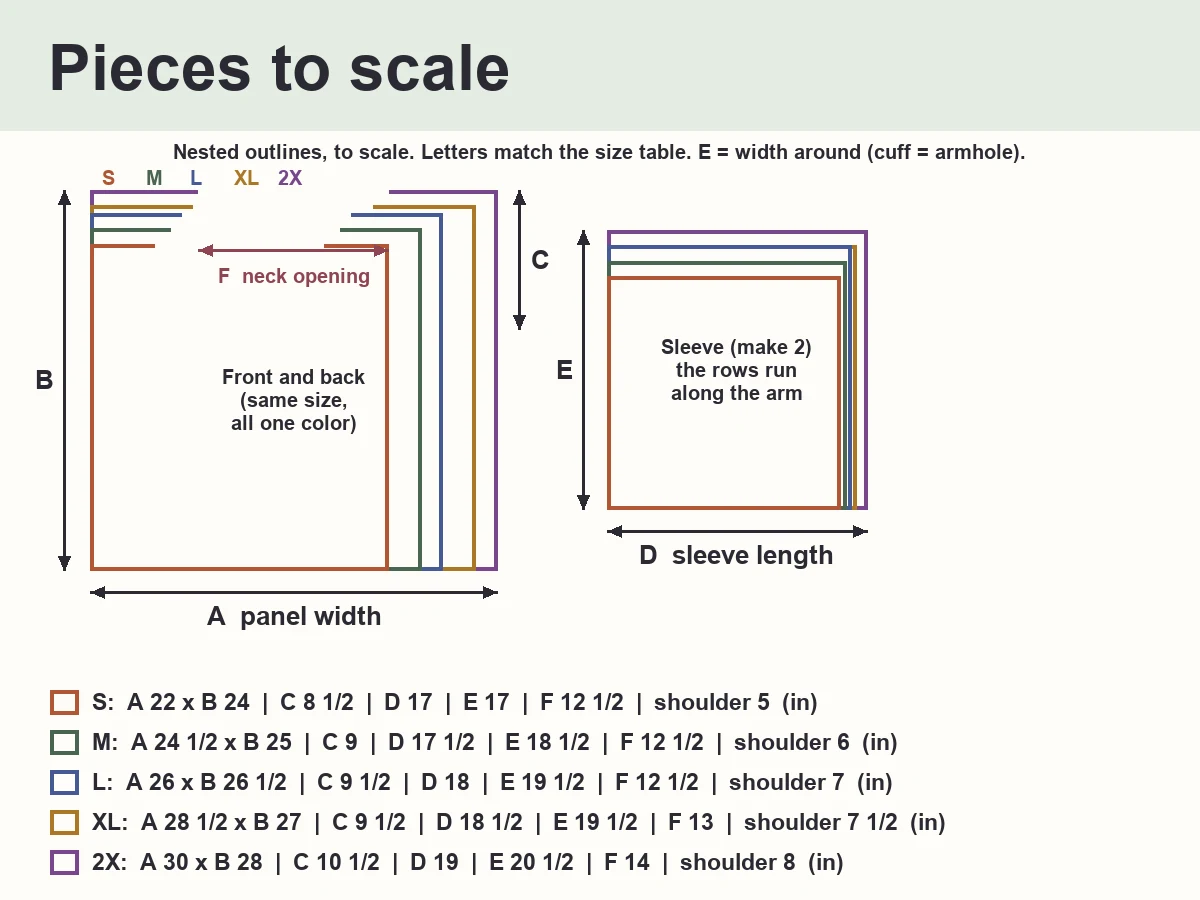
The pieces, size by size
| Part | Rows | Color |
|---|---|---|
| Front | 55 sts x 42 rows, about 22 x 24 in | |
| Back | 55 sts x 42 rows, same as the front | |
| Sleeves (2) | 43 sts x 30 rows, about 17 x 17 in |
| Part | Rows | Color |
|---|---|---|
| Front | 61 sts x 44 rows, about 24 1/2 x 25 in | |
| Back | 61 sts x 44 rows, same as the front | |
| Sleeves (2) | 44 sts x 32 rows, about 17 1/2 x 18 1/2 in |
| Part | Rows | Color |
|---|---|---|
| Front | 65 sts x 46 rows, about 26 x 26 1/2 in | |
| Back | 65 sts x 46 rows, same as the front | |
| Sleeves (2) | 45 sts x 34 rows, about 18 x 19 1/2 in |
| Part | Rows | Color |
|---|---|---|
| Front | 71 sts x 47 rows, about 28 1/2 x 27 in | |
| Back | 71 sts x 47 rows, same as the front | |
| Sleeves (2) | 46 sts x 34 rows, about 18 1/2 x 19 1/2 in |
| Part | Rows | Color |
|---|---|---|
| Front | 75 sts x 49 rows, about 30 x 28 in | |
| Back | 75 sts x 49 rows, same as the front | |
| Sleeves (2) | 48 sts x 36 rows, about 19 x 20 1/2 in |
Finishing
Check that every end is woven in and the seams are flat. Wash as the label says. Lay flat to dry (drying time not tested). Store folded. A finished sweater weighs about 0.5 to 1.4 kg (1 to 3 lb) depending on the size and the yarn (estimate, not weighed). Sew the shoulder seams firmly. Expect the sweater to grow 1 to 2 in in length once worn or wet. Weigh your swatch when you block it.
Tips
- Put a stitch marker in the first stitch of every row so you can count quickly: every row must give the number of sts in your size card.
- Weigh your skeins before you start: the yardage is an estimate, and a second skein of the same dye lot is easier to buy now than later.
- To make the sweater longer or shorter, add or remove plain rows on the front and the back (the same number on both). Then the side seam stays equal.
- Sleeve about 17 in (S) underarm to cuff. Measure your arm and add or remove sts in the sleeve foundation chain (about 2.5 sts per inch).
- Keep your tension relaxed: bulky yarn with a tight hook gives a board, not a sweater.
Common mistakes
- Working in the turning chain: the row gets 1 stitch too many.
- Skipping the first stitch of the row: the row gets 1 stitch too few.
- Different numbers of rows on the front and the back: the side seams will not match.
- Forgetting that Row 1 is a right-side row.
Make it your own
- Make it your own: stripes. Keep the same stitch counts and add a second color on the front and the back only: after every 6 rows of the main color, work 2 rows in the second color (Rows 7-8, 15-16, and so on, the same on the front and the back, so the stripes meet at the side seams). Change color on the last pull-through of the last hdc of the row before: with the 3 loops on the hook, pull the new color through. Carry the color you are not using loosely up the edge (2 rows only) and sew it into the side seam. Keep the sleeves in the main color: their rows run along the arm, so stripes would run along the arm. With stripes, buy the second color (about 170 (200, 220, 250, 270) yd) and about 170 (200, 220, 250, 270) yd less of the main color. Every count is the same: the software replayed one striped version of the front and the back.
- Other yarns: Use soft acrylic or wool-blend #5 yarn. Cotton and linen are much heavier and will stretch. We have not tried any yarn.
Care
- Wash as the label says. Lay flat to dry (drying time not tested). Store folded.
FAQ
More from amgroyal.com
© 2026 amgroyal.com. You may sell what you crochet. Please don't copy or repost this pattern; link to it instead.