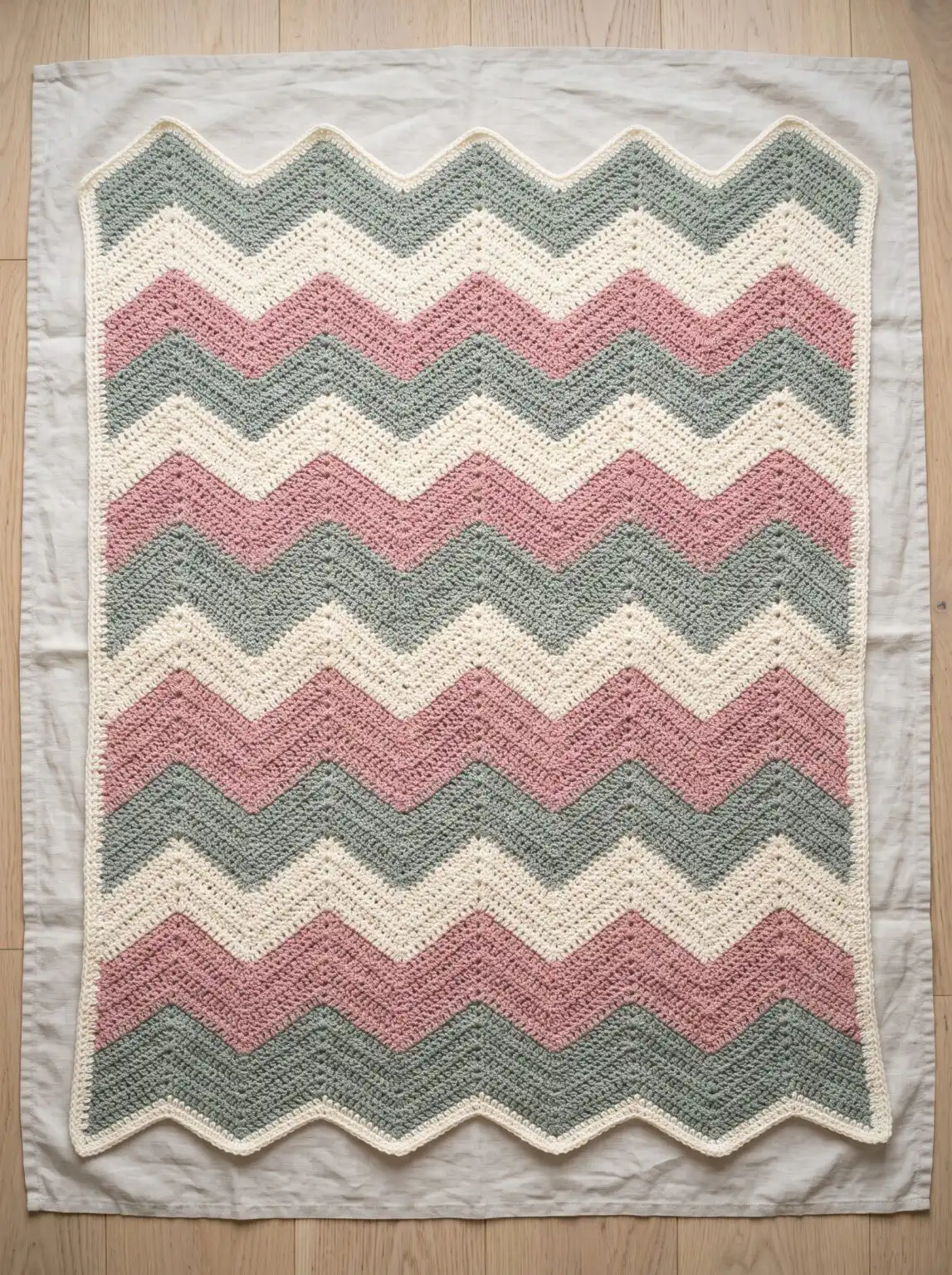
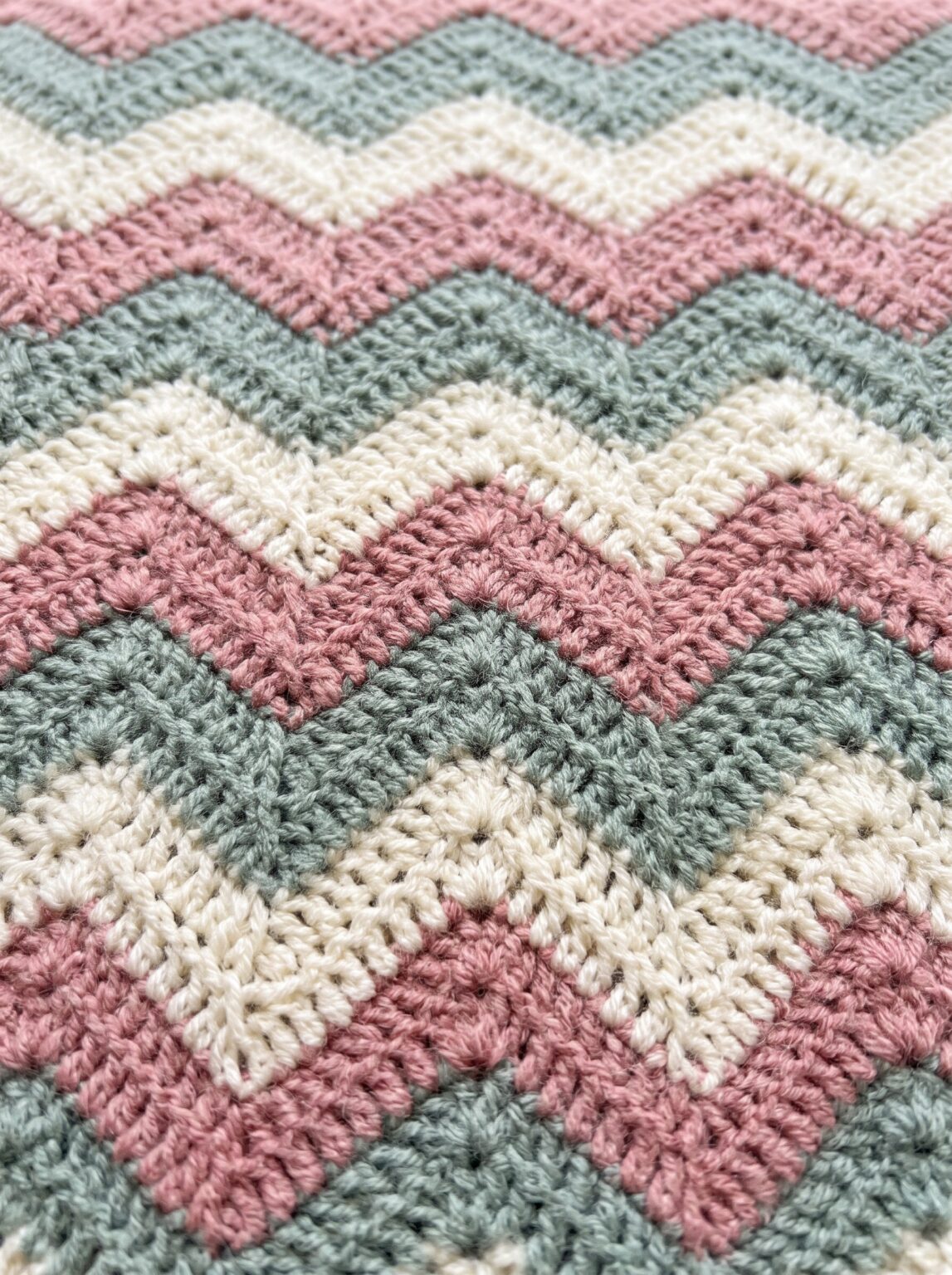
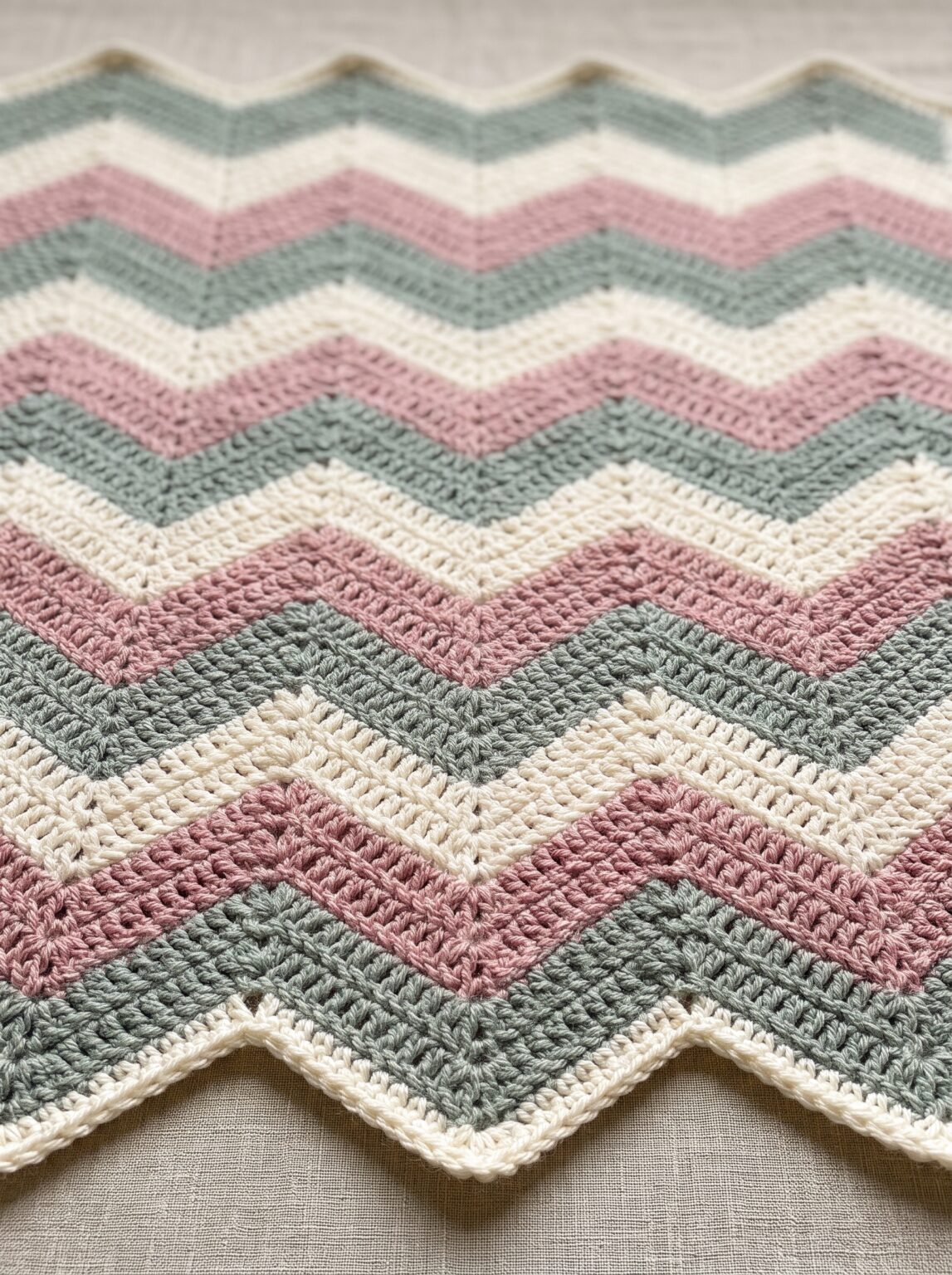
The blanket opened out flat: sharp chevron points in Sage, Cream and Dusty Rose stripes. Your blanket will have 8 peaks across (Stroller) or 10 (Large) and 18 or 22 stripes: this picture shows fewer. Your blanket will differ: the real texture depends on your yarn and tension.
This chevron crochet baby blanket is all double crochet, with a Cream border. Level: advanced beginner. Two sizes: Stroller about 28 1/2 x 36 1/2 in, Large about 35 1/2 x 44 1/2 in. Yarn: DK / light worsted (#3), 3 colors, about 1430 yd (Stroller) or 2140 yd (Large).
Advanced beginner; about 8,000 stitches (Stroller) or 12,000 (Large)
Time
About 18 hours (Stroller) or 27 (Large) of crocheting at 8 sts a minute, plus about 1 hour to weave in the 38 (Stroller) or 46 (Large) ends; estimated, not timed
Finished size
Stroller about 28 1/2 x 36 1/2 in, Large about 35 1/2 x 44 1/2 in (approximate)
Yarn
DK / light worsted weight (#3), 3 colors: about 1430 yd (Stroller) or 2140 yd (Large) in all; yardage per color below
Hook
US G-6 (4 mm).
Gauge
Suggested only, not swatched: We assumed 16 sts and 8 rows = 4 in (10 cm) in dc with the yarn and hook below, measured across the zigzag on a swatch laid flat; the range is 14-18 sts and 7-9 rows. Dc gauge varies with the crocheter and the yarn, so swatch and adjust.
Stitch multiple
14 + 3 (14 x k + 3 ch, k = repeats across): 8 peaks across (Stroller) / 10 (Large). Explained in the notes below
Stripes
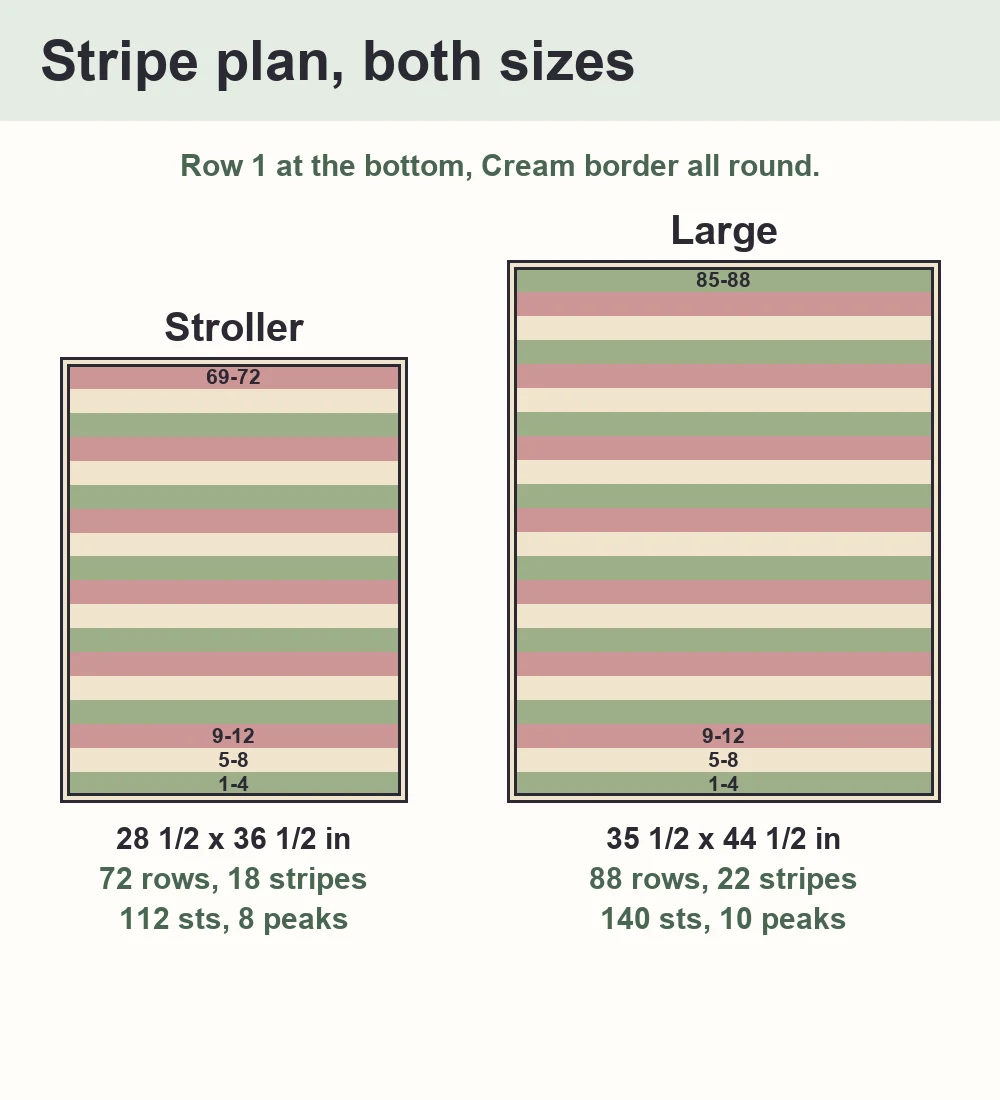
Every stripe is 4 rows. Repeat Sage, Cream, Dusty Rose. Stroller: 18 stripes (72 rows), ending on Dusty Rose. Large: 22 stripes (88 rows), ending on Sage.
Length
Stroller 28 1/2 x 36 1/2 in, Large 35 1/2 x 44 1/2 in. With a different gauge your size will change: see the gauge rule below. The width grows in steps of 14 stitches (about 3 1/2 in): add one repeat to the Stroller for a blanket about 32 in wide.
If your gauge differs
Measure 4 in across your swatch. Fewer than 16 sts: go down a hook size. More than 16 sts: go up a hook size. Or add or remove 1 repeat (14 ch, about 3 1/2 in) and recalculate your yarn (about 170 yd per repeat in the Stroller, 210 yd in the Large, all colors, with the 20 % margin).
How this pattern was checked
Every row of both sizes and both borders was replayed by software. Counts were checked by software. This pattern has not been crocheted and swatched by a person before publication. Make the swatch first.
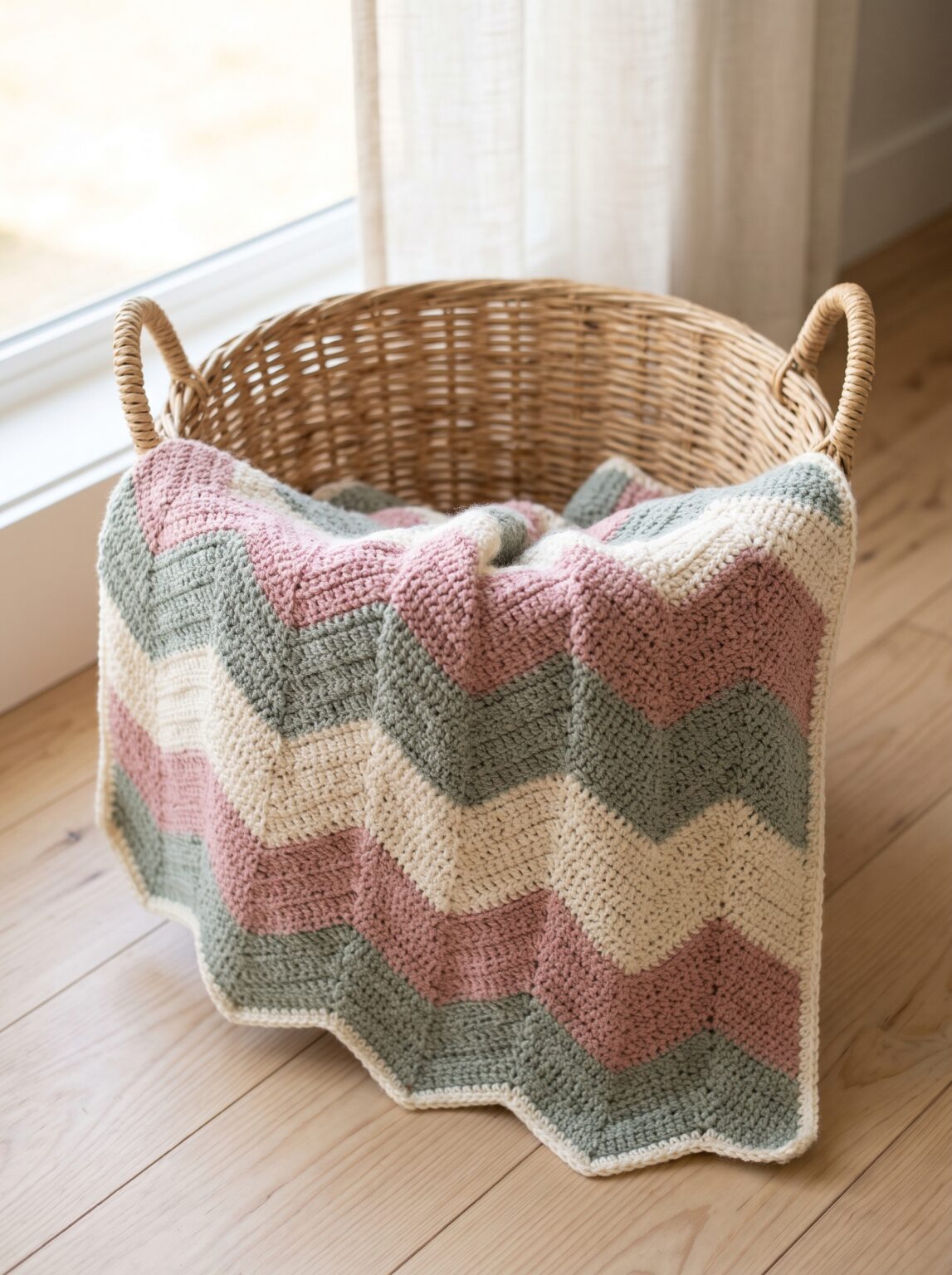
Folded in a basket, the stripes show on the folded edge.
sl st = slip stitch: insert the hook in the st, yo, pull through the st and the loop
sc = single crochet: insert the hook, yo, pull up a loop, yo, pull through both loops
hdc = half double crochet: yo, insert the hook, yo, pull up a loop, yo, pull through all 3 loops
dc = double crochet: yo, insert the hook, yo, pull up a loop, [yo, pull through 2 loops] 2 times
tr = treble crochet: yo 2 times, insert the hook, yo, pull up a loop, [yo, pull through 2 loops] 3 times
dc2tog = double crochet 2 stitches together (yarn over, insert in next st, pull up a loop, yarn over, pull through 2 loops; repeat once in the next st; yarn over, pull through all 3 loops)
st(s) = stitch(es)
RS = right side
WS = wrong side
yo = yarn over: wrap the yarn over the hook
ch 3 = turning chain: counts as the first dc of the row
Dusty Rose (stripes): 460 yd (Stroller) / 660 yd (Large)
Yardage per color, Stroller / Large (estimates, with a 20 % margin, Border A): Sage 460 / 760 yd; Cream 510 / 720 yd; Dusty Rose 460 / 660 yd. Cream (Large): 720 yd with Border A, about 730 yd with Border B.
Yarn needle, scissors, stitch markers (one in every ch-3 turning chain helps you count).
Buy one extra skein of each color if you are between sizes.
Skeins of 180 yd (165 m) vary in weight by brand (check the label). Buy by yardage, not by number of skeins. Buy all skeins of one color from the same dye lot. Use a soft machine-washable acrylic or acrylic blend. Cotton is heavier and may need more yarn. Avoid fuzzy or shedding yarn on a baby blanket.
Look for the number on the label: many "baby" yarns are #3. If you change yarn, swatch again.
Our figure assumes 5 in of yarn per dc and a 20 % margin; it is on the generous side for DK, buy by yardage. A dc chevron uses more yarn than a moss stitch blanket of the same size, so its yardage is higher than in the baby blanket size chart.
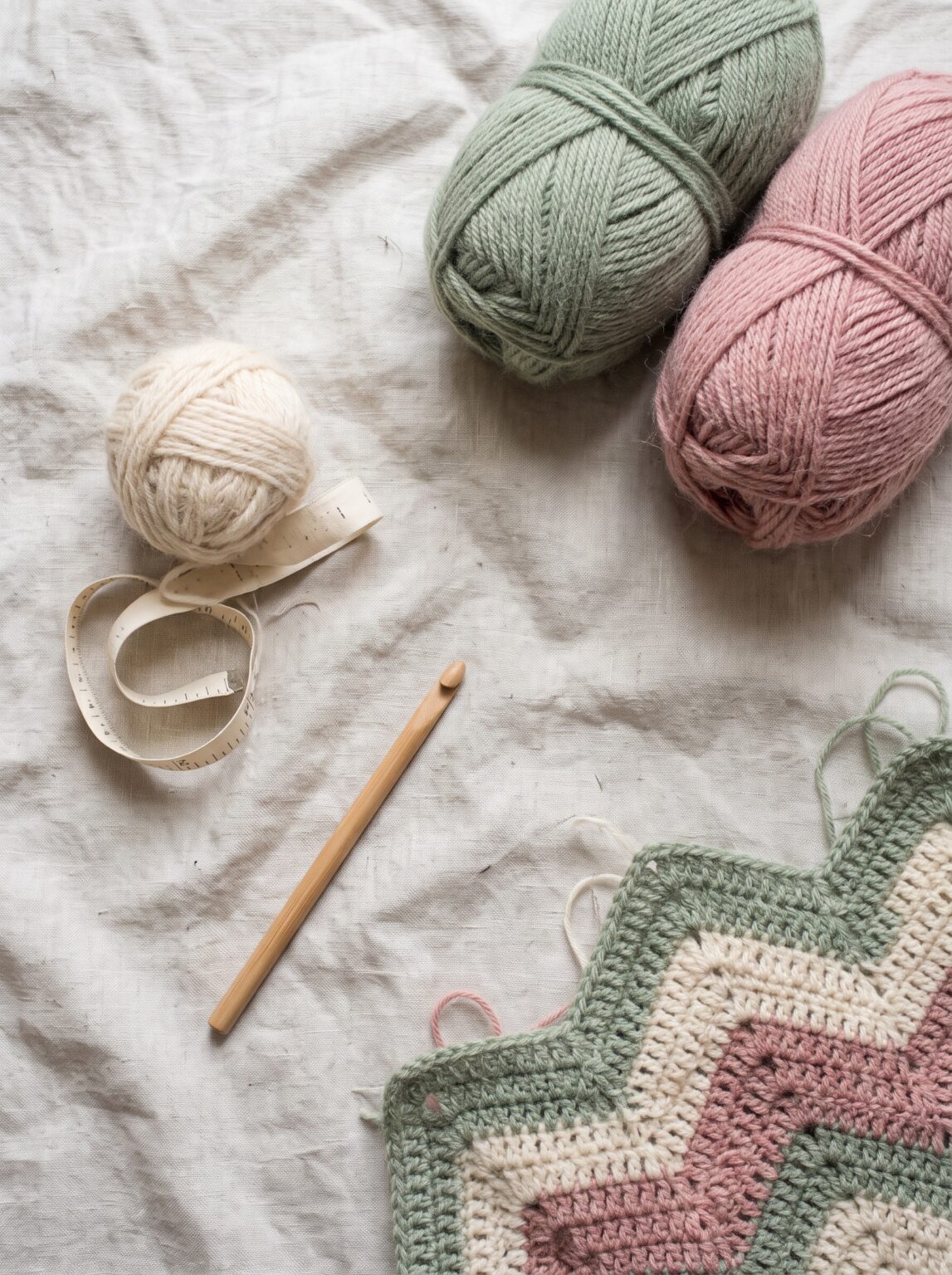
Three colors of DK / light worsted (#3) yarn, a US G-6 (4 mm) hook and a small swatch with a sage edge.
DK / light worsted weight (#3), 3 colors: Sage, Cream and Dusty Rose
Hook
US G-6 (4 mm) (go up a hook size, to a US 7, 4.5 mm, if you get more than 16 sts per 4 in)
Yarn needed
Sage 460 yd (421 m, 3 skeins) · Cream 510 yd (466 m, 3 skeins) · Dusty Rose 460 yd (421 m, 3 skeins), about 1430 yd in all (estimated, with a 20 % margin, border A; border B needs the same Cream; skeins of 180 yd, counted for the larger of the two borders)
Finished size
about 28 1/2 x 36 1/2 in (72 x 93 cm), approximate. Stroller: 25 1/2-32 1/2 in wide and 32 1/2-41 3/4 in long across the gauge range.
Counts
Foundation ch 115; 112 sts per row (14 x 8); 72 rows in 18 stripes. Border A: 515 sc (110 sc along the top, 113 along the bottom, 2 sc in each of 70 row ends up each side, 3 sc in each corner). Border B: 515 sts. About 38 ends to weave in. About 18 hours of crocheting at about 8 sts a minute, estimated, plus about 1 hour to weave in ends.
Large: about 35 1/2 x 44 1/2 in
Yarn
DK / light worsted weight (#3), 3 colors: Sage, Cream and Dusty Rose
Hook
US G-6 (4 mm) (go up a hook size, to a US 7, 4.5 mm, if you get more than 16 sts per 4 in)
Yarn needed
Sage 760 yd (695 m, 5 skeins) · Cream 720 yd (658 m, 5 skeins) · Dusty Rose 660 yd (604 m, 4 skeins), about 2140 yd in all (estimated, with a 20 % margin, border A; border B needs about 10 yd more Cream; skeins of 180 yd, counted for the larger of the two borders)
Finished size
about 35 1/2 x 44 1/2 in (90 x 113 cm), approximate. Large: 31 1/2-40 1/2 in wide and 39 1/2-50 3/4 in long across the gauge range.
Counts
Foundation ch 143; 140 sts per row (14 x 10); 88 rows in 22 stripes. Border A: 635 sc (138 sc along the top, 141 along the bottom, 2 sc in each of 86 row ends up each side, 3 sc in each corner). Border B: 635 sts. About 46 ends to weave in. About 27 hours of crocheting at about 8 sts a minute, estimated, plus about 1 hour to weave in ends.
Gauge and swatch
Make a swatch first
Our gauge is an estimate, not a measurement. With Sage, ch 31 (2 repeats x 14 = 28 sts, plus 3 ch) and work Row 1 and Rows 2-8 (28 sts per row). With 2 repeats, work the part after the * once, with no repeat. Add a few sc along one side and the top (keep the last row to test the border). Lay it flat without stretching and measure across the middle 4 in, counting sts and rows. We assumed 16 sts and 8 rows = 4 in; the range is 14-18 sts and 7-9 rows. Check the peak and the valley: a peak should look like a clean V; a flat peak means too few increases, a hole in the valley means a missed dc2tog.
Notes
US crochet terms: see the abbreviations above.
The part between * and ; is worked once, then repeated the number of times written: k – 1 times in all (Stroller 7, Large 9).
Stitch multiple 14 + 3: one repeat is 14 sts, so the width is 14 x k sts: 8 peaks across (Stroller) / 10 (Large). The 3 extra ch are the turning chain of Row 1: they count as the first dc and are skipped, Row 1 is worked from the 4th ch. To change the width: 14 chains per extra repeat, plus 3 at the start. One more repeat is about 3 1/2 in more at our gauge. The 14 comes from the shape: the peak adds 2 sts, the valley removes 2, and 4 dc on each side of the peak and valley give a point that is 14 sts apart.
Example: 8 repeats x 14 = 112 sts, plus 3 ch = 115 ch (Stroller).
The ch 3 at the start of a row counts as the first dc: the next dc goes in the same st as the ch 3 (the first st of the row below).
Last st of every row: 2 dc in the 3rd ch of the turning ch of the row below.
Odd rows are the wrong side, even rows are the right side. Stripes always end on an even row.
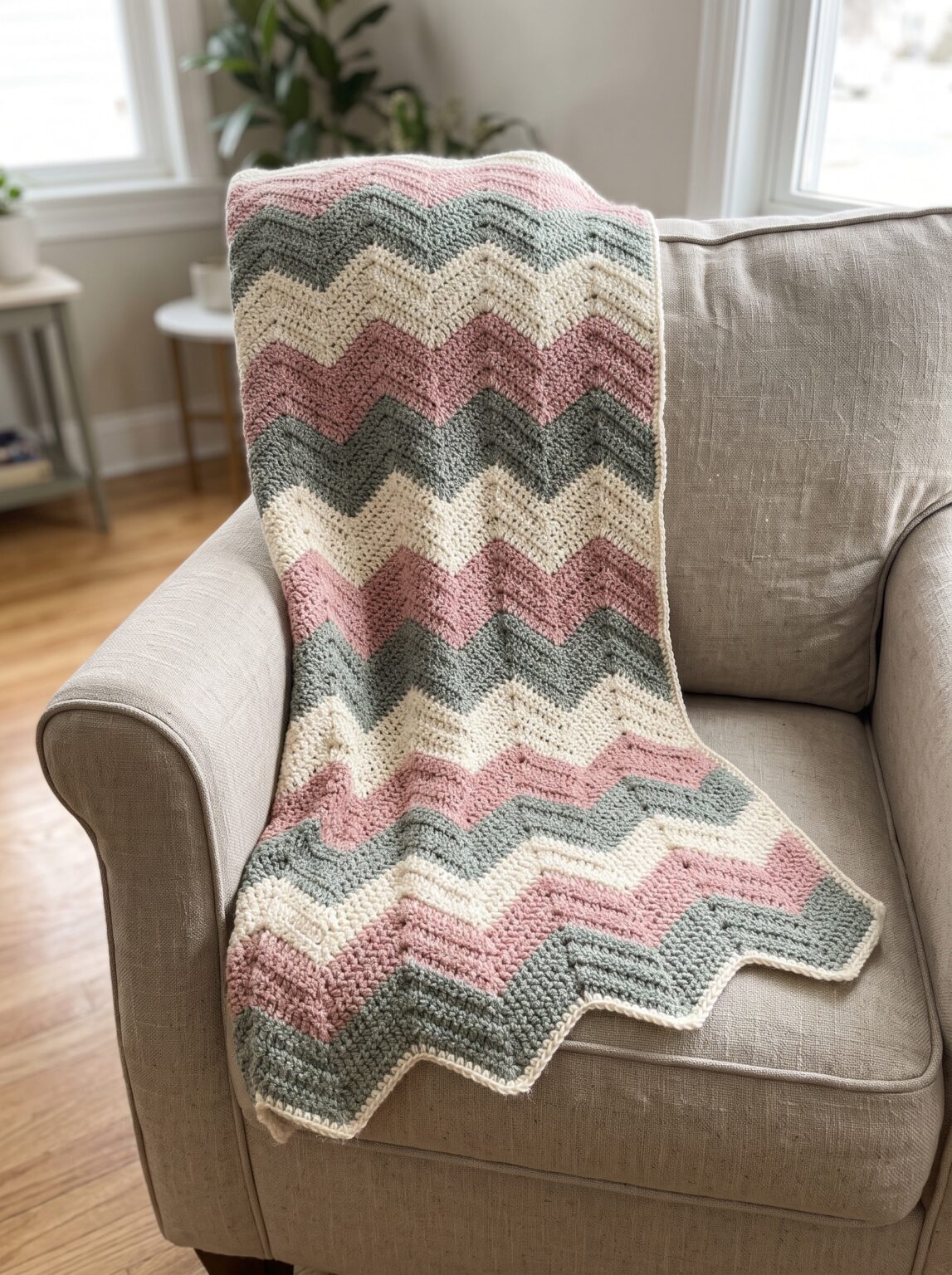
Draped over the arm of an armchair. The picture is for mood, not to scale.
With Sage, leave a 6 in tail, make the foundation chain for your size and work Row 1 from the 4th ch from the hook. Keep the chain loose: a tight chain pulls the bottom edge in. Count your sts at the end of Row 1: they must match your size card. Row 1 tells you early if your count is right. If your peaks do not line up after Row 3, stop and find the row where the count changed.
Work the chevron rows
Every row is the same: ch 3, turn, dc in the same st, 4 dc, dc2tog twice, then the repeat, then 4 dc and 2 dc in the last st. Peaks sit above peaks and valleys above valleys. Count your sts after every stripe.
Change color
Change color on the last dc of the last row of a stripe: work it until 2 loops are left on the hook, then pull the new color through both loops, ch 3 with the new color and turn (this is the start of the next row). Cut the old color, leaving a 6 in tail. Do not carry yarn up the side. Every stripe is 4 whole rows, so every change happens on an even row, always on the same edge (the left edge as you look at the right side). Weave in each tail on the wrong side as you finish a stripe, so you do not face all the ends at the end.
Chevron crochet baby blanket pattern, row by row
Foundation, Row 1, then repeat Row 2. Counts for both sizes are given in the Sizes cards.
FoundationCh 115 (Stroller) or 143 (Large). To change the width: 14 chains per extra repeat, plus 3 at the start.Stitch count: 115 ch (Stroller) or 143 ch (Large)
Row 1 (WS)Work Row 1 into the back bump of each ch. Dc in the 4th ch from the hook (the 3 skipped ch count as the first dc) and in each of the next 4 ch. Dc2tog 2 times (each over 2 ch; 2 sts made from 4 ch). *Dc in each of the next 4 sts, 2 dc in each of the next 2 sts, dc in each of the next 4 sts, dc2tog 2 times; repeat from * 6 (Stroller) or 8 (Large) more times. Dc in each of the next 4 sts, then 2 dc in the last st (the last ch).Stitch count: 112 sts (the ch 3 counts as 1) (Stroller) or 140 sts (the ch 3 counts as 1) (Large)
Row 2 (RS)Ch 3 (counts as the first dc), turn. Dc in the same st (the st at the base of the ch 3), then dc in each of the next 4 sts. Dc2tog 2 times (each over 2 sts; 2 sts made from 4 sts). *Dc in each of the next 4 sts, 2 dc in each of the next 2 sts, dc in each of the next 4 sts, dc2tog 2 times; repeat from * 6 (Stroller) or 8 (Large) more times. Dc in each of the next 4 sts, then 2 dc in the last st (the top of the turning ch of the row below: work into the 3rd ch of its ch 3).Stitch count: 112 sts (the ch 3 counts as 1) (Stroller) or 140 sts (the ch 3 counts as 1) (Large)
Rows 3 to the endRepeat Row 2 until you have the number of rows in your size card. The last row is always an even row. Change color as in the stripe sequence.Stitch count: 72 rows in all (Stroller) or 88 rows in all (Large)
Close up: each peak points up, each valley dips down, row after row.
Get the free printable PDF (Letter + A4)Every size and stitch count on paper, ready to print.Get the free PDF
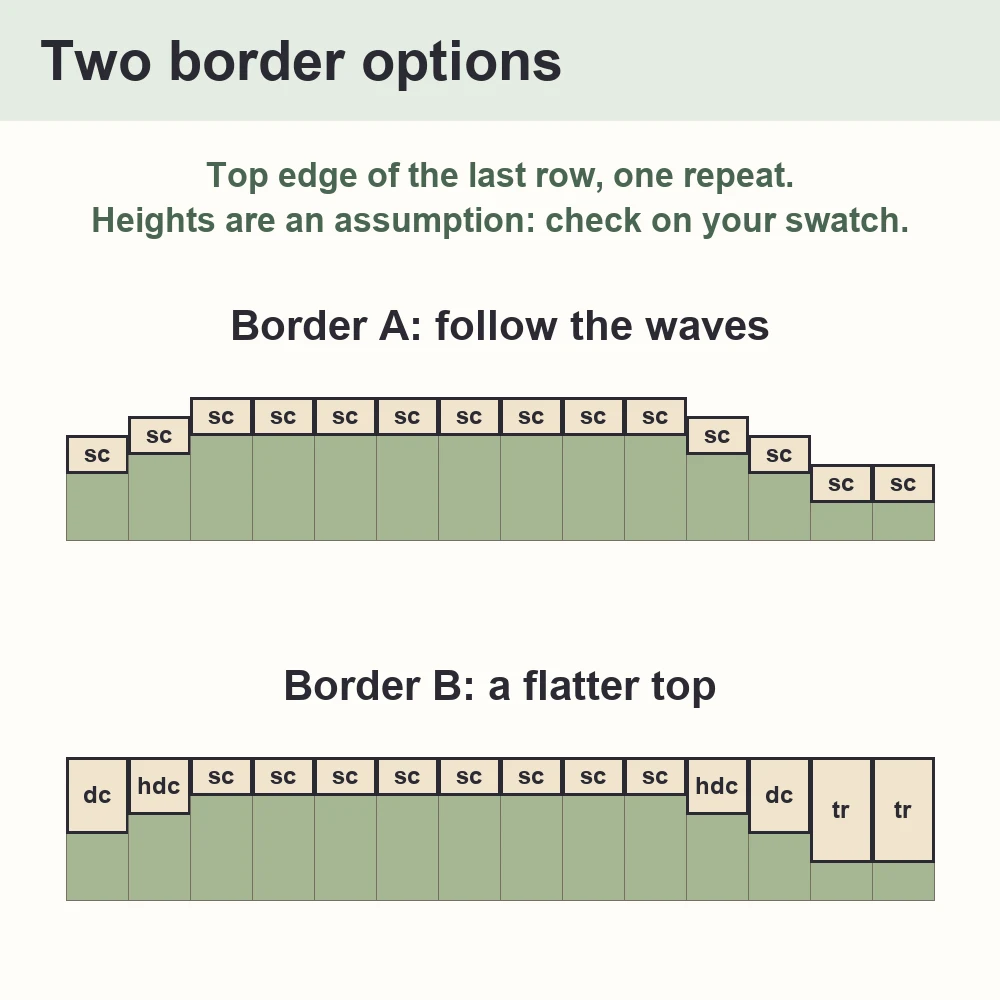
Border options for the wavy edge
Choose A if you want the quickest finish. Border A: easiest, keeps the zigzag top. Border B: a flatter top edge, needs about 10 more yd of Cream and careful counting. Not sure? Choose A. Cream, 1 round, right side facing. Sides and bottom are the same for both; only the top edge differs.
Border: corners, sides and bottom (A and B)Directions are for right-handed crocheters; left-handers mirror them. Fasten off the last color, leaving a 6 in tail. Hold the blanket with the right side facing you and the last row at the top: the last row ends at the top left corner. Join Cream with a sl st in the last dc of the last row (top left corner), leaving a 6 in tail. Ch 1 (does not count as a st), 3 sc in the same st (corner). Do not turn the work: keep the right side facing you and go round the blanket counterclockwise. Left side, going down: 2 sc in the end of each of the next 70 (Stroller) or 86 (Large) rows (the end of a row = the side of the end dc of that row or the ch 3, rows 2 to the second-to-last; the top and bottom rows are the corners). Bottom left corner: 3 sc in the free loop (the front V) of the last ch you made (the bottom of Row 1's turning ch 3). Bottom edge: work the border into the front V of each ch, the loop left free: sc in each of the next 113 (Stroller) or 141 (Large) ch. Bottom right corner: 3 sc in the free loop of the first ch you made (next to the slip knot). The bottom edge is the foundation chain: it starts flat, so it needs no shaping. Right side, going up: 2 sc in the end of each of the next 70 (Stroller) or 86 (Large) rows, starting at Row 2. Top right corner: 3 sc in the top of the turning ch of the last row.Stitch count: the same for A and B
Top edge, Border A (follows the waves)Top edge, Border A, going left: 1 sc in each of the next 110 (Stroller) or 138 (Large) sts of the last row (the top of each dc or dc2tog). The waves stay as they are. Join with a sl st in the first sc. Fasten off. If the sides pull in, work 3 sc in every 10th row end instead of 2 (one more sc); if they wave, work 1 sc in every 10th row end instead of 2. Each change adds or removes 1 sc: adjust your counts.Stitch count: 515 sc in all (Stroller) or 635 (Large)
Top edge, Border B: a flatter top edgeTop edge, Border B, going left: 110 (Stroller) or 138 (Large) sts of the last row, one stitch in each, filling the valleys. Number the sts of the last row from the right: the top right corner (the ch 3) is st 0, so the sts of the top edge are 1 to 110 (Stroller) or 138 (Large), and the top left corner is the last st of the row. In each group of 14 sts (sts 0-13, 14-27, and so on): tr in sts 6 and 7 (the 2 dc2tog of the valley), dc in sts 5 and 8, hdc in sts 4 and 9, sc in every other st. Join with a sl st in the first sc. Fasten off. If the sides pull in, work 3 sc in every 10th row end instead of 2 (one more sc); if they wave, work 1 sc in every 10th row end instead of 2. Each change adds or removes 1 sc: adjust your counts.Stitch count: 515 sts in all (Stroller) or 635 (Large)
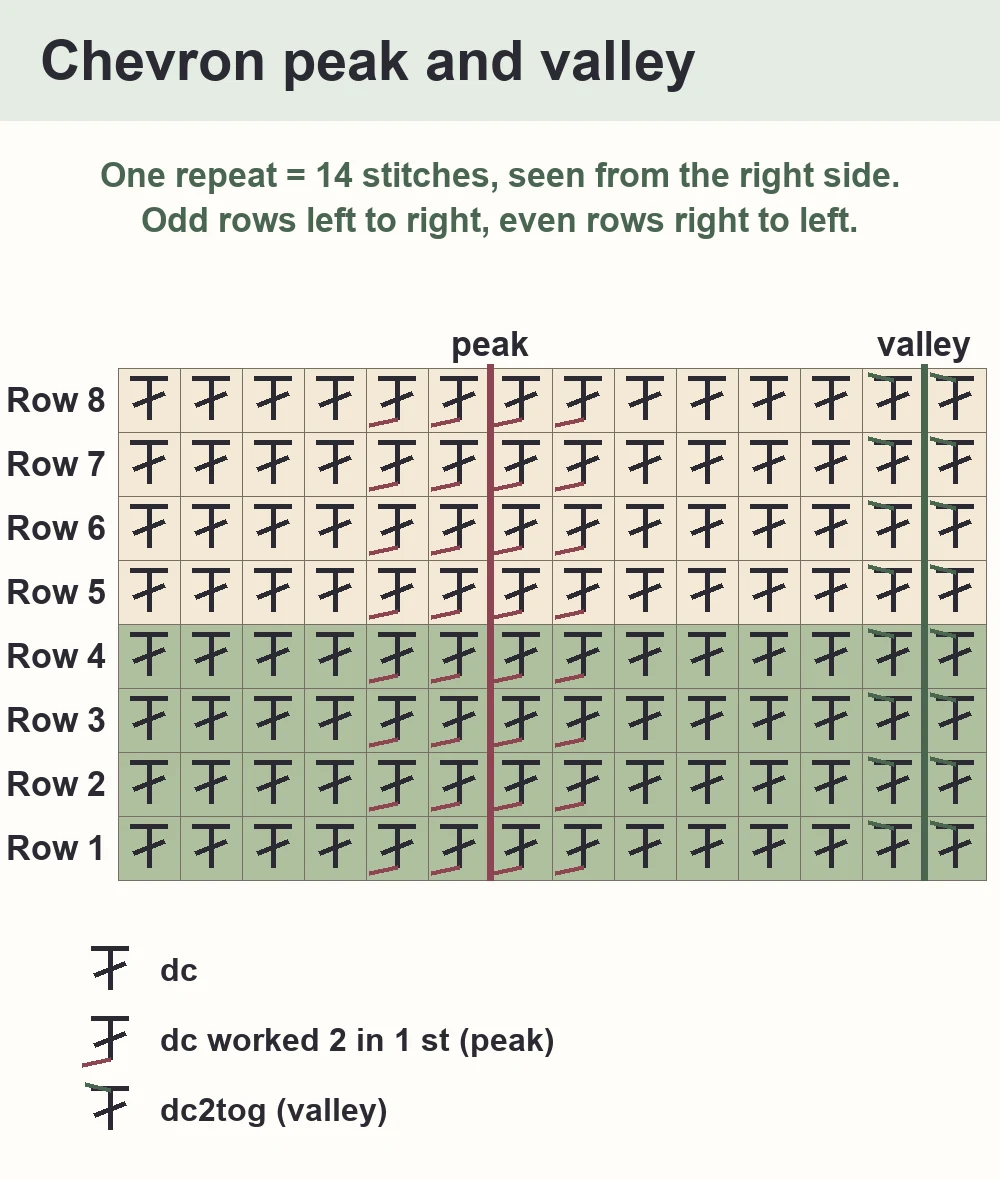
How the peak and the valley work (chart)
Seen from the right side: odd rows left to right, even rows right to left.
Rows 1 to 8, one repeat (14 sts): a peak is 2 dc in one stitch, a valley is a dc2tog (2 stitches worked together). A computer drawing from our row model. Tap to enlarge: Open it full size
Stroller 72 rows and Large 88 rows, with the row numbers of the first three stripes and the last one (the stripe card lists every stripe) and the Cream border (drawn thicker than scale). A computer drawing. Tap to enlarge: Open it full size
One repeat of the top edge. Border A keeps the waves. Border B fills the valleys so the top edge is flatter. Stitch heights are assumed (1 sc = 1 unit): check them on your swatch. A computer drawing. Tap to enlarge: Open it full size
Check that every end is woven in. Wash and dry the blanket as the yarn label says before you gift it. Block only if the yarn label allows it: pin the top and sides straight, spray lightly with water and let dry flat. Do not pin hard. Store clean, dry and loosely folded.
Weave in and wash
Weave each end through 2 or 3 inches of stitches of the same color on the wrong side. Wash and dry as the yarn label says.
Every stripe is 4 rows: Sage, then Cream, then Dusty Rose.
Put a stitch marker in the ch 3 of every row so you can count quickly.
To change the width, add or remove repeats: 14 more ch for each repeat. To change the length, add or remove 4 rows (one stripe).
Weave in the ends as you go, after each stripe. 38 (Stroller) or 46 (Large) ends at the end of the project feel much longer.
Mark each valley with a stitch marker on Row 1 and move it up every few rows: it shows right away if a valley drifts.
Common mistakes
Missing the dc2tog at a valley: the row gets 1 stitch too many and the chevron drifts to one side.
Working the first dc in the next st instead of the same st as the ch 3: the row gets 1 stitch too few.
Forgetting the last 2 dc in the turning chain top: the edge pulls in.
Pulling the foundation chain tight: the bottom edge puckers.
Make it your own
Other colors: any 3 colors with good contrast keep the stripes clear.
One color: skip the stripes, the chevron still shows.
Softer ripple: add more stitches between the peaks (swatch first).
Care
Follow the washing and drying instructions on the label of your yarn.
FAQ
What is the stitch multiple for this chevron crochet baby blanket?
14 stitches per repeat. The width is 14 x k stitches, where k is the number of repeats: 8 repeats make 112 stitches (Stroller) and 10 make 140 (Large). One repeat is 4 dc, 2 dc in each of 2 stitches (the peak), 4 dc, then dc2tog 2 times (the valley). The peak adds 2 stitches and the valley removes 2, so every row keeps the same count. To go wider, add 1 repeat: 14 more chains, about 3 1/2 in at our suggested gauge.
Why do I chain 14 x k + 3?
The 3 extra chains are the turning chain of Row 1. They count as the first dc and are skipped, so Row 1 starts in the 4th chain from the hook. Example: 8 repeats x 14 = 112 stitches, plus 3 chains = 115 chains (Stroller). The Large is 10 x 14 + 3 = 143 chains.
What is the best border for a chevron blanket?
Border A is Cream single crochet that follows the waves and is the quickest. Border B fills the valleys of the top edge so it is flatter. Not sure? Choose A, and try the border on your swatch. If the sides pull in, work 3 sc in every 10th row end instead of 2. If they wave, work 1 sc in every 10th row end instead of 2.
Is this an easy chevron blanket?
It is for an advanced beginner, not a first project. You should already work dc and count stitches, and the Stroller has about 8,000 stitches (Large about 12,000). The yarn is cut at every color change, so you weave in 38 ends (Stroller) or 46 (Large). Weaving in ends after each stripe makes the job lighter.
Can I leave this blanket in a crib with a baby?
No. It is for supervised use: stroller, play, cuddling. Do not leave it in a crib or bassinet with a sleeping baby (see Baby safety above).
Baby safety
This blanket is for supervised use (stroller, play, cuddling, photos with an adult next to the baby). Do not leave it in a crib or bassinet with a sleeping baby: the American Academy of Pediatrics says to keep soft objects and loose bedding, blankets included, out of a baby's sleep area. Stitches are open: check that no finger or toe can catch in a loop. Not a toy.
The AMG Royal pattern teamPatterns on AMG Royal are designed by calculation: every row is simulated and the full pattern is independently re-checked before publishing. They are not hand-crocheted samples — times and yardage are estimates.How we make our patternsFound a mistake? Tell us
 SweatersCrochet Baby Sweater Pattern: Moss Stitch, Sizes 0-3 to 18-24 Months
 SweatersFree Chunky Crochet Cardigan Pattern: Boxy Open Cardigan, Sizes S to 2X
 Baby BlanketsEasy Crochet Baby Blanket in Moss Stitch (Free Pattern, 2 Sizes)
 SweatersCrochet Christmas Sweater Ornament (Mini Tapestry Sweater)
 SweatersChunky Crochet Sweater (Boxy Pattern, Sizes S-2X)
 SweatersCrochet Christmas Sweater (Boxy Pattern, Sizes S-2X)