
If you are working out how to homeschool multiple kids, the first thing to know is that you do not need to run two or three separate schools at one table. Most of the sources below sort every subject into one of two piles: what the whole family can learn together, and what each child has to learn at their own level.
This guide sorts subjects by age gap, shows what children can usually do alone at 5, 7, 9 and 12, and adds rotation plans, three worked examples, a troubleshooting table and a free printable planner. Clock-by-clock schedules are in our homeschool schedule examples; this article is about who learns what, together or apart. No company paid to be mentioned and there are no affiliate links.
Key Takeaways
- Teach content together (history, science, read-alouds, art) and skills apart (math, phonics, writing).
- The wider the age gap, the less you combine: keep the topic, change the task.
- Give each child a short one-on-one block, then rotate. Published advice runs from 20 to 30 minutes.
- Write one page per child so the plan lives on paper, not in your head.
The Rule Behind Every Multi-Age Homeschool
Advice for teaching several ages keeps landing in the same place. Homeschool.com calls teaching in a family-style way “the #1 recommendation of experienced homeschool parents for managing multiple levels,” and names math as the exception. Sonlight sorts subjects into two types: shared ones, and skill subjects chosen “for each child, according to each child’s skill level.” Build Your Library describes the same order: family subjects first, then math and language arts as independent work.
The reason is how the subjects are built. History and science are topics, so a seven-year-old and a twelve-year-old can hear the same story and take away different things. Math and phonics are sequences, where each step depends on the one before, so a shared lesson is too fast for one child and too slow for the other. In short: same topic, different task; same sequence, never the same lesson.
How to Homeschool Multiple Kids: A Together-or-Split Matrix by Age Gap
The right mix depends less on grade names than on the distance between your children. Use this as a starting point, not a standard. It is this guide’s rule of thumb, built on the advice in the sources below. Sonlight says its shared subjects “can be shared by siblings within a 3-year age range,” and Demme Learning says gaps of 2 to 3 years “often work well for combined learning.”
| Age gap | What to teach together, and what to split |
|---|---|
| 0–2 years apart for example, 7 and 8 | Together: history, science, geography, read-alouds, art and music, plus spelling or grammar games if both children are at the same point. Split: math and phonics (unless a placement test shows the same point), handwriting and writing instruction. |
| 3–4 years apart for example, 6 and 10 | Together: one read-aloud, one science or history topic. Younger child draws or narrates; older child reads and writes. Split: all of math, reading and phonics, handwriting and writing instruction. |
| 5 or more years apart for example, 5 and 12 | Together: a short family block: a story, a nature walk, cooking or art. Split: nearly all academic work. The older child works mostly alone, with check-ins, while you teach the younger one. |
| A toddler or baby plus school-age kids | Together: a song or story at the start of the day. Split: everything else. Schedule your one-on-one blocks around the little one’s box or nap. |
As the gap grows, the shared block gets shorter and independent work gets longer. With a wide gap you plan more independent tasks. The ladder below shows what to put in them.
Subject by Subject: What Combines and What Does Not
Subjects that combine well
- History and geography. One story for everyone, then a task sized to each child.
- Science. One demonstration or video, then a drawing, a caption or a written report depending on age.
- Read-alouds. The easiest shared block, because a story needs no leveling.
- Art, music and cooking. Open-ended work scales on its own.
Subjects that stay separate
- Math. Homeschool.com lists it as the exception to teaching as a group. The homeschool math curriculum guide explains how to place each child.
- Phonics and early reading. One child sounding out words cannot share a lesson with one who is reading chapter books. See the homeschool reading curriculum comparison.
- Handwriting and writing instruction. Each child needs feedback on their own work.
Morning Basket, Unit Study or Multi-Level Program?
Three formats can carry the shared block. The Canadian Homeschooler describes a morning basket as “an intentional group time where you have set subjects to do together as a family.” Demme Learning describes a unit study as one topic for several ages, with depth adjusted for each. Group programs, the Canadian Homeschooler says, usually “offer options and adaptations for younger learners and high school students.” Its author says she tried to do a lot of her homeschooling together through unit studies for many years, and that it “ended up not being the best way for my kids to learn.” In our view, a morning basket can fit well when the gap is wide and a unit study when it is two or three years; math and phonics stay separate either way. Check a program’s statement about faith content before you buy; the curriculum review guide shows how to test one.
Three Worked Examples: Who Does What
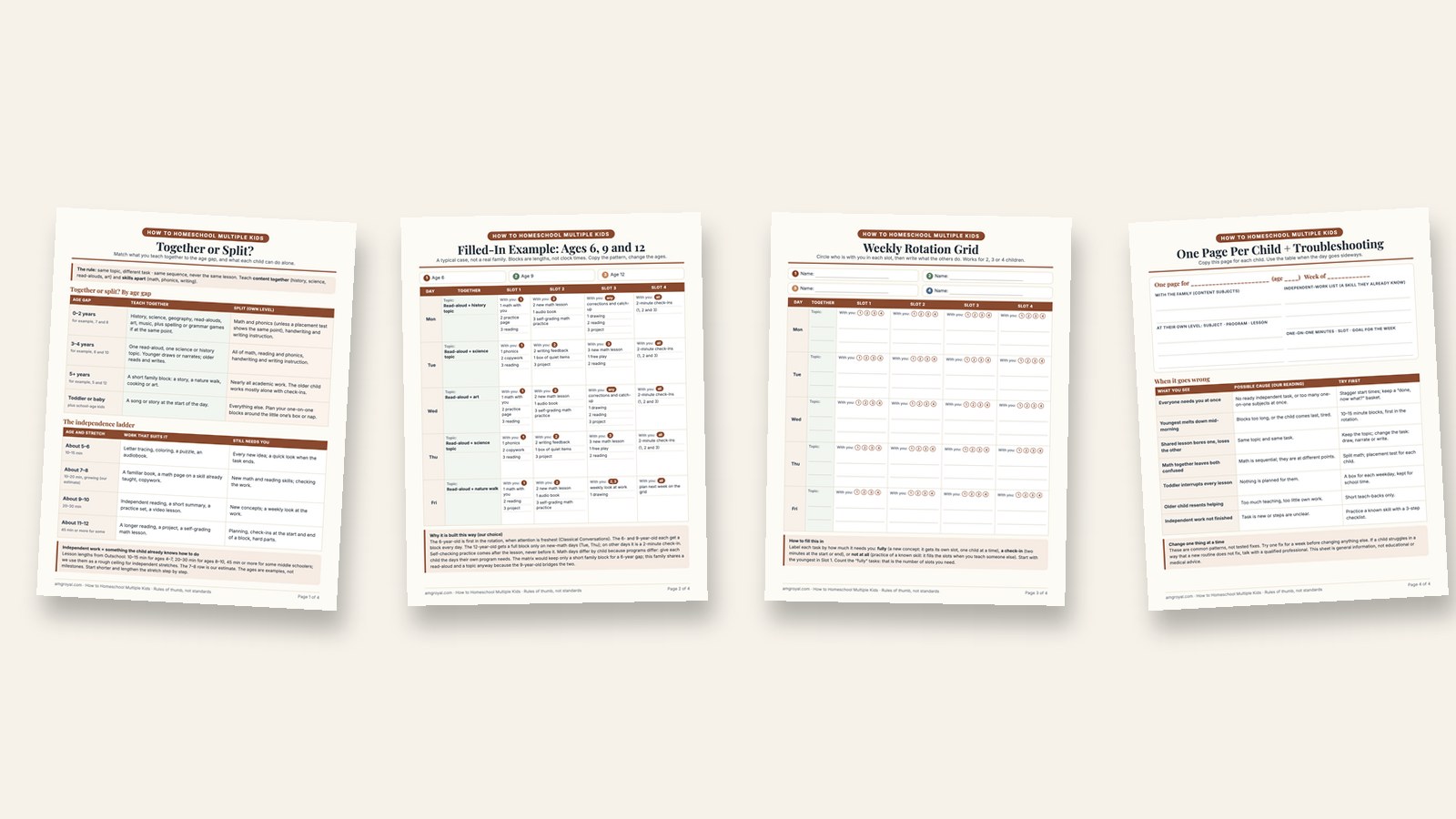
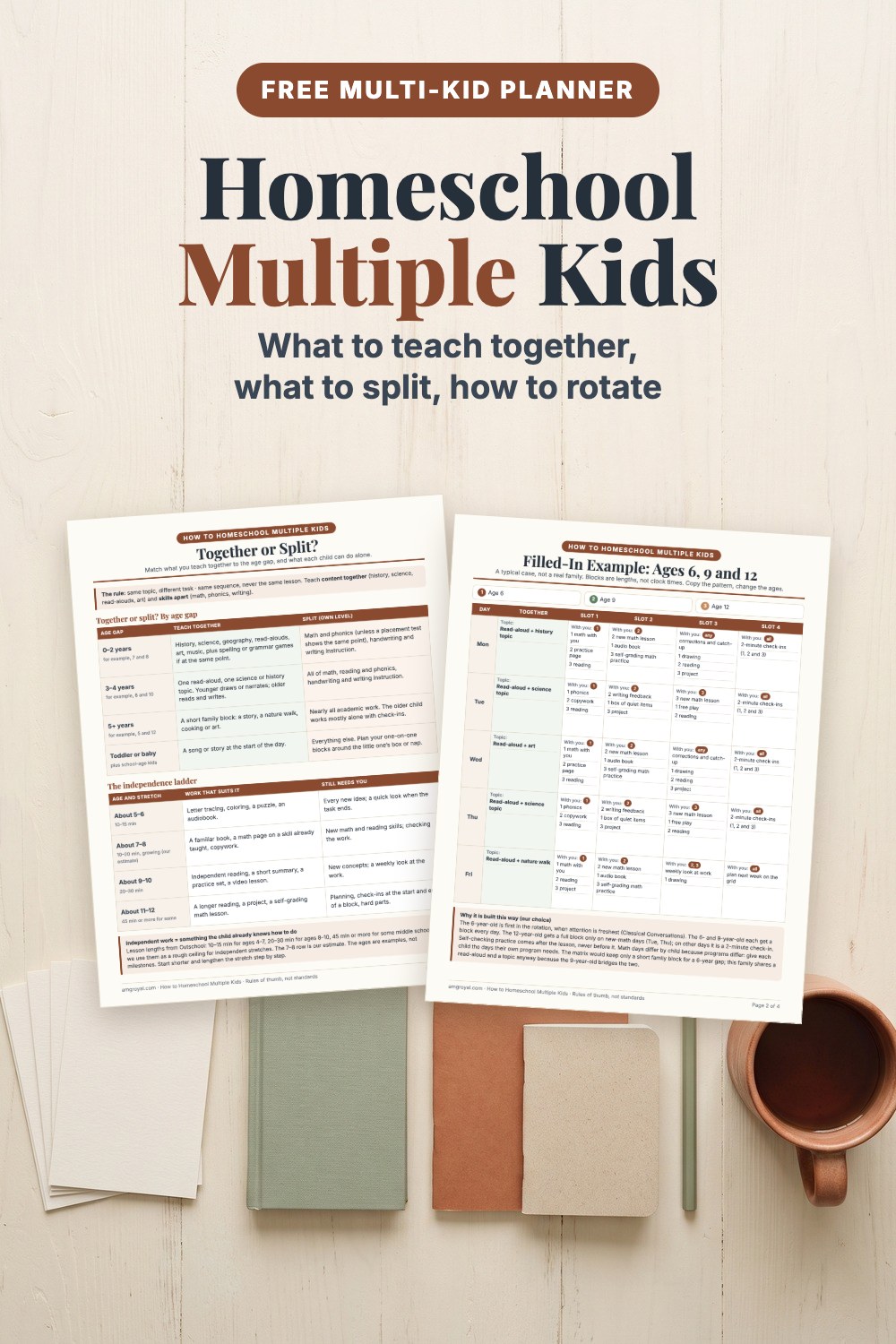
These are typical cases, not real families, and the ages are examples you can adapt. Each one uses the matrix above, the independence ladder and the “needs you” levels. Blocks are lengths, not clock times. Example 2 is filled in on page 2 of the free planner.
Example 1: Ages 5 and 8
- Together: a read-aloud and one science topic. The 5-year-old draws or tells; the 8-year-old writes a sentence. (A 3-year gap is at the edge of Sonlight’s limit, so keep the task different.)
- Split: math and phonics for the younger child; math and writing for the older one.
- On their own: the 8-year-old reads or does a page on a skill already taught; the 5-year-old traces letters or listens to an audio book.
- You: one block with the 5-year-old first, then one block with the 8-year-old. That is two one-on-one blocks a day.
- Why: the youngest is freshest first, as Classical Conversations suggests, and each child works alone while you teach the other.
Example 2: Ages 6, 9 and 12
- Together: a read-aloud and a history or science topic. The 6-year-old draws, the 9-year-old writes a short summary, the 12-year-old adds a question of their own.
- Split: all math, phonics for the 6-year-old, writing for the other two.
- On their own: the 12-year-old gets the longest stretch: reading, a project, a self-grading math lesson.
- You: a block for the 6-year-old and one for the 9-year-old every day, and a block with the 12-year-old on new-math days, plus a two-minute check-in on the other days.
- Why (our choice): 6 and 12 are in the “5 or more years” row, so the matrix would keep only a short family block. This family shares one read-aloud and one topic each day anyway, because the 9-year-old bridges the two (about 3 years on each side); the 12-year-old gets the hardest task and the longest time alone. If you prefer the matrix as written, cut the shared block to the read-aloud. Math days differ by child because programs differ, so give each child the days their own program needs.
Example 3: Ages 4, 7, 10 and 14
- Together: only a short family block: a story, a nature walk, cooking or art. The 7- and 10-year-old can also share one science topic, since they are within three years.
- Split: everything academic. We assume no formal lessons for the 4-year-old, just a box and a song; the preschool guide covers the options.
- On their own: the 14-year-old works alone for most of a block and meets you at the start and end of it. This goes beyond the published ranges, so treat it as an estimate.
- You: the 4-year-old’s box goes out first, then a block with the 7-year-old, one with the 10-year-old and a check-in with the 14-year-old. A short teach-back from the oldest to the youngest is optional.
- Why: with a 10-year spread, in our view a short shared block plus one science topic is enough. The “needs you” count, not the age, decides how many blocks you need.
The Independence Ladder: What Kids Can Do Alone
You cannot teach one child while another needs you every two minutes. Independence is the thing that makes a rotation work, and it grows in steps. The published numbers are about lesson length, and they are short. Outschool says younger children (ages 4 to 7) “generally need 10-15-minute focused sessions followed by breaks,” ages 8 to 10 can handle 20 to 30 minutes, and middle schoolers “might work independently for 45 minutes or longer.” We use them as a rough ceiling for independent stretches. The 5–6, 9–10 and 11–12 rows follow those numbers; the 7–8 row is our own estimate between the two published ranges.
| Age and stretch | Work that suits it, and what still needs you |
|---|---|
| About 5–6 10–15 minutes | Letter tracing, coloring, a puzzle, listening to an audiobook. Still needs you: every new idea, and a quick look when the task ends. |
| About 7–8 10–20 minutes, growing (our estimate) | Reading a familiar book, a math page on a skill already taught, copywork. Still needs you: new math, new reading skills, checking the work. |
| About 9–10 20–30 minutes | Independent reading, a short written summary, a practice set, a video lesson. Still needs you: new concepts and a weekly look at the work. |
| About 11–12 45 minutes or more for some | A longer reading assignment, a project, an online or workbook math lesson that grades itself. Still needs you: planning, a check-in at the start and end of a block, and talking over the hard parts. |
The ages above are examples, not milestones. What matters is the pattern the sources share: independent work is something the child already knows how to do. Outschool’s examples are a five-year-old tracing letters and a seven-year-old reading or finishing a math worksheet they have already been taught.
A simple way to build independence
- Start by sitting next to the child for the first five minutes of an independent task, then leave.
- Then add a written checklist of two or three steps so they do not need to ask what is next.
- Keep a basket of “done, now what?” choices: a book, drawing paper, an audiobook.
Rotation Plans: Three Ways to Run One Morning
Once children can work alone for a stretch, you rotate your attention. Homeschool.com recommends keeping one-on-one sessions “no longer than thirty minutes per child, if possible,” and Outschool suggests rotating every 20 to 30 minutes. Here are three patterns. Pick one for a few weeks before you change it.
Where to begin the rotation: Classical Conversations suggests you “begin with the youngest learners in the morning when their attention is freshest,” and HowToHomeschool.com says to have school with the youngest children “right after breakfast.”
Pattern 1: Build the rotation from “needs you” levels
Instead of copying someone else’s grid, label each child’s tasks by how much they need you, then place the high-need tasks one after another so that no two overlap. This is our own method, not a published one. For a worked two-child morning with times, see the schedule examples.
| How much it needs you | What to do with it |
|---|---|
| Fully a new concept, a first lesson | Give it its own slot, one child at a time. Everyone else is on a task from the lines below. |
| A check-in review, corrections | Stand at the table for two minutes at the start or end of a slot. It does not need a slot of its own. |
| Not at all practice of a known skill | Fill the slots when you are teaching someone else: reading, copywork, a practice page, an audiobook. |
Count the “fully” tasks for the week. That count is the number of slots you need; if it is more than your day can hold, drop or move one before you add anything. The weekly grid in the free planner is built for exactly this.
Pattern 2: Staggered starts
Abeka suggests that if three children can each learn independently for windows of time, you can start one at 8 a.m., the next at 9 a.m. and the third at 10 a.m. It also describes setting an older child up with an assignment for a window of “an hour or so” while you begin with the youngest. This pattern suits families with a big gap, and it can be combined with Pattern 1.
Pattern 3: Older helps younger, in small doses
Classical Conversations notes that “older students can reinforce their own understanding by explaining concepts to younger siblings.” Keep it to a short teach-back or a read-aloud to the younger child. If the older child starts to sound frustrated, cut the helping back and give them more of their own work (see the troubleshooting table).

One Page Per Child
When you have one child, the plan fits in your head. With three, it does not. The fix is one page per child with five things: the subjects they do with the family, the subjects they do at their own level and the program for each, their independent-work list, their one-on-one minutes, and one goal for the week. The last page of the free planner is that sheet. Fill it out once a week and the rest of the plan follows. Homeschool.com puts an organization system first, and a shelf, bin or cart per child is the simplest one: share read-alouds, kits and art supplies, and keep the math and reading programs, workbooks and folders per child.
Printing outside the US? Get the A4 version of the Multi-Kid Planner.
When It Goes Wrong: What You See, Why, What to Try First
These are common patterns and starting points, not tested fixes; the causes are our reading of the advice above. Change one thing at a time and give it a week.
| What you see | Possible cause (our reading), and what to try first |
|---|---|
| Everyone needs you at once | Cause: no ready independent task, or too many one-on-one subjects at the same time. Try: stagger the start times and keep a done-now-what basket. |
| The youngest melts down by mid-morning | Cause: blocks too long, or the child comes last when tired. Try: shorter blocks of 10 to 15 minutes, first in the rotation. |
| A shared lesson bores one child and loses the other | Cause: same topic, same task. Try: keep the topic and give each child a different task: draw, narrate or write. |
| Math together leaves both confused | Cause: math is sequential and the two are at different points. Try: split math and use a placement test for each child. |
| The older child resents helping | Cause: too much teaching, too little of their own work. Try: limit helping to short teach-backs. |
| Independent work never gets finished | Cause: the task is new or the steps are unclear. Try: swap in practice on a skill they know, with a 3-step checklist. |
If a child seems to be struggling in a way that a change of routine does not fix, talk with a qualified professional rather than redesigning the whole plan. This guide is general information, not educational or medical advice.
Printing outside the US? Get the A4 version of the Multi-Kid Planner.
Frequently Asked Questions
How do I homeschool multiple kids at different grade levels?
Start with the age gap, not the grade names. With children 0 to 2 years apart you can share most content subjects; Demme Learning says gaps of 2 to 3 years “often work well for combined learning.” With 5 or more years apart, plan a short family block and let the rest be separate. The matrix in this guide shows the split, and the schedule examples show a worked morning for two children.
How much one-on-one time does each child need?
Published advice is short: Homeschool.com suggests “no longer than thirty minutes per child, if possible,” and Outschool suggests rotating every 20 to 30 minutes. Younger children need shorter blocks, so start with the youngest.
Can I teach math to two kids at the same time?
Usually not. Homeschool.com names math as the exception to family-style teaching, and Demme Learning says students should not be taught the same level of math at the same time. If both children are at the same point in the same program, a shared lesson can work for a while; check with a placement test.
Sonlight says its shared subjects “can be shared by siblings within a 3-year age range.” That is one publisher’s rule of thumb, not a standard. With a bigger gap, keep the same topic and change the task: the younger child draws or narrates and the older child reads and writes.
What do I do with a toddler during lessons?
Give them their own track. One published tip is a special box of quiet activities for each homeschool day, plus school with the youngest right after breakfast. For a child ready for real lessons, see the homeschool preschool curriculum guide.
Do I need a separate curriculum for every child?
Not for every subject. Sonlight puts it this way: skill-based subjects such as language arts, spelling and math should be chosen “for each child, according to each child’s skill level,” while history, science and read-alouds can be one program for several children. See the subject guides for options in each area.
The Bottom Line
Sort the subjects into together and split, give each child a few minutes of one-on-one time, and write one page per child. Start by filling in the weekly grid for next Monday. New to all this? Begin with how to start homeschooling and homeschooling 101; for the shape of one child’s day, see how to homeschool. All the free planners are on the homeschool printables page.
Planning for more than one learner? Pin this image so you can find the Multi-Kid Planner again.
This article is for general information only and is not educational, legal or medical advice. Quotes and figures were read on each source page on October 24, 2026, and the pages can change at any time.
Sources
- Outschool: How to Homeschool Multiple Kids
- Homeschool.com: How to Homeschool Multiple Children
- Abeka: Tips for Homeschooling Multiple Children at Once
- Classical Conversations: How to Homeschool Multiple Ages, 10 Helpful Tips
- A Healthy Slice of Life: Practical Tips for Homeschooling Multiple Ages
- Sonlight: Homeschooling Multiple Ages and Students
- Build Your Library: Tips for Teaching Multiple Ages
- HowToHomeschool.com: Homeschooling Multiple Kids
- The Canadian Homeschooler: How to Homeschool Multiple Kids Successfully
- Demme Learning: Strategies for Homeschooling Multiple Ages