
Choosing a homeschool language arts curriculum sounds like one decision, but it is really six: reading, spelling, grammar, writing, handwriting and literature. Some programs bundle most of them in one box. Others teach a single strand well and expect you to add the rest.
This guide compares nine programs by one question: what is actually inside the box? Each strand is marked as inside, partly or optional, sold separately or no course found, using only what the publishers say on their own pages (read in October 2026; product ranges change, so check the date). A free printable planner puts the grid on paper. No company paid to be listed, there are no affiliate links, and there are no prices because they change too often.
Key Takeaways
- Language arts is six strands, not one subject. Ask which are inside the program and which you must add.
- On the pages we read, only Easy Peasy lists all six strands inside the program, with caveats: its handwriting is a kindergarten course, its spelling course is optional and its literature is one grade 8 course. The Good and the Beautiful has five inside and sells handwriting separately; BookShark has four inside and treats handwriting and literature as partial.
- Specialists such as Easy Grammar and Handwriting Without Tears cover one strand each and pair with a reading program.
- Handwriting is the strand most often outside the core course: three programs teach it inside (Easy Peasy, Handwriting Without Tears and Logic of English Foundations A and B); the rest sell it separately, treat it as optional or do not list it.
- Test the strands you will actually use, one real page each, before you commit.
What Counts in a Homeschool Language Arts Curriculum?
Publishers bundle language arts differently, but six strands cover almost every program.
- Reading and phonics: decoding words, fluency and comprehension.
- Spelling: rules, patterns and words to memorize.
- Grammar: parts of speech, sentences and punctuation.
- Writing: sentences, paragraphs, stories and reports.
- Handwriting: print, cursive and, later, typing.
- Literature: the books and poems your child reads and discusses.
Young children start with phonics. For a ten-program comparison of phonics and early reading, see our homeschool reading curriculum guide. This one steps back and asks how reading fits with the other five strands.

All-in-One or Separate Subjects?
Easy Grammar and IEW each sell one strand. The Good and the Beautiful and BookShark bundle most of them. The trade is simplicity against control.
When an all-in-one makes sense
An all-in-one gives you one scope and sequence, one teacher’s guide and fewer purchases. The cost is that a weak strand stays attached to a strong one.
When separate subjects make sense
Separate programs let you match each strand to the child, for example a slower spelling program next to a strong reader. The cost is more materials and more lesson plans to read.
The middle path
You can run one all-in-one for the daily core and add a single specialist for the weakest strand. The guide to homeschool curriculum reviews explains how to test before you buy.
Nine Homeschool Language Arts Programs at a Glance
Each description comes from the publisher’s own pages. The faith label is what the publisher says about itself; “no faith statement found” means the pages read made no religious claim. The secular homeschool curriculum guide explains how to read those labels.
| Program | Levels and faith label |
|---|---|
| All About Reading + All About Spelling | Reading: pre-reading + 4 levels. Spelling: 7 levels No faith statement found Two products from one publisher |
| Logic of English | Foundations ages 4–7, Essentials ages 8 and up No faith statement found |
| The Good and the Beautiful Language Arts | Preschool to high school Says Christian, non-denominational |
| BookShark Language Arts | Ten age-based levels, ages 5 to 18 Says faith-neutral |
| Easy Peasy All-in-One Homeschool | Free online, preschool to grade 8 (separate high school site) Says Christian |
| IEW (Institute for Excellence in Writing) | Writing method, grades 3–5, 6–8 and 9–12 No faith statement found |
| Easy Grammar | Grammar workbooks, grades 1–12 and up No faith statement found |
| Handwriting Without Tears (Learning Without Tears) | Print TK and K–2, cursive grades 2–6 No faith statement found |
| Khan Academy ELA | Free online, course lists for grades 2 to 10 No faith statement found |
We could not place several all-in-ones that search results mention. The Brave Writer, Master Books (Language Lessons for a Living Education) and Well-Trained Mind pages returned errors in our browser (403 or 530). Abeka’s kindergarten overview was readable, but we found no page listing its strands by grade. Common Sense Press describes Learning Language Arts Through Literature as an integrated, literature-based approach but lists no strands on the pages we read. Nothing was guessed.
What Is Actually Inside the Box
Guides usually give each program one main job. This table marks all six strands for every program with one rule, and each mark rests on the publisher’s own wording, which we read page by page in October 2026.
- Inside: taught in the program’s own lessons, at one level or more.
- Partly or optional: only a light, introductory or optional part, or only in some packages.
- Sold separately: a different product from the same publisher, bought on its own.
- No course found: no course or product turned up on the publisher pages we read (Khan Academy: 3 pages; the other eight programs: 14 to 30 pages each). A passing mention is not a course, and the absence holds only for those pages, so ask the publisher before you rely on it.
| Program | Strands, by status |
|---|---|
| All About Reading + Spelling | Inside: reading, spelling Partly or optional: writing No course found: grammar, handwriting, literature |
| Logic of English | Inside: reading, spelling, grammar, handwriting Partly or optional: writing Sold separately: literature |
| The Good and the Beautiful | Inside: reading, spelling, grammar, writing, literature Sold separately: handwriting |
| BookShark Language Arts | Inside: reading, spelling, grammar, writing Partly or optional: handwriting, literature |
| Easy Peasy All-in-One | Inside: reading, spelling, grammar, writing, handwriting, literature |
| IEW | Inside: writing Partly or optional: grammar, literature Sold separately: reading, spelling, handwriting |
| Easy Grammar | Inside: grammar Partly or optional: writing No course found: reading, spelling, handwriting, literature |
| Handwriting Without Tears | Inside: handwriting Sold separately: reading, grammar, writing No course found: spelling, literature |
| Khan Academy ELA | Inside: reading, grammar Partly or optional: literature No course found: spelling, writing, handwriting |
Counting only the “inside” marks: six: Easy Peasy All-in-One; five: The Good and the Beautiful; four: Logic of English, BookShark Language Arts; two: All About Reading + Spelling, Khan Academy ELA; one: IEW, Easy Grammar, Handwriting Without Tears. The planner shows the partial marks as half-filled circles. Limits are noted on the cards below: Easy Peasy’s handwriting is a kindergarten course and its literature is one grade 8 course, and Logic of English’s handwriting instruction sits in Foundations A and B.
Printing outside the US? Get the A4 version of the Language Arts Planner.
The Programs, One by One
1. All About Reading and All About Spelling
Two programs, two purchases: All About Reading for decoding and All About Spelling for spelling, which the publisher describes as seven levels. The publisher says one set of letter tiles covers both. We found no grammar or handwriting course. All About Spelling mentions “writing activities” (dictation and a Writing Station) but no writing course, so plan grammar, handwriting and composition separately. The phonics side is covered in our homeschool reading curriculum guide.
2. Logic of English
The publisher’s home page describes Foundations for ages 4 to 7 and lists handwriting alongside phonics, spelling, vocabulary and grammar, and Essentials as phonics, spelling, grammar and vocabulary for ages 8 and up. Handwriting instruction is explicit in the Foundations Level A and B workbooks, with Rhythm of Handwriting sold on its own. Composition is only an introduction in Foundations, plus an optional Essentials reader bundle, so writing needs a partner. Literature is a purchase: the Foundations D bundle page says the Children’s Literature Bundle is not included but is required to complete Foundations D.
3. The Good and the Beautiful
The language arts collection runs from preschool to high school. The details here come from the Level 3 course page: 120 parent-led lessons that fold phonics, reading, spelling, writing, grammar, literature, art, poetry and geography into one course, with optional videos that can replace a lesson. Handwriting is the exception, sold as a separate handwriting collection. The faith label is in the table above and in the secular guide.
4. BookShark Language Arts
Levels are set by age, not grade: ten levels from 5 to 18, plus three Literature & Language Arts courses for ages 14 to 18. BookShark lists phonics, spelling, copywork, creative expression and writing mechanics, with grammar named in the Level D guide. Two strands are partial. Handwriting Without Tears is an optional supplement scheduled in the guide (the All-Subject Packages include it). Readers are a choice in Levels 1 to 4, and in Levels D to H they come with a Reading with History or All-Subject package, not with Language Arts alone. The publisher calls the program completely faith-neutral; our secular curriculum guide explains how that label applies to science.
5. Easy Peasy All-in-One Homeschool
Easy Peasy is the one program here whose course list covers all six strands, at no cost: reading and phonics courses, Language Arts 1 to 7, a Kinder Writing course that teaches handwriting (later courses only carry handwriting as daily practice items), and one Literature and Composition course for English 8. Its Spelling course is described as “not intended for everyone, just for those who are struggling with spelling.” The site describes itself as a Christian curriculum, and high school sits on a separate site.
6. IEW: Institute for Excellence in Writing
A writing method first. IEW’s Structure and Style is a 24-week course taught by video for grades 3 to 5, 6 to 8 or 9 to 12 (see the writing products). The Basic Plus package adds a full year of Fix It! Grammar, while the Basic package does not, so compare the package contents before assuming grammar is covered. The shop also sells Primary Arts of Language for grades K to 2, whose Writing book includes handwriting instruction, along with phonics, spelling and poetry/literature products.
7. Easy Grammar
Easy Grammar Systems is grammar for grades 1 to 12 and up, with an “Easy Writing” menu item for a separate writing book, and its grade 3 to 6 and Plus workbooks also carry a short writing section (appositives, semicolon construction). Daily GRAMS is a 5 to 10 minute daily review, and the Ultimate Series for grades 8 to 12 and up has 180 ten-minute lessons. It does not list reading, spelling or handwriting.
8. Handwriting Without Tears
From Learning Without Tears, Handwriting Without Tears teaches print for TK and grades K to 2 and cursive for grades 2 to 6. The same publisher sells Building Writers, which teaches sentence construction with grammar in context, and Phonics, Reading, and Me as separate programs, which is why they are marked as sold separately in the grid.
9. Khan Academy English Language Arts
Khan Academy is free. Its ELA index lists reading and vocabulary courses for grades 2 to 10 and grammar topics, from nouns to punctuation and style and tone, from 5th grade. The 4th grade course includes lessons on reading literary texts. We found no spelling, writing or handwriting course on the pages we read. Khan Academy also runs a separate Writing Coach tool, which its page says is free for teachers and their students in the U.S.
Who Teaches: You, a Video or Your Child
Each publisher describes who delivers the lesson: a teacher’s guide, video lessons or a self-directed course.
| Who teaches | Programs from this guide |
|---|---|
| You, from a teacher’s guide | All About Reading and Spelling, Logic of English, BookShark, The Good and the Beautiful (preschool to grade 3) |
| A video teacher | IEW, plus optional videos in The Good and the Beautiful and optional online lessons in Logic of English |
| Your child, mostly alone | Khan Academy, Easy Peasy, The Good and the Beautiful (grades 4–8 and high school courses are described as mostly self-directed) |
| Short daily drills | Easy Grammar Daily GRAMS and Handwriting Without Tears |
Language Arts by Level
Levels below come from each publisher’s own page.
Kindergarten to grade 2
Reading and handwriting lead: All About Reading, Logic of English Foundations, Handwriting Without Tears print, Easy Peasy’s Kinder Writing and the early levels of The Good and the Beautiful or BookShark. See the kindergarten homeschool curriculum guide.
Grades 3 to 5
Easy Grammar and IEW treat grammar or writing as a course of their own, while all-in-ones such as The Good and the Beautiful fold them into daily lessons. IEW Level A is written for grades 3 to 5.
Grades 6 to 8
Khan Academy lists grammar topics from 5th grade, The Good and the Beautiful describes its grades 4 to 8 courses as mostly self-directed, and IEW Level B is for grades 6 to 8.
Grades 9 to 12
IEW Level C is for grades 9 to 12, Easy Grammar’s Ultimate Series covers grades 8 to 12 and up, BookShark has literature courses for ages 14 to 18, and The Good and the Beautiful lists mostly self-directed high school courses. For the whole stretch, see the homeschool high school curriculum guide.
A Sample-Page Check for Each Strand
These checks are our own rule of thumb, not publisher claims. For each strand you plan to buy, print one real page. For faith content in model sentences and copywork, use the check in our secular homeschool curriculum guide; for how to try a program before you pay, see the curriculum reviews guide.
- Reading: is the text something your child can decode with the sounds taught so far, or does it rely on guessing from pictures?
- Spelling: are words grouped by a pattern or rule, and does a later lesson bring old words back?
- Grammar: are the exercises on whole sentences, and could you teach the lesson cold in a few minutes?
- Writing: is there a model to follow and a clear first step, and does the teacher’s guide say what to do when a child is stuck?
- Handwriting: does the page show how each letter is formed, and is the amount of practice small enough to finish?
- Literature: are the books named, and can you borrow them from a library instead of buying?
The same checks are on page 2 of the planner, with a place to score each one.
What You See, Possible Cause, Try First
This table is our editorial rule of thumb, not a publisher claim. Use it before you switch programs.
| What you see | Possible cause | Try first |
|---|---|---|
| Tears over writing | Task too big | Shorter task, add copywork |
| Reads well, spells badly | Strands out of sync | Add a spelling program |
| Grammar feels pointless | No link to writing | Edit your child’s own sentences |
| Messy letters | Long practice sessions | Five minutes, fewer letters |
| You skip language arts | Too much prep | Pick a scripted program |
| Finishes fast, no challenge | Placed too low | Take the publisher’s placement test |
If a problem lasts for weeks, talk with a qualified professional rather than switching programs again and again.
Free Printable Language Arts Planner
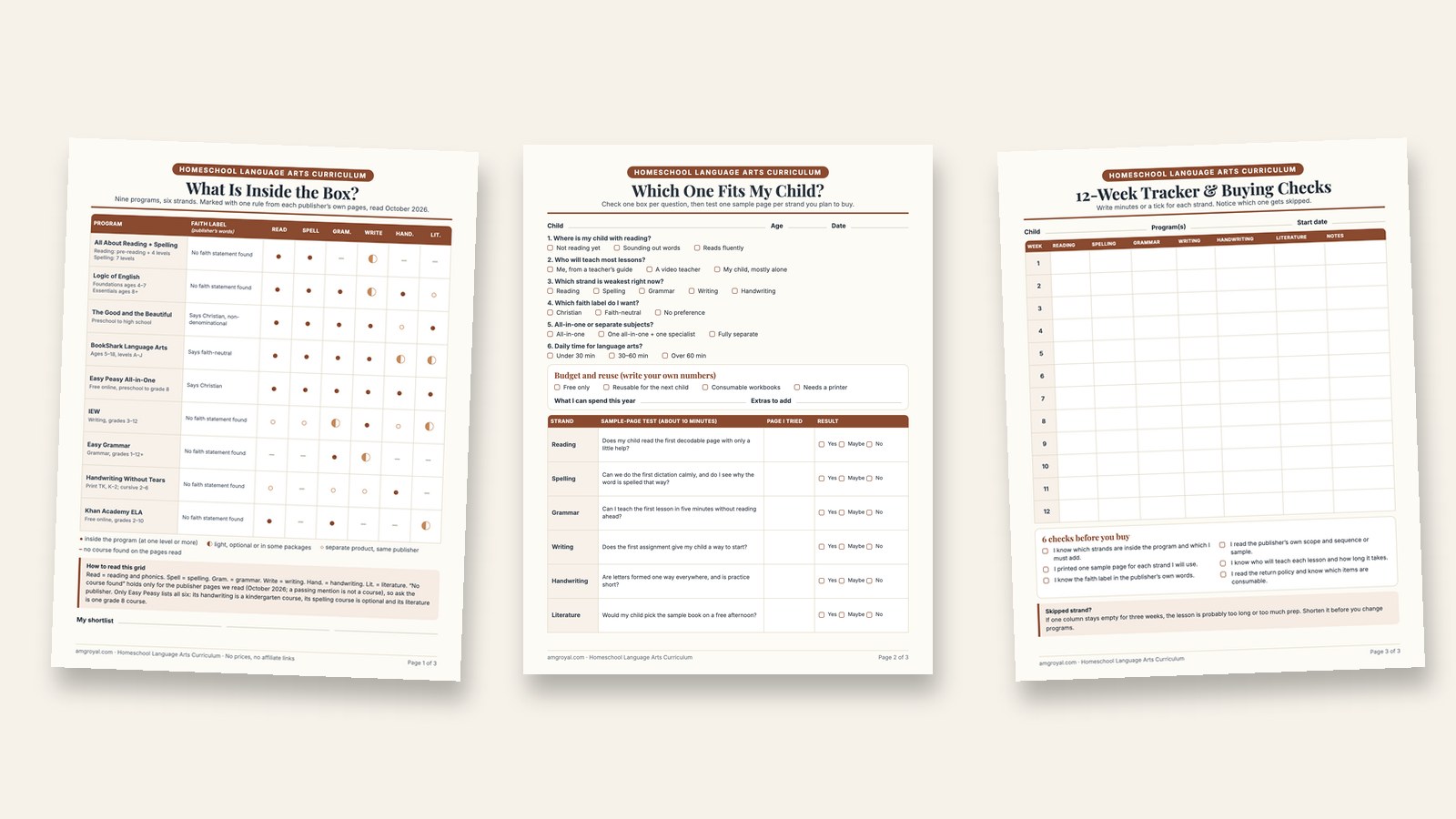
The free three-page planner has the six-strand grid, a “which fits my child” worksheet with the strand-by-strand sample test, and a 12-week tracker with six checks before you buy. US Letter and A4.
Printing outside the US? Get the A4 version of the Language Arts Planner.
Frequently Asked Questions
What is included in a homeschool language arts curriculum?
BookShark’s FAQ defines the key components as “phonics and reading, spelling, grammar and writing mechanics, copywork, and creative composition.” Most guides add handwriting and literature. The nine programs here split those strands differently, so check which ones are actually inside the box.
Is an all-in-one language arts program better than separate subjects?
Neither is better for every family. An all-in-one such as The Good and the Beautiful, BookShark or Easy Peasy gives you one plan and fewer decisions. Separate programs such as All About Spelling or Easy Grammar let you fix one weak strand without changing everything. You can also pair one all-in-one with one specialist.
Do I need a separate handwriting program?
It depends on the program. Easy Peasy teaches handwriting in its Kinder Writing course, and Logic of English Foundations has explicit handwriting instruction in its Level A and B workbooks. BookShark says it includes Handwriting Without Tears through its All-Subject Packages, while The Good and the Beautiful sells handwriting workbooks separately.
What is the best free homeschool language arts curriculum?
Three programs here have free versions. Easy Peasy All-in-One Homeschool is a complete online course that describes itself as Christian. The Good and the Beautiful says it offers free course sets for levels K to 8, delivered as a download after an email sign-up, and describes itself as Christian, non-denominational. Khan Academy offers free reading, vocabulary and grammar practice with no faith statement on the pages read, but its ELA index lists no writing or handwriting course.
How much time does language arts take each day?
It varies by program. All About Reading says “only 20 minutes a day,” Easy Grammar’s Daily GRAMS review takes 5 to 10 minutes and its Ultimate Series lessons are ten minutes each. Reading aloud and writing time come on top. Our homeschool schedule examples show where each block fits.
When should I start formal grammar and writing?
There is no single age. Publishers start at different points: Easy Grammar offers a Grade 1 book, IEW’s Structure and Style begins at grades 3 to 5, and Khan Academy lists grammar topics from 5th grade.
Your Next Step
Pick one all-in-one and one specialist for your weakest strand, print a sample page for each and use page 3 of the planner for the first weeks. Starting out? Read homeschooling 101 and how to start homeschooling. All the free planners are on the homeschool printables page.
Planning language arts? Pin this image to your homeschool board so you can find the planner again.
This article is for general information only and is not educational, medical or legal advice. Program details were read on each publisher’s own site on October 24, 2026 and can change at any time.
Sources
- All About Learning Press: All About Reading
- All About Learning Press: All About Spelling
- All About Learning Press: All About Spelling Level 3
- Logic of English: home page
- Logic of English: Foundations
- Logic of English: Essentials
- Logic of English: Foundations D bundle
- The Good and the Beautiful: Language Arts courses
- The Good and the Beautiful: Level 3 Language Arts Course Set
- The Good and the Beautiful: Handwriting
- The Good and the Beautiful: free Language Arts course sets
- BookShark: Language Arts packages and FAQs
- BookShark: Language Arts D Instructor’s Guide
- Easy Peasy All-in-One Homeschool
- Easy Peasy All-in-One Homeschool: Spelling
- Institute for Excellence in Writing: Writing products
- Institute for Excellence in Writing: Our methods
- Institute for Excellence in Writing: Phonics and Primary Arts of Language
- Easy Grammar Systems
- Easy Grammar: Grade 3 student workbook
- Learning Without Tears: programs
- Khan Academy: English language arts
- Khan Academy: Writing Coach